
• BC Christian News • MAY ISSUE 2001 • VOL. 21 #5 • Formerly "Christian Info News" •
Reflections on poetry, politics and nation
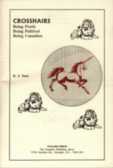
• Ron S. Dart: Crosshairs: Being Poetic, Being Political, Being Canadian, Synaxis Press, 2001.
THE PUBLICATION of Ron Dart's third volume of verse has provided readers with the opportunity to reflect on the relationship between poetry and politics. Dart's political stance as a 'Red Tory' is the framework for this collection, as is his commitment to the humanist Christian tradition. Dart is a professor of political science at the University College of the Fraser Valley.
In the introduction, Robin Mathews, whom Dart claims is "the crown prince of Canadian political poets," declares that a poet is a "person speaking to the people." We do well to note Mathews' observation that "the formalities of poetry are bent and broken [in Crosshairs] for the sake of ideas."
In the opening section, 'The Lute and the Anvil,' the speaker waits in eagerness for one who calls back, unheard amidst the speaker's duties: "If you hide yourself from me, yet again and again, I will learn to bear your absence, your silence." Here, there seems to be a clear reference to the figure of Christ, who calls to those who are not listening to his voice.
The language of these verses is that of psalmody, of rest and refuge, that is countered by the language of despair and questing. The imagery depicts the elusiveness of the spiritual quest, which oscillates between innocence and experience, longing and desolation, wilderness and manna. The speaker assumes the voice of the messenger/ prophet who calls vainly to those in power -- who refuse to address the profound needs of the oppressed.
Focusing his agenda clearly for the reader, Dart's poetic voice denotes Mulroney, Thatcher and Reagan as the oppressors, in this landscape. The context for this section is elaborated by allusions to Canadian historical and literary luminaries and poignant personal references to Dart's marriage, family and travels.
In the section which follows, a series of political verses repeats variations on the theme that poets must address the people, instructing and urging them to respond to the context of history around them. Dart dedicates some of these verses to his literary and political heroes: Tommy Douglas, Stephen Leacock, Noam Chomsky and Mazo de la Roche, for example. He comments on the Palestine question, the Gulf War, NATO and, moving further back, the saints and martyrs at Hiroshima.
The best writing in this volume occurs in its final section -- which revisits Dart's recent climbing of Desolation Peak, in Northern Washington. In this retrospective, we are given a very personal reflection on the writer's literary and historical experience of the sixties. Here, Dart questions the authenticity of the Beats and their countercultural ethos. Dart is clearly readjusting his lens and eventually announces that he is bidding "adieu for good, to much that once held [him]."
Lynn Szabo teaches English at Trinity Western University.