
• BC Christian News • JUNE ISSUE 2001 • VOL. 21 #6 • Formerly "Christian Info News" •
Rwanda's genocide: 'Never again,' says pastor
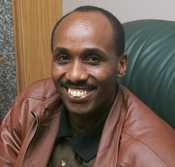 |
BEGINNING in 1994 with 15 people, Rwanda's Restoration Church has grown to 3,000 members, and some 30 congregations.
Joshua Masasu, the church's president, recently visited B.C., along with vice president Leo Rucibigango. They came at the invitation of Rod Forrest, head of the International Child Care Fund, which is active in Rwanda.
The Rwandans spoke May 20 at Glad Tidings Church in Vancouver. They also visited some of the 45 Canadians who ministered in Rwanda in February and March, as part of a healing project sponsored by the Surrey-based Upstream Christian Initiatives.
Masasu spoke to BCCN, recalling the horrifying events which swept Rwanda when members of the Hutu tribe rose up to butcher hundreds of thousands of members of the Tutsi tribe, as well as moderate Hutus. He had been living in Congo at the time.
"After the genocide, God said I must go back -- and I said, 'No, God.' I had had a nice ministry in Congo for the past 15 years. But God said, 'Let all this go.'" In 1994, Masasu began the Restoration Church in Kigali.
"After a year," he continued, "I went back to get my parents. But the spirit of genocide had continued in other parts of Rwanda -- and my parents were killed."
 |
Despite the tragedy, he still believes that "God has a wonderful way to do things. When we used to talk about unity, or reconciliation or forgiveness, people would say, 'You don't understand what we've been through, because you've been outside the country. You don't understand our pain.' But now, I am like one of them. I am equipped to talk about reconciliation, because I passed through the same situation -- and so I can tell them about the one who makes me able to forgive and love the killers of my parents. I tell them: 'This is the one who can give you the same power to forgive.'
"The Hutu killers I talk to see how God gives me a true love for them; and the Tutsi survivors see how I am peaceful, and see how God comforts me and sets me free from hatred -- and so they say, 'There is a God who can comfort us also.' So the death of my parents became an instrument of reconciliation."
With both Hutu and Tutsi members, Masasu's church is a model of healing.
"We now have hope," he asserts. "But we are not just meeting for the excitement of worship. The church is also trying to bring correct teaching and discipleship. And reconciliation is slowly taking place."
Masasu helps this process as a member of the Rwandan branch of Prison Fellowship. "Many of the killers are repenting. There are 2,500 in one prison, who have admitted to killing people. Under the government's policy, such prisoners get reduced sentences."
He discussed one of the most appalling aspects of the 1994 tragedy -- the fact that members of various churches participated in the butchery. "People ran to churches expecting to be saved, and were killed there." However, Masasu said, the idea that Christians murdered other Christians is a distortion of the truth.
"Statistics have said that 95 percent of Rwandans at that time were Christians; but many of them were not really. . . . The people who did the killings were nominal Christians, as opposed to truly born again Christians. The 95 percent have no spiritual power -- no Holy Ghost within them, no personal commitment to Jesus. So they couldn't resist a political movement, a kind of tornado of killing."
This tornado, he said, permeated the country. "On TV, radio, newspapers, and loudspeakers on roadsides, announcements were saying 'You must kill to stay safe. If you don't, you will not survive.' Church leadership was in partnership with the government. The bishop of the Catholic Church was second in power in the government in 1994. If your leader is in government, then you, as one of the sheep, will say, 'I'm blessed to obey in killing, to do the will of my pastor, my elder, who's supposed to guide me in the right way -- and now the right way is to kill.'"
He cited one pastor, who invoked 1 Samuel 15 to exhort his flock to murder. "He com-pared the Tutsis to the Amalekites, and said Saul was rejected by God because he failed to exterminate all of the Amalekites. He said 'If you don't exterminate the Tutsis, you'll be rejected. If you don't want to be rejected by God, then finish the job of killing the people God has rejected. No child, no wife, no old man should be left alive.' And the people said 'Amen.'"
Asked whether another such killing frenzy was possible, Masasu was quick to respond. "No. I think it will never happen again. Why? Because I think people of every ethnic group have learned much from the genocide. The leaders of Rwanda, and international leaders, understand why it happened -- and the enormous consequences -- and they will not allow it to happen again."
Masasu said very concrete reminders reinforced this determination. "There are 146 genocide sites in Rwanda, with thousands of bodies -- some with as many as 20,000 bodies. Some are churches -- closed and full of bones. It is a sign, like a monument -- saying 'See! Be aware. Never again.'"