
September 2001
Dune presents a complex and ruthless messiah
 |
"MESSIAHS should come with a label on the forehead: 'May be dangerous to your health.'" So stated Frank Herbert in an interview about the key concept behind his most famous novel, Dune.
In creating the tale, he said, "I went to the messiah story that's so strong in our mythology. But I wasn't going to do the Jesus story. I went to the Arthurian legend, and I was trying to create a mythology that would give people a different view of how we give over our lives to leaders -- not just to messiahs, but to people who pose as our leaders, or who make themselves our leaders, or who entice us into following them."
In Dune, Herbert presents a futuristic messiah infinitely different from the loving and self-sacrificing Lamb of God. The book deals with the negative implications of the wrong kind of leader, one who manipulates prophecy to become the ruler of a vast religious empire. Herbert complicates matters by giving his messiah benevolent qualities.
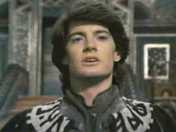
Paul Atreides begins as a carefree duke's son on a verdant planet. His family is transported to the desert planet of Arrakis, or Dune, and he begins to realize that he may be the 'Kwisatz Haderach' -- a super-being whose coming has been predicted for centuries. Paul sees visions of the future, and realizes that he has no choice but to counterract the evil intentions of his opponents. He knows that if he doesn't manipulate the religious, political and economic forces at work, his enemies will do it for him; thus, he must ruthlessly pursue his own leadership agenda, in order to protect humanity from catastrophe.
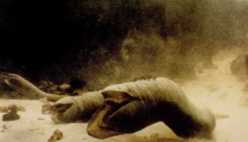
His foes include the depraved Baron Harkonnen; the power-hungry Emperor Shaddam IV; and a machiavellian sisterhood of psychics, known as the Bene Gesserit. He allies himself with the Fremen, Dune's inhabitants; with their help, he takes control of the gigantic sandworms which roam the planet, and plots his way to the Emperor's throne.
It should be noted that some Christian critics have labelled Dune a 'New Age' book because of its depiction of alternative spiritual concepts. But the book does not promote the key New Age tenet, i.e. that every person is God. Rather, God is depicted as the creator and ultimate ruler, and the messiah is presented as God's instrument.
Dune is a masterful fantasy, a sprawling and complex tale which intelligently combines elements of political intrigue, ecology, spirituality and the supernatural.
The book has twice been brought to the screen; both films are available on video.
• Frank Herbert's Dune (2001)
Written and directed by John Harrison, this was originally a TV mini-series. At almost four and a half hours, it has ample time to do justice to the many intricate plot twists and thought-provoking ideas of the book.
William Hurt and Saskia Reeves are outstanding as Paul's parents -- the noble, doomed Duke Leto Atreides, and the Lady Jessica. Ian McNeice plays the bloated and vicious Baron Harkonnen as a supremely intelligent schemer who amuses himself by sometimes rhyming his dialogue. P.H. Moriarty makes a suitably stalwart and sombre Stilgar, the Fremen leader. And Barbara Kodetova brings sensitivity and tenderness to the role of Paul's Fremen lover, Chani.
Alec Newman plays Paul as a somewhat sullen, often grim sort. In the wrong hands, this could have backfired; but Newman's skilled and nuanced approach gives us some understanding of Paul's realization of the seriousness of his predicament.
The film especially excels in its rich depiction of the rituals and everyday life of the Fremen, as they desperately preserve water and pray for deliverance.
The photography, art direction and special effects are all first-rate.
• Dune (1984)
When it was first released, this film was unmercifully trashed by most critics; to his eternal disgrace, Roger Ebert even picked it as the worst film of the year.
Over the years, the criticism has gradually affected writer-director David Lynch; in some interviews, he has pronounced the film a failure, because he did not have final control over the finished product.
But in my opinion, Lynch is wrong. Dune was a gigantic and arduous production, and the result is extraordinary. It has spectacular sets, excellent performances and dazzling special effects -- and Frank Herbert reportedly loved it.
At two hours and 20 minutes, this version lacks some of the complexity of the Harrison edition. But rather than giving us so many details, Lynch brilliantly compresses the essentials of the book -- sometimes in very subtle ways. At times, he even improves on Herbert's ideas. In the book, the climactic transformation of Paul into the all-powerful Kwisatz Haderach takes place in an underground chamber. Lynch transfers it to the desert -- enabling him to show huge sandworms clustering around Paul, signifying that he is now in control of the entire planet.
Kyle MacLachlan (in his film debut) invests Paul with a charismatic quality missing in Newman's interpretation. MacLachlan also captures Paul's inner strength, and somehow conveys nobility even as he vows bloody revenge on his foes.
Lynch gives the film the quality of a fable; it is as if we are viewing the retelling of a grand legend, centuries after the events took place. He presents the various planets and cultures as truly alien societies far removed from our time; he uses sound brilliantly to create atmosphere; and he skillfully conveys a genuine sense of mysticism.
Lynch's film has an artistic and emotional power that stands up under repeated viewings. All told, it's a magnificent achievement.
In David Lynch's 1984 version of Frank Herbert's Dune, Kyle MacLachlan (inset) plays futuristic messiah Paul Atreides, who comes to power by taking control of the monstrous sandworms of the planet Arrakis.