
September 2001
Scholars explore Bible's Jewish foundation
IN RECENT months, several new books exploring the Bible and related Jewish literature have been published. The following are some of the more interesting examples:
• Peter W. Flint: The Bible at Qumran: Text, Shape and Interpretation, Eerdmans, 2001.
Peter Flint is one of the co-directors of the Dead Sea Scrolls Institute, based at Trinity Western University in Langley. He is the editor of this book, which also includes contributions from other TWU faculty, including: Martin G. Abegg of the Dead Sea Scrolls Institute; professor of biblical studies Craig Evans; and professor of religious studies James Scott. Other contributors include Bruce Waltke, professor emeritus of Old Testament studies at Regent College; and widely respected Scrolls scholars James A. Sanders, Eugene Ulrich and James C. VanderKam.
Topics include: 'How we got the Hebrew Bible,' 'The Dead Sea Scrolls and the Canon of Scripture,' 'Noncanonical Writings in the Dead Sea Scrolls,' and 'Moses in the Dead Sea Scrolls.' This book is part of a series, entitled 'Studies in the Dead Sea Scrolls and Related Literature.'
In a statement of purpose, the series' general editors (Flint, Abegg, and Florentino Garcia Martinez) declare: "The Dead Sea Scrolls have been the object of intense interest in recent years, not least because of the release of previously unpublished texts from Qumran Cave 4 since the fall of 1991. With the wealth of new documents that have come to light, the field of Qumran studies has undergone a renaissance. Scholars have begun to question the established conclusions of the last generation . . . .
"New proposals and competing hypotheses, many of them of an uncritical and sensational nature, vie for attention. Idiosyncratic and misleading views of the Scrolls still abound, especially in the popular press, while the results of solid scholarship have yet to make their full impact. At the same time, the scholarly task of establishing reliable critical editions of the texts is nearing completion. The opportunity is ripe, therefore, for directing renewed attention to the task of analysis and interpretation."
In an endorsement of The Bible at Qumran, James H. Charlesworth of Princeton Theological Seminary clarifies the significance of the current wave of scholarship: "For almost 2,000 years, Christians and Jews shared a common base for translating the Hebrew scriptures into modern languages. Now, with the discovery of copies of Old Testament books that predate Jesus, the situation has changed: with some books, especially the books of Samuel and Jeremiah, Hebrew texts are available for the first time in markedly different versions. What does one do now about translating 'scripture' for synagogue or church? Equally important is the issue of interpretation -- and it is imperative to observe, sometimes for the first time, how early Jews interpreted the books that Christians cherish as scripture."
• Karen H. Jobes & Moises Silva: Invitation to the Septuagint, Baker Academic, 2000.
The creation of the Septuagint -- a Greek translation of the sacred Hebrew scriptures (the Old Testament), begun in the second century B.C. -- was one of the most significant developments in the history of Bible translation.
Among other things, this book deals with the Septuagint's significance in the area of biblical scholarship; early Greek translations of the Bible; current research into the Septuagint; transmission of the Septuagint; quotations from the Septuagint in the New Testament; and the Septuagint in relation to the Dead Sea Scrolls.
The authors' perspective is clarified in an introduction to the first chapter:
"The Septuagint . . . is a fascinating treasure from the ancient past. Whether you are Christian or Jewish or neither, whether you are only generally interested in religious studies or are an aspiring biblical scholar, it is worth your while to become acquainted with it. Because the Septuagint was the first translation made of the Hebrew Bible (or of any literary work of comparable size) into another language, it marks a milestone in human culture. Any knowledge of the ancient world would be incomplete without understanding the significance of the Septuagint and the history that brought it into existence."
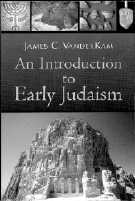
• James C. VanderKam: An Introduction to Early Judaism, Eerdmans, 2001
VanderKam, one of the leading Dead Sea Scrolls scholars, has turned his attention to the history and development of Judaism. This book is an overview of the Jewish religion from the building of the second temple in Jerusalem, in the 6th century BC, to the second Jewish revolt against Rome, in the 2nd century AD.
In addition to history, the author deals with Jewish religious institutions, sects, leadership, festivals, forms of worship, the sacrificial system, and the structure of the temple. More than half of the book consists of a detailed exploration of sacred writings. As one would expect from VanderKam, particular emphasis is placed on some of the more fascinating extrabiblical and apocryphal works, such as: The Testament of Moses, Sibylline Oracles, The Psalms of Solomon, The Prayer of Manasseh, The Letter of Jeremiah, The Astronomical Book of Enoch, The Book of the Watchers, Jubilees, The Apocalypse of Weeks and The Book of Dreams.
VanderKam is co-editor of the Encyclopedia of the Dead Sea Scrolls, and author of The Dead Sea Scrolls Today and The Book of Jubilees.