
October 2001
'Before the Big Bang, God is'
An astronomer talks about his faith and his science
By Jack Krayenhoff
 |
DOES a scientist who is a Christian have to keep his faith and science in separate compartments? Or can the two live comfortably and reasonably together in his brain?
For Dr. Christopher Morbey, a Victoria astronomer who works at the Dominion Astrophysical Observatory, the question of faith and science is no problem. He thinks, instead, that it's the scientist who denies God who should be uncomfortable with his reasoning, as well as with some of the scientific data and calculations he faces.
"A non-Christian scientist might look at the universe and conclude there is no God," says Morbey. "But since he is defining the universe by what he can see, and since God is invisible, he defines him out of existence to begin with. That is not good thinking.
"It is also interesting that his view about God relies entirely on what he can see, while he knows that certain observations and calculations make it clear that only 10 percent of the universe is visible in the first place. Since he knows he cannot see 90 percent of the universe, how can he conclude there is no God?"
But on the positive side, there are strong scientific considerations that make the existence of a creator not only possible, but likely. "When I look at a tree, or just a crystal, I see a complexity much greater than simple chance could account for," says Morbey.
"That should give a scientist a hint that what in fact we see could never be predicted by a science which believes that nothing happens except by random chance.
"It is so baffling," Morbey says, "that on one hand some scientists believe that everything happens by chance, yet when they make observations and measurements, they are always looking for patterns of design, which would indicate that things happen not by chance, but by necessity.
"In fact, science has found that in the universe these two supposedly opposing forces -- necessity and chance -- are indeed both at work. This is at the heart of quantum mechanics. That fits in with the Christian teaching of both predestination (things happen by necessity) and free will (things happen by choice).
"Then, of course, there is the Big Bang theory. Formerly, many scientists believed in a 'steady state' universe: matter has always been and will always be; there was no beginning and there will be no end. But now, many facts have come to light that can best be explained by a sudden event during which matter came into existence, about 15 billion years ago. This, of course, is a perfect match with the biblical teaching of creation.
"The Big Bang fits in with the fact the universe is expanding; it accounts for the formation of galaxies, it explains why there is a residual temperature of three degrees above absolute zero in the universe. In fact, much in science fits in with the notion of the Big Bang."
Morbey, who attends both Saint John The Evangelist Anglican Catholic Church and Saanichton Bible Fellowship, notes that "The average scientist does not like to think of a time before the Big Bang, but a Christian would say that God created not only the universe, but also time. Before creation, there was no matter, and no time either. We can only say that before creation, or before the Big Bang, God is."
What about the Genesis account of a six-day creation?
"For one thing," Morbey says, "The word 'day' is used elsewhere in the Bible to indicate periods much longer than 24 hours. Also, the findings of science overwhelmingly point to an 'old earth.'
"But more importantly, to give the Genesis account a straight literal interpretation, is to confine the message. When I read Genesis, I hear a song. Particularly in the Hebrew, it has the features of poetry; you could almost sing it. If we took it literally, it would take away the splendour of it all. forcing it into our own idea of time and space."
Any word of advice for Christians interested in science? Morbey replies, "By all means, read science, and watch scientific programs on TV, but do it with a dose of skepticism. Especially the TV programs are often infiltrated by the underlying assumption that there is no God."
Reprinted by permission from Sunday Magazine.
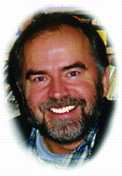
Chris Morbey