
October 2001
More Christians are reading the 'Book of Creation'
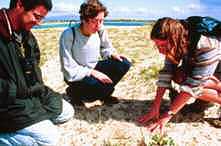 "Since the creation of the world, God's invisible qualities -- his eternal power and divine nature -- have been clearly seen, being understood from what has been made."
INSPIRED by these words from Romans 1, men like 17th century astronomer Johannes Kepler and 18th century botanist Carl Linnaeus studied the 'Book of Creation'; they believed that the earth's ecosystem was part of God's revelation of himself to humankind -- much like scripture.
Their legacy was celebrated as the 'rich scientific tradition of the Western world,' at 'Creation & Gospel: From the Garden to the Ends of the Earth,' a conference held September 28 - 29 at Regent College in Vancouver.
Ironically, for much of contemporary history, the study and care of God's created masterpiece has not held a place of honour in the church. However, with the birth of the environmental movement in the 1970s, the church has seen an increasing growth in 'Christian environmentalism,' with the number of organizations increasing every year.
'God's greens'
A recent Outside magazine article provides a comprehensive overview of the current history of what it calls "God's greens." The article says there are now hundreds of individual 'religious green' groups that may join together at any given time -- for such things as defending the American Endangered Species Act or releasing statements on global warming -- as part of what the article calls the 'greening of religious communities" across North America.
Indeed, B.C. is now host to the Canadian headquarters of A Rocha: Christians in Conservation; and the Au Sable Institute, which teaches conservation, now has a Pacific Rim Campus on Whidbey Island, in Puget Sound. Further south in Vancouver, Washington, Peter Illyn directs the Pacific Northwest branch of Target Earth, a group whose work in saving pristine rainforest from the ravages of corporations like Coca Cola has been featured in futurist Tom Sine's Mustard Seed vs. McWorld.
Is Christianity suddenly taking up the green cross?Regent College professor Loren Wilkinson has spoken extensively on environmental subjects; with his wife, Mary Ruth, he co-authored Caring for Creation in Your Own Backyard. In the historical light of men like Kepler, Linnaeus, St. Francis of Assisi and others, he says, the proliferation of evangelical environmental groups does not denote a change within the flow of Christianity. The resources Christians draw upon in responding to contemporary environmental problems, he says, are "rooted in scripture -- there's nothing new about them."
This thought is echoed by Peter Bakken, research fellow and coordinator of outreach for Au Sable Institute, who recently spoke at their Pacific Rim Campus. There is a "tradition of concern about wider creation," he says, which "goes back a long way" in Christian history.
Wilkinson asserts that it is more accurate to talk about "waves of interest" within the Christian community, concerning the concept of protecting creation. He believes that the current wave has more to do with Christians identifying themselves with a "cultural fad" and its attendant environmental ideology.
"Increasingly," he says, "Christians are beginning to realize that this quite hyped and overheated -- yet genuine -- discussion of environmental issues does have some connection with their faith." The problem, however, comes in engaging environmental concerns from a primarily ideological point of view.
Environmentalism, says Wilkinson, is "an ethic in search of a religion." There is a tendency for individuals to be "environmental first, and give it a Christian tinge." In fact, he adds, the environmental movement has tended to "ransack the world's religions and theological traditions for anything useful . . . to give it depth" -- a fact that the deep ecology movement has been "quite frank about." This may explain the incessant New Age flavour of much of the environmental movement, including the recent 'Summit on Spirituality and Sustainability' held in Vancouver.
"There has been a good deal of bandwagon jumping" by some environmentalists, says Wilkinson. "There's been a tendency for Christians to let the secular environmentalists set the agenda, rather than seeing that concern for the environment proceeds out of the very heart of their faith."
Superficial change?
Much of the recent bandwagon effect has created a "superficial" response among Christians to environmental issues, says Del Vander Zee, director of Au Sable's Pacific Rim summer session. "It's easy to say, 'we recycle, we don't throw garbage out our car window.' The bigger question is this: is it an SUV window that you're not throwing garbage out of? These systemic issues aren't grasped by the church at large, or by the society at large. We don't have to ask tough questions about the largesse of capitalism, for example."
Vander Zee says that, despite increased interest, environmental Christians "haven't made a dent" in the established church with their message. He asks: "How can pastors be reached, so they come out with solid theological education in creation care?"
Peter Illyn, who also runs an activist group called Restoring Eden, says evangelical environmentalists are no longer "holding our breath for the institutions of the church to rise up." He believes a "small percentage of people get what we're about; but those who do are deeply passionate. We're not going to try to win 51 percent of the church, and have votes and win. We'll get five percent of the church -- but we'll stand strong and proud and loud, and say 'God made a good earth, and it is not our place to destroy it.'"
Wilkinson says the church, as a body of believers, is not meant to become an environmental institution -- or to "advance any particular political goal." The church, he asserts, will begin to be a positive force for the care and sustaining of creation when individual Christians "connect that with what it means to be a Christian -- rather than having the church become a sort of baptized environmental organization."
He and his environmentalist colleagues, he says, "are not . . . 'Christian environmentalists.' That gets the adjective and the noun the wrong way around. We're Christians first, and we're coming to realize that being a follower of Christ implies a love and care for the created world -- that it comes from the very basic centre of what it means to be Christian."
Movements like A Rocha, Wilkinson says, are "deeply and centrally Christian." They see a concern for creation as being an outworking of a "basic understanding" of the gospel, in which "all things are reconciled to God in Christ -- both our created nature, and the rest of creation."
Removing Greek glasses
This cosmic redemption, that all of creation is reconciled to God in Christ, is at the heart of an understanding of caring for creation. In the last few centuries, Bakken says, a "retreat" of theology to the "high ground beyond the reach of science" occurred -- as the territory of the natural sciences expanded, and the territory of theology contracted. Theology was relegated to the realm of the personal, spiritual "internal" world, whereas science was seen as dealing with the "external" world, he says.
This spirit / matter dualism, a holdover from Greek thought, has long plagued Christian biblical interpretation, Wilkinson says. "There has been a long Christian tendency to read the Bible through Greek glasses, to see salvation as salvation out of the created world, rather than for the created world."
We were created, he says, to "tend the garden" -- a task restored to us through Christ, the second Adam.
"We're not made to go to heaven. At the end of Revelation, heaven descends to earth; 'the dwelling place of God will be with man.' From the very beginning, we're created for this place. When we begin to realize that this is what salvation is about -- the restoration of all these broken relationships, including our relationship with the place and with other creatures -- then that fullest understanding of the gospel will make a difference."
Markku Kostamo, director of A Rocha Canada, concurs. "Time is sacred, and matter matters -- in the sense that God is concerned about matter." He rejects the dualism that often takes place in Christian thinking, elevating the spiritual over the physical. "We're arguing that it's all one. It's an integrated whole, in a Judeo-Christian worldview."
Illyn also emphasizes the need to escape dualistic thinking, in order to truly love both God and neighbour. "The reason the integrity of ecosystems is sacred is because they represent the wonder, wisdom and whimsy of God. Psalm 104:24 says: 'In wisdom you made them all, the earth is full of your creatures.' When we see something as representing God's wisdom, it's easier to treat it with some humility. Can we love God and destroy what God called good? Can we love our neighbour, and destroy what our neighbour needs to live on?"
Vander Zee also sees the connection between loving people and caring for their environment. "Ultimately, unless you have a fruitful environment, you won't be able to serve the needs of people. You cannot have prosperous human communities and economies, unless the life support system is intact."
How can the church make more progress toward loving both God and his creation? "Things will begin to move forward," says Kostamo, "when we collectively start to adopt a lifestyle that reflects creation care. Ultimately, the way we live will affect everybody in the world. The Wilkinsons' book . . . is very appropriate -- it is my backyard, and we all affect it. This is not only a challenge for the church, but for our society as a whole."
"We've already won the day, theologically," Illyn declares. As he concludes in the Outside article: "Thirty years ago, people were openly justifying their bigotry. Fifteen years ago there was silent bigotry. Now, these younger Christians find tremendous value in racial diversity. Ten years from now we'll look back on the issue of environmental stewardship and go, 'Why was there even a question?'"