
October 2001
Are Muslims our enemies?
 |
THE DEVASTATING September 11 terrorist attacks in the United States have had international repercussions. The massacre of thousands of people has caused outrage, much of it directed at the world's Muslims.
As the investigation into the slaughter unfolds, it is becoming clear that Islamic zealots -- affiliated with the notorious Osama bin Laden -- are likely behind the suicide bombings. As the United States government prepares to retaliate, a backlash against Muslims has occurred in both the United States and Canada; ironically, an estimated 800 Muslims have been identified as victims of the World Trade Center bombings.
Despite strong condemnations by President George W. Bush and Prime Minister Jean Chretien, mosques have been vandalized and some Muslims assaulted. There have also been killings in the United States; but not all the victims have been Muslims. A Sikh was killed, evidently mistaken for a Muslim because he was wearing a turban; and a Coptic Christian of Egyptian extraction was murdered.
Meanwhile, many non-Muslims have been reaching out to their Muslim neighbours, and making a greater effort to understand their religion. CBC Radio recently reported an increased interest in Islam, saying that sales of the Koran have gone up since the attacks.
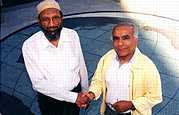
In B.C., Muslims have publically expressed sorrow over the mass murders in New York and Washington. In one Surrey mosque, a special prayer service for the victims was held on the afternoon of the attack. Some Christians have been directly extending good will to Muslims; to that end, a group of pastors visited the Mashid Al Nuhr mosque in Surrey.
Unlike many parts of the continent, B.C. has seen very little sign of anti-Muslim activity. Aside from some verbal abuse and telephone threats, Muslims here say, things have been fairly quiet.
"We're not afraid to walk the streets," says Adam Buksh, chair of the B.C. Muslim Association. "We compliment the people here for being so understanding and civilized."
"I would like to thank the many Christian leaders who have called, sympathizing and empathizing with us," adds Asgar Husain, president of the Muslim Youth Centre in Surrey.
Jihad
Since the terrorist actions, the word 'Jihad' has been frequently bandied about. The term is generally taken to mean 'holy war.' Many commentators assume that the terrorist action was a form of Jihad; however, the term has many levels of interpretation.
"The word Jihad is like 'crusade,'" says Paul Marshall, chair of the Religious Liberty Commission of the Evangelical Fellowship of Canada. "Billy Graham has crusades, but he doesn't kill people -- whereas, on the other hand, the Crusaders did."
"Jihad means to make a serious effort to bring about a change toward something beneficial for the community," Husain asserts. "Jihad can mean casting your vote, writing letters to the editor or protesting injustice."
John Stackhouse, professor of theology and culture at Regent College, delineates two distinct types of Jihad. "The greater Jihad is the holy struggle with oneself to become thoroughly submitted to the will of God. The lesser Jihad is the taking up of arms to protect the House of Faith." Muslims, he says, have conducted the lesser Jihad "to bring what they saw as the blessing of God's law to other societies -- first by persuasion, then by force of arms if necessary.
"This is not unlike the way some Christians have felt about bringing the benefits of Christian civilization, whether others wanted it or not -- which is what happened with the European colonial conquests."
Other scholars compare Jihad to a traditional Christian perspective on armed conflict, according to Joanne Pepper, assistant coordinator of the intercultural religious studies program at Trinity Western University. "The concept of Jihad is similar to the concept of a just war, where people rise up against some kind of injustice or tyranny," she says.
Seervan Dowlati, pastor of the Vancouver Persian Church, was born and raised in Iran. As a one-time Muslim, he says the terrorist attacks do not represent a legitimate form of Jihad. "My understanding is that, in Jihad, Islamic people are required to pit themselves against whoever is against Islam. But it is a defensive action. The Koran has some rash verses about people who aren't Muslims; but Islam is genuinely promoting peace."
While the Koran does advocate struggle between Muslims and non-Muslims, it also states that such a battle must be fought only under specific circumstances. Surah 2 states: "Fight for the sake of Allah those that fight against you, but do not attack them first. Allah does not love the aggressors."
"There's no such thing as surprise attacks in a true Jihad," says Younis Kathadra, director of the Dar Al Madinah Islamic Society. "Also, civilians, women and children, and devout worshippers of any faith, are to be left alone. The Koran says that if you've unjustly taken a human life, it's like you've killed all of humanity."
Husain takes a similar approach. He also believes the terrorists -- if they were indeed Muslims -- violated the basic tenets of Islam.
All the talk about a 'holy war' has clouded the issue, says Buksh. "Jihad has to be a response to an attack on your religion, or on the people of your religion, or on the house of God. Any political fight is a misuse of the term." Further, says Reda Hanna, pastor of the Arabic Evangelical Church: "The Koran says you don't commit suicide -- the Koran teaches that the time to die is determined by God."
Their view of the terrorists is borne out by a recent pronouncement by the Grand Mufti of Saudi Arabia. "Killing innocent people without a just cause, this is nothing but a manifestation of injustice, oppression and tyranny," he said. "It is expressly forbidden and it is amongst the greatest of sins."
Robert Granholm is director of a Surrey ministry called Friends, and has worked with Muslims for some 15 years. "The average Muslim," he says, "would pay little attention to the concept of Jihad. I would say they ignore it."
Demonization
Despite denunciations of the terrorists by many Islamic leaders, the demonization of Muslims continues -- some of it, unfortunately, exacerbated by Christians.
On a recent People to People program, broadcaster Bob George quoted from the Koran, focussing on passages dealing with conflict between Muslims and non-Muslims. While he made it clear that he disapproved of mistreatment of Muslims, he advocated that they be registered and fingerprinted. He further suggested that the authorities go into mosques and demand of Muslims: "Here's what your book says. Are you for this, or are you going to deny this?"
But some see the danger of linking average believers with the actions of a few extremists. "We understand, as Muslims, that the Christian religion cannot be judged by what we hear in the secular media, nor by the actions of certain individuals or groups,"says Kathadra. There's no way we could judge Christianity by the actions of Timothy McVeigh -- or by Bill Clinton's adultery."
"We would resent anyone making generalizations about Christians," says Pepper, "just because they saw Madonna in a video wearing a cross. Just because the terrorists are Arabic speaking, or from the Middle East, we can't assume that they are devout Muslims." Marshall sees the hand of friendship, not the sword, as the image of Muslim Canadians. "The Muslim guy running the 7-11 down the road is not a terrorist," he says. "He's in Canada because he thinks it's a good country to live in, and to raise a family. The best way to respond to him is as friendly as possible."
Loving our enemies
"Our response should be one of grace, mercy and respect for our Muslim friends," says Granholm. "Muslims are not our enemies, but radical Islam is.
"As it says in Ephesians 6:12, our battle is more with spiritual forces than with physical ones. Jesus calls us to love our enemies -- but that does not mean allowing evil to go unchecked, because the capacity for greater levels of atrocity is real. How do we love Osama bin Laden? By praying for his salvation."
Christians need to examine themselves, even in the face of violent attacks, warns Dowlati. "We should not keep in our heart any hatred toward the people who have done this," he says. "We must pray for them -- even the terrorists. They need to be punished; but we need to pray that they will understand the depth of the cruelty they have done, and will ask forgiveness."
"This is the time to show love and compassion," Hanna stresses. "As a church, we must open our hearts to show the truth and the love of Jesus to the Muslim people."
"If I want to witness to Muslims, I must show the love of Christ," Dowlati adds. "If I can't show love to them, I can't be a good witness. Not all people who identify themselves as Christians are showing the love of Christ."
"Our Muslim friends and neighbours are really vulnerable," says Pepper. "This is the time for love in action. In Seattle, I've heard that Christians have been coming out at night to stand outside mosques, to potentially ward off anyone trying to firebomb them. That's grace at work."