
October 2001
Talent and faith create common ground for writers
• Carolyn Arends: Living the Questions: Making Sense of the Mess and Mysteries of Life, Harvest House, 2000.
• Anne Lamott, Travelling Mercies: Some Thoughts on Faith, Random House, 1999.
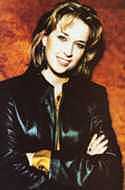 CAROLYN ARENDS is Anne Lamott with a happy childhood. Also, she plays the guitar.
I turned to Carolyn's new book, Living the Questions, with a certain trepidation, a small warning to myself. I'd just finished Anne Lamott's Travelling Mercies, an extraordinarily well written and insightful book of memoirs and personal essays that it seemed every Christian I met recommended to me.
I braced myself for the inevitable let-down. After all, this was Arends' first attempt, where Lamott had several novels and a regular Salon.com column behind her. Indeed, she'd even written Bird By Bird, a wonderful book on writing.
"Adjust your expectations," I cautioned myself. One is a professional musician, the other is a professional writer. Would you expect a whole lot from an Anne Lamott CD? The book will probably be worth reading, but face it, Carolyn Arends is not Anne Lamott.
I was wrong. She is. Or at least they are twins separated at birth. Anne got sent to a turbulent, artistic, political, fractured family in the San Fransisco Bay area, Carolyn to an utterly normal, loving, conservative Christian family in Coquitlam. I mean, good grief, her dad was a banker and her mother was a nurse! But once you notice it, the sisterly resemblance is unmistakable.
When Carolyn's sheer normalcy was inadvertently revealed to her by a grade eight English teacher, she was horrified; "I was pretty sure that typical, conservative girls didn't become famous folk singers. I needed a dangerous, fascinating or tragic background something a biographer could at least call interesting. But I had to face the facts. There was no use denying it, at least not while there was a bologna and Wonder Bread sandwich lurking under my desk in the lunch bag my mother had carefully packed for me that morning."
The troubled background is what Anne got -- a chaotic childhood that left her with a legacy of alcoholism, bulimia and relationship problems. I'm not sharing celebrity gossip here; these struggles are at the very heart of her book, an unnervingly personal, frank account of her spiritual life. And indeed, this sort of soul-baring honesty is exactly the same strength Carolyn brings to her work. That, and great humour, and tremendous writerly gifts.
Each book begins with an extended essay recounting a life-changing spiritual journey central to the author's life. Lamott writes, "My coming to faith did not start with a leap but rather a series of staggers from what seemed like one safe place to another. Like lily pads, round and green, these places summoned and then held me up while I grew. I can see how flimsy and indirect a path they made. Yet each step brought me closer to the verdant pad of faith on which I somehow stay afloat today."
It was a journey from inherited atheism into faith: "My father despised Christianity. No one in our family believed in God. It was like we'd all signed some sort of loyalty oath early on, agreeing not to believe in God in deference to the pain of my father's cold Christian childhood."
Arends recounts a different journey, a movement from faith into doubt. She grew up in a safe, comforting environment of family, church and friends, with a faith that was real enough, but untried. The opening section of her book,'The Summers Of My Discontent,' tells that story, centering on one particular, agonizing summer when she suddenly found herself stripped of all that had previously come so easy to her; "Everything sane and solid and good in my life, everything I had believed effortlessly (instinctually and spontaneously, so that my believing was as natural as breathing), seemed to disintegrate into absolutely nothing. I could not feel the presence of God."
I'll leave the details of their respective tales to these two gifted storytellers, but suffice it to say, God truly is in the details here. Each writer has a blessed eye for the particular, a marvelous ability to take us into their experience with the brilliantly-turned phrase, the hilarious or heartbreaking anecdote, the fresh metaphor. These women can write!
If you've seen Carolyn Arends on stage, you know her winsome, witty, self-effacing, never self-deprecating style. So I suppose it should come as no surprise that she writes the same way. She is clever, but never annoyingly so, and has a tremendous sense of timing. She turns phrases like a songwriter.
In this pair of remarkably parallel volumes, two women with very different lives but the same God write about many of the same realities; raising children, losing family members, relating to scripture, living as artists, finding a place in a church community that sometimes feels like an alien planet. Both women write particularly well and entertainingly about prayer. And both lives are marked by the books, movies, films, plays and poetry that God uses to speak truth into their lives.
At the end of her desperate, doubting summer, Arends writes "God never did answer my desperate plea to make my faith like it used to be. I could no longer list all the things I did not understand about God as threats to my faith; instead, they became the primary evidence that God was, in fact, God and that I was, in fact, not."
I know a man with a robust, seemingly unshakable faith that's seen him through a huge helping of crises and challenges who says "I've doubted every single thing I now believe." After spending time with these two women by reading about their journeys, it seems clear that both could say the same. And the faith that results never removed from utterly human lives, mundane or troubled, vulnerable or triumphant by turn is deep, substantial and inspiring.
Ron Reed is the artistic director of Pacific Theatre. If you would like to be notified by email about arts events that may be of particular interest to Christians, email him at: ronreed@home.com to be added to Art Alert.