
November 2001
African peacemaker extols 'God of hope'
BC Christian News, · Top Stories
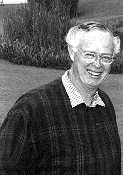
MICHAEL CASSIDY has been evangelizing Africa for almost four decades. A widely respected South African author and preacher, he is president of African Enterprise (AE), which he founded in 1962. Cassidy made several appearances in the Lower Mainland October 2 - 7.
Christian faith, he said, has played a key role in the transformation of his country from a racist dictatorship to a multi-racial democracy. In 1993 and 1994, Cassidy instigated numerous meetings between representatives of the country's various political factions; this endeavour was one of many Christian initiatives which, he told BCCN, eventually helped to bring down the vicious apartheid system.
"From the late 1940s to the late '80s, the mainline South African churches -- Catholics, Anglicans, Presbyterians and Methodists -- gave a strong and credible opposition to apartheid, in the name of Christian conscience and biblical justice." This stance, however, was not shared by all Christians. "By and large, the evangelical, Pentecostal and charismatic churches in South Africa were very weak in demonstrating opposition -- and sometimes implicitly supported apartheid. However, this changed in the early '90s."
The substantial presence of biblical faith, he said, helped to avert a national catastrophe. "We could've had a mass bloodbath. In the weeks leading up to the 1994 elections, Christians played a very significant role in preventing serious conflagration and bloodshed. Major political peace-making, involving Henry Kissinger, had failed. Two weeks before the election, Kissinger said Armageddon was coming in a few weeks. Some estimated that up to a million could die. In the fortnight before the election, Christian networking and backstage initiatives were a decisive factor in preventing bloodshed."
Another key factor, Cassidy believes, was the spiritual perspective of the charismatic central figure of the anti-apartheid movement, Nelson Mandela. Cassidy met with Mandela several times in 1996, in conjunction with peace initiatives concerning strife in the province of Natal.
"I first met him when I delivered a Billy Graham book to him personally. I don't know him well; but . . . I think he would profess to be a Christian. He spoke the language of faith. He told me that he had been a Sunday school teacher in his younger days. When he was in prison on Robben Island, he went to chapel and Bible study, and took communion. He recently got married in a Methodist church."
Mandela, he asserted, "has manifested Christian attitudes of forgiveness and reconciliation, holding out the hand of friendship to his enemies . . .which, without some kind of faith factor, would be very difficult after 27 years in prison."
Cassidy expressed enthusiasm for AE's recent Egyptian campaign, which took place in August and early September. The AE team preached to 64,000 people at 500 meetings in 12 locales, including Cairo. Because Egypt is ruled by an Islamic regime, however, there were certain restrictions. The meetings "had to be all in churches, not stadiums. We were not legally allowed to do it in public buildings." There were 4,000 first-time commitments to Christ, he said.
Cassidy also addressed the spiritual impact of the September 11 attack on New York and Washington. "I think [this] will be a time for many Muslim leaders and people to do some self-examination -- and this likely will also happen in the Western church.
"I think this event may lead to greater dialogue -- and possibly even understanding -- between Christians and Muslims. It's a time to hold out the hand of friendship and love to Muslims. We must defuse the idea of this being a war between the world of Islam and the so-called Christianized West."
The terrorist attack, he said, could become a catalyst for a spiritual awakening. "At this moment, the Western gods have died: the gods of materialism, symbolized by the World Trade Center towers; the god of military might, represented by the Pentagon; and the god of technology -- because we've seen that it couldn't prevent this event. This is a moment for people . . . to have a fresh vision of God, as in Isaiah 6:1 -- a divinely given moment for insight and clarity."
A broad spectrum of people, he said, "are now talking of God, talking the language of prayer and love. The concept of evil is being reintroduced into the secular reality. Suddenly, theological language and categories are back into the vocabulary of even the secular media. This is a reappearance of the Judeo-Christian worldview -- we're facing a reappraisal of the huge moral and spiritual slippage which has taken place in the West."
Cassidy said he had a lot of empathy for believers in the United States and Canada, who had been deeply affected by the American disaster. "North American Christians have expressed love and concern for the Two Thirds World for many years, through prayer, ministry and financial support. It's time for Christians from Africa and Asia to wrap their arms around North American Christians, and to express appreciation for what they've done."
Asked to give a biblical perspective on the uncertainties of the coming months, Cassidy responded: "The basic spiritual requirement is . . . to grasp that the God of biblical faith is ultimately in charge . . . This enables Christians to remain people of hope -- a hope that is rooted in a transcendent God, and not in the events of history."
He cited Jeremiah 29:11, a scripture which, he emphasized, "was written during Israel's darkest moment, when history seemed to have ground to a halt. That verse reveals a God of hope -- and commits us to a God of hope. It reminds me of a quote from C.S. Lewis: 'For a Christian, despair is a worse sin than whatever causes it.'"