
November 2001
Hospitality Suite: Selling our religion
BC Christian News, · Arts
• Hospitality Suite
Pacific Theatre
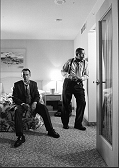
"BE ASSURED: you will not be preached to," says Georgia Strait columnist Colin Thomas' review of Pacific Theatre's recent production, Hospitality Suite. "Playwright Roger Rueff is really trying to sell something -- I'm just not entirely sure what he's peddling," counters Vancouver Courier critic Jo Ledingham, whose review headline states that the play's dialogue "fizzles with Jesus references."
Pity the predicament of Pacific Theatre: while they consistently garner well-deserved positive reviews in the local press for their acting and production, they are just as consistently scrutinized for any hint of preachiness -- even when their production is openly critical of that exact issue, as Hospitality Suite is.
The play, better known for its 1999 film version (The Big Kahuna, starring Kevin Spacey and Danny DeVito), is a modern day parable. Like many other good parables, it is aimed squarely at the religious community. Not unlike the Good Samaritan story, it poses the unspoken but clear question: which of these really loved his neighbour?
The play takes place in an aquarium-like hotel suite as three industrial lubricant salesmen attend a convention in hopes of meeting the 'big kahuna' -- i.e. the contract that will make or break them. As in Samuel Beckett's Waiting for Godot, the big kahuna never sets foot on stage -- and yet, much is revealed about the three characters who wait for him in the interim, and their internal search for the true 'Big Kahuna.'
Phil, played by Tom Pickett, with whom the play opens and closes, is a world-weary veteran salesman with a failed marriage, who is beginning to re-ask the deeper questions of life. His friend Larry, acutely played by Michael Kopsa, is a shark skilled in the art of the sales hunt; he is alternately oily smooth and viciously blunt -- vulgar, yet honest.
Bob, in a believable performance by Kevin Brady, is the new kid on the block, a naive, newly wed, good-little-Baptist-boy apparently sincere in his Bible-quoting, moral high horse position. There is also a nice cameo appearance of a drunken man by Larry Young, PT's current acting apprentice.
As the events of the play unfold, conflict arises between Bob and the two older salesmen, as he unknowingly lets the big kahuna slip away from their suite. When opportunity to redeem himself -- and the big sale -- arises, Bob flagrantly wastes it by talking to the big kahuna about "Jesus, life and death." This leads to a confrontation with his colleagues, one of whom asks Bob: "Did you discuss which industrial lubricant Jesus would recommend?"
Larry openly accuses Bob of directing the conversation to his real end: selling Jesus. Larry yells: "When you lay your hands on a conversation to steer it, Bob, it's not a conversation -- it's a pitch! You're not a human, you're an advertising representative!" Heavy stuff for those who lived through the '80s evangelism program craze, and were taught to ask questions designed to steer conversations to the topic of salvation.
In the midst of this conflict, an apparently depressed Phil asks Larry: "Do you love me?" He then quotes a verse he recalls from Sunday School: "Greater love hath no man than this -- that he lays down his life for his friends." Larry is clearly uncomfortable with the question, and tries to dodge it in every possible way.
As the play closes, an angry and shamed Bob leaves without recognizing the heart of the two men with whom he has just spent the evening. Larry, however, calls Phil from his hotel room and tells him something, to which Phil responds: "I love you too, Larry." The unspoken question hangs heavy in the air: which of these really loved?
The production had some flaws. The set's heavy faux-steel bars often blocked the view of the characters; and the night I saw it, the timing was off in the first act, while Pickett as Phil seemed weak and overly serious -- a surprise to me, as he has been a consistently strong actor in other PT productions. Part of this problem may have been a directing dilemma: whether to play the three main characters equally strong, or to let Phil be the fulcrum of the piece, which opens and closes with him, and into whose life struggle we are drawn.
The play was written by a self-described former evangelical Christian, who sees the characters as a progression -- i.e. that one could move from being Bob to Larry to Phil. (Playwright Roger Rueff attended the October 12 and 13 showings and held a talkback after the shows.) In producing this controversial piece, Pacific Theatre has done again what they do best. They have given us a play which challenges the church where it needs to be challenged, by raising questions that must be asked about the ways Christians have followed the commodity culture and tried to market God.
The play's run ends November 3. Pacific Theatre's next production, Cariboo Magi, begins November 30.