
December 2001
Tony Campolo wants to propagate a holistic gospel
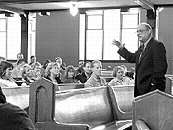
DR. TONY CAMPOLO, who has spoken at Missions Fest Vancouver and is co-founder of UrbanPromise with Bruce Mains, will be speaking November 24 at 'Good News to the Poor' at First Baptist Church and St. Andrew's-Wesley United Church in Vancouver. BC Christian News spoke with Campolo about the justice, the poor, and the Palestinian issue, among other things.
Meg Johnstone: You will be speaking at the 'Good News to the Poor' conference to both the evangelical and mainline wings of the church, which have traditionally had polarized points of view on social issues. How have you been able to bridge the gap between the two camps in your ministry?
Tony Campolo: Well, I don't even understand why there is a gap. I think that the stereotypical image of evangelicals as being unconcerned about social justice issues belongs to another time. Over the last 25 years, evangelicals have come to embrace the requisites of scripture to care for the poor and to stand up for the oppressed. The day when evangelicals labelled anybody who was concerned about social justice issues as being a 'liberal social gospeller' is long since over. The coming together of evangelism with social action is so much a part of the evangelical tradition right now, that it's really attacking an outdated caricature when they say, "Oh, all we're interested in is getting people saved and into heaven when they die." We are interested in a holistic gospel that takes into account the need for people to have a personal relationship with Christ, and eternal life, as well as being concerned about seeing the manifestations of the Kingdom of God here on earth.
Likewise, to look at mainline denominations, and to contend that they are not interested in evangelism belongs to another place and another time. Over the last decade, at least, every mainline denomination, and certainly the United Church in Canada, is aware that they're losing members at such an incredible rate that unless they begin winning converts, they will cease to exist. I think that at this particular point, traditional mainline denominations and evangelicals can have a great symbiotic relationship. Each can teach the other. I think that evangelical denominations who are saying "we want to address social justice issues" can learn a lot from mainline denominations that have been tackling this issue for a long time. And vice versa, mainline denominations that are trying to figure out how to win converts can learn a lot from evangelicals who have made it a fine art.
MJ: What is your own denominational background?
TC: I'm American Baptist.
MJ: You've written a book, Can Mainline Denominations Make a Comeback? How did your interest in this topic develop?
TC: Well, American Baptist is a mainline denomination. It's my own denomination. I wrote that particular book specifically for my own denominational press. It's very, very important for us as a mainline denomination to ask, "Why are we dying?" and "What can we do to come back to life again?"
MJ: Is your message to these two wings of the church the same, or do you challenge the different audiences in different ways?
TC: No, I only have one message. The thing is, I try to propagate a holistic gospel that puts the two together so that you cannot separate the one from the other. So that you cannot deal with evangelism unless you deal with social justice, and you can't deal with social justice unless you deal with evangelism. That in reality, in the gospel, if you read the words out of Jesus' mouth in Matthew, Mark and Luke, Jesus came "declaring that the Kingdom of God is at hand." The Kingdom of God, by definition, is kingdom people -- that's people who have been transformed by kingdom experiences -- and the kingdom of God is also transformed society, by definition. A kingdom is institutions and people. Evangelicals have tended to focus on people, and trying to get them in tune with God. Mainline denominations have focussed on institutions, trying to get them in tune with God. Both must be in tune with God.
MJ: What is a biblical view of the concept of justice?
TC: Well I think you can see that brilliantly outlined in the book of Isaiah, the 65th chapter, in which the Kingdom of God is described as a society in which people are living righteous lives with God, in which infant mortality is abolished, in which elderly people are safe and live out their lives with health and well-being. It's a place where everybody has a decent house to live in, has a job with fair pay. All these things are concretely and specifically defined as the Kingdom of God, I would even go so far as to point out that the Kingdom of God is a society in which the environment is protected. The Bible is very clear about this. It's a society in which the land is made new again, and which everything is revitalised and restored to what God willed for it to be when he created it.
The Bible is all about the Kingdom of God, but the kind of specific things I just gave you are spelled out in Isaiah 65:17-25. When I talked about the environment, the 25th verse reads like this: "And the wolf and lamb shall feed together, the lion shall eat straw like an ox, but the serpent, its food shall be dust. They shall not hurt or destroy on all my holy mountain." If you want more specific verses on the environment, you might go to Romans 8:17, which says that all of creation is groaning and in travail, that nature is suffering, waiting for the sons and daughters of God to rescue it.
So the Kingdom of God is the restoration of the cosmos to where it was intended to be when God created it. We are fallen people in a fallen world, and God wants to restore the fallen people, and he wants to restore the fallen world. We all long for that day when Christ returns, and the renewal that is begun in us, and the renewal of the things that the church is initiating in the world will be brought to completion and fulfilment.
MJ: What are a few practical, day-to-day ways that the average family with children can participate in this view of justice?
TC: I think every family has, to a large degree, to define its own calling. Some families will spend all of their time and energy in evangelism. Others will say, "Let's clean up the environment," and perhaps go out on Saturdays and pick up trash along the highways, saying, "This is the work of God, we're restoring nature to its beauty, we're going to defend the environment against encroachment." Others will stand against racial injustice. We have to really keep our eye on that right now because there's a tendency to discriminate against Arab people. And they say, "We're going to participate in working for racial reconciliation; perhaps we'll invite Arab families to our house for dinner and learn about them and treat them with dignity." The Bible is very clear in Corinthians that there are diversities of calling. That not every family is called upon to do everything. That's why we have a church with many families. Some families are called to do one thing and others another things, and together we cover the whole array of needs that people in this world have.
MJ: What is the bottom line of your message at the upcoming 'Good News to the Poor' conference in Vancouver?
TC: It's the recognition that there are more than 2,000 verses in scripture that specifically call upon us to meet the needs of the poor. More than any other subject, caring for the poor is highlighted in the Bible. Furthermore, the only description that Jesus gives us of Judgement Day is in Matthew 25, where he lets it be known that on that day he will ask us specifically what we did for the poor and oppressed of the world. Did we feed the hungry, did we clothe the naked, did we visit the sick, did we reach out to those who are in prison, and did we take in the stranger? And he tells us whatever we did to the least of them, we did to him. And therefore, one cannot be a Christian without responding to the needs of the poor.
MJ: I remember Ron Sider wrote an editorial, 'Are evangelical leaders going to burn in hell?', addressing that issue. I guess you would share his viewpoint?
TC: As you know, Ron teaches at the same school I do, Eastern. We all hang out at the same place because there are not enough of us, and we all have to hang out together so as to defend each other.
MJ: Do you see any correlation between the events of September 11, the North American tendency to ignore the poor?
TC: Yes. Let's face certain realities. I can't speak for Canada; I can only speak for the United States. We delude ourselves into thinking we are a very generous people. Of the 17 industrialised nations of the world, on a per capita basis, we are dead last in giving to the poor of the world. Comparison: for every dollar on a per capita basis that Americans give to the poor of the world, Norwegians give $70. We have allowed injustices to be perpetrated against Palestinian people. We have been so zealous as evangelicals in supporting the state of Israel, and guaranteeing its survival, that we have forgotten that the God we worship is the God of all nations and all peoples, and requires that we not only support the well-being of the nation Israel, but we stand up for justice on behalf of Palestinian people. It's about time that we recognise that almost 25% of the Palestinians are Christians. We forget that. We think they're all Muslims. And they want to know why Christians in Canada and the United States who are all evangelicals lend unquestioned support to tyranny against their own people. And we have done that.