
January 2002
Scotland has mystic attraction for pilgrims
BC Christian News, · International
"Well does the fair Lord show us a course, a path." From The Protection of Columcille, attributed to St. Columba of Iona.
THE ANCIENT idea of pilgrimage has been making a comeback among Protestants in recent years, although the focus today is usually less about revering a saint than it is about completing an inward journey.
The Celtic idea of pilgrimage, known as peregrinatio, describes what many modern day pilgrims are seeking. It is an inward journey marked by an external journey, a journey taken "for the love of God" as Esther de Waal puts it in The Celtic Way of Prayer (Doubleday, 1999): "What they are seeking is the place of their resurrection, the resurrected self, the true self in Christ, which is for all of us our true home."
Martin Robinson, director of mission and theology at the British Bible Society, expands on the concept of pilgrimage in Transmission journal (Spring 2000): "The individual seeks a new vista . . . a place of significance, from which to revisit the story of his or her own life journey."
On a recent trip to Scotland that fits into this definition of pilgrimage, my family and I visited several such 'places of significance,' often also destinations of ancient pilgrims, in addition to some less well-known sites.
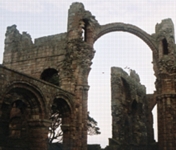
The Northumbria community lies a few miles south of the Scottish border in England, near the town of Berwick. Inspired by the lives of Celtic saints like Aidan, Cuthbert, Oswald, Hild and Brigid, several couples came together in the mid-'70s to establish what may be called a new monastic community in the region of Lindisfarne, also known as Holy Island, in Berwickshire.
The community has two houses, known as the 'Upper' and 'Nether Springs,' one on Lindisfarne Island, the other inland. Following a simple rule of 'availability and vulnerability,' Northumbria community members are dispersed around the world, although many live near or at one of the two houses.
The 'Nether Springs' community hosts individual and guided retreats. We attended a 'Quiet Waters' retreat while there, enjoying the pastoral setting, community living and working, and five daily offices or prayers from the Celtic Daily Prayer liturgy for which the community is known.
Our next destination took us to the very northern tip of Scotland, to the small town of Freswick and Freswick Castle, a tower house owned by British screenwriter Murray Watts. The site is home to the Wayfarer Trust, an organization that aims to provide a place of refuge for artists and their families. Now staffed with a chaplain, the cottage and castle on the grounds of this originally Viking settlement are available for private retreat for a very reasonable fee. The chaplain, an Anglican minister, is available to give services in the castle's small chapel and to meet for private discussion. In this wild, elemental, beautiful location, time is best spent exploring the many ruins, walking the beach and sitting by a coal or peat fire listening to the winds howl through the castle ruins. The grounds also house a crumbling chapel built on earlier foundations established by St. Moddan. This chapel is slated for restoration, as is most of the castle itself.
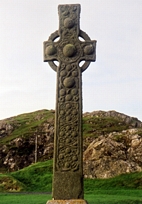
Our trip closed with a visit to the Isle of Iona, to the abbey built on the site of St. Columba's Abbey, from whence he evangelized much of Scotland in the late 500s. Iona has become a popular modern-day site of pilgrimage, hosting retreats year-round. The island is known for the sense of homecoming many pilgrims feel when they arrive on the island. While we did not experience this feeling ourselves, Iona is a very peaceful island with an almost Mediterranean feel, and the Abbey and other sites are rich in Christian heritage.
The idea that Iona is one of Scotland's 'thin places' where the spiritual realm is somehow more immediate has attracted followers of other pagan religions to the area as well. Canadians living at the community tell me that the Iona community is nonetheless orthodox in its belief.
The journey to each of these locations is a pilgrimage, as we discovered with Columba: "The path I walk, Christ walks it."