
April 2002
Arts & Peace counteract violence and abuse
BC Christian News, · Top Stories
'Vivid imagery' is the best phrase to describe the common denominator among the various forms of art used to honour victims of abuse at the opening night of the Fraser Valley Arts and Peace Festival, held March 1 - 10 at University College of the Fraser Valley (UCFV) in Abbotsford.
The evening began with the opening of the Art Gallery, featuring works by B.C. artists Bob Evermon, Edith Krause and Hugo Myny, as well as the work of Illinois prison inmate and artist Hector Maisonet. Many of the paintings used vivid colour and layered, complex images to depict images of struggle and of war. One of the most striking pieces was a series of banners by Krause -- which hung nearly ceiling to floor in the vaulted entrance way of UCFV, where the artwork was displayed throughout the festival.
The banners were created as a result of Krause's reading of Marilyn Waring's book If Women Counted, which explores how the international community determines value.
"Waring discovered that work that does not involve the exchange of money has no value," Krause said, "so basically most of the work that women do, like work at home, subsistence farming, childcare, has no value."
The five banners in the series, entitled 'Corporate Ladder,' 'Men Count,' 'Sand $,' 'Invisible Majority,' and 'Ascension,' addressed the issue of value on several levels: economics, men, nature, women and technology.
The concert that followed featured Juno award winner Shari Ulrich, poet and writer Barbara Nickel, local jazz/folk band The Russian Judge and poet Gareth Brandt.
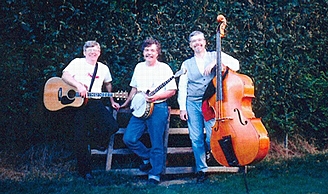
The Russian Judge opened the evening with their eclectic mix of guitar, bass and banjo and vocals. One of their more haunting pieces was a ballad that chronicled the deaths of the Sarajevo 'Romeo and Juliet,' a young couple -- one of them a Serb, the other a Muslim -- who were shot by snipers while trying to elope.
Barbara Nickel read several poems from The Gladys Elegies. The fictional poems are based on a real-life set of twins whose debutant photo Nickel had found while researching another project. Nickel created a series of poems in the forms of letters between the sisters, chronicling their lives growing up in a restrictive social society, and dealing with domestic abuse. But Nickel ended her readings with a humorous series based on her eclectic 'Uncle Hans' who, among other things, showed up at Christmas with gifts, -- forgetting who they were for, and solving the problem by raffling them off.
While Shari Ulrich's set was much shorter than it should have been, she entertained the audience with her wit and her music. Sharing some of her personal experience with violence, her songs were filled with images of hope and restoration. Although she described herself as someone who does not go to church or read the Bible regularly, one of her most moving songs was about the Samaritan woman who meets Jesus at the well.
"I loved that image of living water," she said, adding with a laugh that she could also relate to the kind of woman who had had five husbands.
The highlight of the evening for many was the dramatic and vivid reading by local teacher and poet Gareth Brandt. Through poetry and explanation, Brandt shared his experience of childhood sexual abuse and the ongoing journey of healing. Each of the poems described a phase of the healing process: denial, pain, anger, grief and hope.
Often using biblical imagery, his poems are filled with raw emotion, which came out in his effective reading. 'The Cleansing of the Bedroom' was developed when a therapist asked him to imagine Jesus there with at a time of abuse. The poem echoed the image of Jesus clearing the temple: 'The bedroom is a place of quiet and safety / but you have made it a place of pain.' The anger was as palpable as was the tenderness at the end of the poem when Brandt described Jesus taking the child on his lap and saying, "Blessed are those who mourn, for they will be comforted."
Another highlight of the festival was the morning worship service March 3. Through music, scripture reading, litany, story-telling and poetry, participants reflected on the often painful history of the Christian faithful. But the service, held at Emmanuel Mennonite Church in Abbotsford, was not one of sadness; rather it was one of celebration and hope.
Using Hebrews 11 and 12 as the theme ('the cloud of witnesses'), the worship team, led by Angela Neufeld, led the congregation through a series of songs from different cultures and a litany prayer all focusing on our need for God to release us and our world from injustice.
Barbara Nickel read from her poetry and led the children's feature. Her poem, 'Martyrs,' described the death of an Anabaptist woman who was martyred by drowning. Drowned in a river, Nickel used the imagery of life-giving water and of the river becoming sea to reflect how the death of one woman centuries ago could give inspiration to another now.
Author Rudy Wiebe also shared a martyr story from his latest novel, Sweeter Than All the World. The story of Weynken Claes, burned at the stake in the Hague, Netherlands, was told through the voice of her daughter, Trien. Despite being illiterate, Claes defended herself before the council by quoting scripture from memory.
Still, for her refusal to accept the sacrament as containing the actual body and blood of Christ and for refusing to confess her sins to a priest, Claes was put to death. It was a moving story and often Wiebe seemed to be near to tears as he read.
The service ended with a song of commitment and encouragement: 'I bind my heart this tide to the Galilean's side, to the wounds of Calvary, to the Christ who died for me / I bind myself to peace, to make strife and envy cease. God, knit thou sure the cord of my thralldom to my Lord!'