
April 2002
Merton's Christianity was multi-dimensional
BC Christian News, · Top Stories
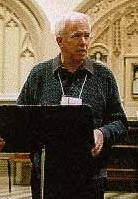
THOMAS MERTON and Interfaith Dialogue, a conference presenting both scholarship and the arts, was held March 15 - 16 at Canadian Memorial United Church and Centre for Peace in Vancouver.
Hosted by the B.C. Chapter of the International Thomas Merton Society, the event featured internationally renowned scholars as speakers and workshop leaders.
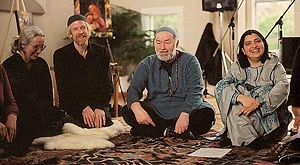
Christian, Buddhist, Jewish and Islamic spiritual perspectives were explored; one presentation featured Sufi mysticism, an esoteric branch of Islam. Various sacred traditions were presented through dance, music, poetry and painting.
Among the lecturers was Ross Labrie, professor of English at UBC and author of several books on Merton.
Labrie first read Merton's spiritual classic, Seven Storey Mountain when he was a student commuting to university in the 1950s.

Engrossed in Merton's autobiographical account of his conversion to Christianity, Labrie said he "fell under the spell of Merton's evocative prose." However, he didn't come back to his writings until the '70s, when he realized the importance of Merton's dialogue with secular and contemporary culture.
Labrie's first book on Merton's writings, The Art of Thomas Merton, was one of the earliest approaches to the Trappist monk's literary genius. Labrie noted that in it he "examined the conflict in Merton's writing between the roles of the contemplative and the artist."
Labrie emphasized the immense international influence of Merton's writings; he extolled Merton's ability to lead ordinary people to see that their lives should include a contemplative dimension. Merton, he wrote, calls us to respond to "a divine summons that has been built into our natures."
Merton's influence on North American writers extends to such luminaries as Annie Dillard; Canadian writer Jane Urquhart; and Kathleen Norris of Cloister Walk fame.
Spiritual autobiography has acquired respectability as a literary discipline, giving Merton scholars credibility amongst their secular peers. Labrie, like other Christian scholars, feels it is necessary to locate our voices in the current study of literature and religion. Merton creates opportunities for such voices in the debates about culture and Christianity because, according to Labrie, "he allows us to break down the division between religious and secular cultures, providing ways to observe the workings of God in the world."
Merton made the trek over bridges which created conversation between himself and the non-religious culture which surrounded him.
Labrie concluded that "Merton respectfully acknowledges the importance of the intellectual and ethical dimensions of secular thought, without compromising his Christian beliefs." In these succinct and insightful words, Labrie clearly articulated what drew the crowd to the conference's meaningful and significant discussions about how Christians can maintain the integrity and influence of their faith in a pluralistic culture.
Books on Merton by Ross Labrie:
The Art of Thomas Merton (1979): In this accessible study of Merton's literary genius, Labrie methodically discusses the sources of Merton's extraordinary essays, poems and journals. This book provides a fine introduction to the range and depth of Merton's writings.
The Catholic Imagination in America (1997):Labrie's purpose in this collection of insightful essays was to show that many of Merton's most attractive ideas were drawn from the literary tradition of Romanticism which had much in common with Western mysticism. In this context, Merton creates a positive attitude towards creation and nature in his writings, emphasizing the importance of the imagination and intuition in understanding spiritual relationships between God and human beings. Merton gives a refreshing contrast to the pragmatic, rational approaches to spirituality often fostered in Western Protestantism.
Thomas Merton and the Inclusive Imagination (2001):Labrie successfully ties together the various threads of Merton's thought into a coherent whole. The book solidly establishes Merton as a religious, philosophical and intellectual force in Western culture. Labrie explains that "Merton was not ecumenical in the usual sense" in that he retained his identity as a Christian even as he sought unity with other human beings in their spiritual search.