
May 2002
The artistry of the mass
THE CELEBRATION of the mass has, by far, inspired more choral music than any other Christian tradition. Using ancient texts that embody all the key elements of Christs life, most of the greatest composers have outdone themselves artistically. Herewith, a generous sampling:
• Howard Dyck: Beethoven - Missa Solemnis, EMI Music Canada, 2000.
As the host of CBC-FMs long-running Choral Concert, Howard Dyck has arguably done more to promote the appreciation of sacred choral music than anyone else in Canada. In his alter-ego as the conductor of the Ontario-based Consort Caritatis Choir, Dyck has helped raise well over $200,000 for humanitarian groups such as Habitat for Humanity, World Vision and the Mennonite Central Committee.
The choir records one CD per year; this one was produced to benefit groups involved in helping victims of land mines. Aside from aiding good causes, the Consort has performed superb versions of some of the immortal choral works, including Handels Messiah, and the Verdi Requiem. Beethovens magnificent Missa Solemnis is a worthy addition to this impressive body of work. Recorded live in Prague, the CD features the Prague Radio Symphony Orchestra, soprano Heidi Klassen, mezzo-soprano Susan Platts, tenor Paul Frey and bass Phillip Ens. For more information, contact MCC at 1-800-313-6226.
• Michael Halasz: Mozart - Mass in C Minor, Naxos, 2000.
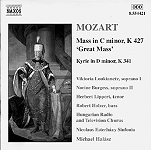 |
Although it was, sadly, never quite completed, Mozarts Mass in C Minor fully deserves its subtitle -- Great Mass. The music was undoubtedly influenced by the choral works of Bach and Handel. Judging from the composers letters, the work was probably partly inspired either by his marriage, the birth of his first child, or his wifes recovery from a sickness.
Conductor Michael Halasz leads the Hungarian Radio and Television Chorus through several outstanding passages, especially in the Gloria. Also quite striking are the female solos in the Kyrie and the final part of the Credo -- the latter is a particularly challenging aria. Kudos to Ukrainian soprano Viktoria Loukianetz and Canadian mezzo-soprano Norine Burgess.
The CD ends with Kyrie in D Minor, a separate work which was evidently intended for another major sacred composition; it provides a suitably substantial conclusion to the album, compensating for the fact that the Great Mass is missing the traditional Agnus Dei.
• Helmuth Rilling: Franz Schubert - Mass in E Flat Major, Hanssler Classic, 1998.
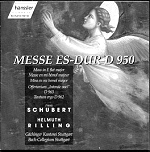 |
This mass was the sixth and last major sacred work by Schubert -- written in 1828, the year he died. Sadly, he never got to hear it; it was first performed the year afterward. Critics rejected it for its length, its sombre atmosphere, and its unconventional harmonies; but it has endured, as one of the truly great choral works.
Schubert did unconventional things with the sacrosanct standard text of the mass. The composition repeats several phrases, specifically several terms of praise such as Adoramus and Glorificamus, and words of thanksgiving. Most significantly, just before a passage of text which asks for forgiveness of sins, the composer dramatically inserts words of praise, including Gloria in excelsis deo. The fact that he chose such unusual ways to reinforce the meaning of the text bolsters the contention of some scholars that the work was a sincere statement of fervent faith.
The very subdued opening has a funereal grandeur; this mood is dispelled by an exuberant Gloria. The majestic Sanctus emphasizes the grandeur of Gods holiness; the Agnus Dei begins with extraordinary gravity, emphasizing what the Lamb of God has done for us all. Helmuth Rilling directs his Gachinger Kantorei and Bach-Collegium Stuttgart, and outstanding soloists: soprano Sibylla Rubens; alto Irene Friedli; tenor Christoph Genz; and bass Thomas Mehnert.
• Novospassky Monastery Choir: Russian Divine Liturgy, Naxos, 2000.
The Novospassky (New Saviour) Monastery has a remarkable history. Originally built in the 15th century, it played host to Russian royalty; contained a sepulchre holding the remains of the Romanov dynasty; and was also used as a fortress. Under the Communists, it was used as a concentration camp, a KGB archives, and a womens prison. In 1991, the monastery was returned to the Russian Orthodox Church. Given such a background, this CD is particularly meaningful and moving.
The Divine Liturgy is the Eastern Orthodox equivalent of the Roman Catholic mass. This CD presents the celebration of the mass by a bishop and choir, utilizing music by a dozen of the most respected Russian choral composers. Personally, I prefer the Eastern Orthodox style of chant to the Gregorian chant of Rome; it generally tends to be more energetic and assertive than the more contemplative Gregorian style. This choir offers a fine example of this music -- which somehow manages to sound both ancient and timeless; its a most fitting way to celebrate the triumphant survival of the faith in Russia.
• Westminster Cathedral Choir: Frank Martin - Mass for Double Choir, Hyperion, 1998.
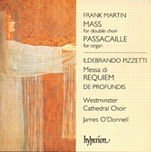 |
Frank Martin, an underappreciated 20th Century Swiss composer, produced one of that centurys supreme choral works. He incorporated influences as varied as Bach, Renaissance composers, 19th Century German romanticism and the notorious 12-tone music of Schoenberg. He was also a very painstaking artist, who preferred to withhold his compositions from public performance until he was completely satisfied with them. That tendency almost deprived the world of this extraordinary work.
Begun in 1922 and finished in 1926, the Mass for Double Choir was kept in a drawer for almost four decades; Martin finally allowed it to be published and performed in 1963. The reason he withheld it was deeply spiritual. Raised as a Calvinist, Martin remained a devout believer throughout his life. Expressing his faith in music was intensely personal. As he explained at the time of the premiere of the work, "I considered [the Mass] as being a matter between God and myself. I felt then that an statement of religious feelings should remain secret and removed from public view."
We can only be grateful that he changed his mind. Featuring no soloists or instruments, this very special work conveys a deep sense of reverence through ever-shifting layers of utterly exquisite polyphony. Its a simply stunning composition, immaculately sung.
• Sergio Vartolo: Palestrina - Missa de Beata Virgine, Naxos, 2000.
Still considered one of historys most important choral composers, 16th century master Giovanni Pierluigi da Palestrina also played a key role in the Counter-Reformation. At the Council of Trent in 1545, certain Roman Catholic authorities insisted that liturgical music should be confined solely to plainchant, in order to emphasize the words of scripture; Palestrina, according to popular accounts, successfully advocated on behalf of the use of multiple melodic lines, or polyphony -- for which centuries of music lovers should be thankful.
His Missa de Beata Virgine is a fine example of his craft. One highlight is the opening, in which a striking and evocative solo proclaims: "Let us all rejoice in the Lord." This effectively sets a contemplative tone, with a sense of urgency. The spell is broken -- and another one is cast -- by the Kyrie Eleison, as other voices join the lone singer. Other standouts include the Credo and Sanctus, featuring lovely polyphonic singing. The superb performers are seven soloists from the Cappella Musicale di S. Petronio di Bologna, led by director and organist Sergio Vartolo.
• Helmuth Rilling: J.S. Bach - Sacred Music in Latin, volumes. 1 & 2, Hanssler Classic, 1999.
As a staunch Lutheran, Bach must have raised a few eyebrows when he set the traditional language of Rome to music. In his beloved Mass in B Minor, he utilized the entire text of the Mass. For these smaller masses, however, he chose to use only the Kyrie Eleison and Gloria sections; these two CDs feature four such settings.
The most interesting work is the Mass in A Major. The Kyrie features particularly sensitive ensemble work from the soloists, effectively overlapping each other; there is also a lovely slow interlude in the middle of a powerful choral passage. The Gloria has a wonderfully bright and joyful introductory chorus, and several other celebratory choral passages; they are offset by slow and reverent interludes sung by two soloists, providing a dynamic contrast. In addition to the masses, the recording includes a sublime piece -- combining the traditional Kyrie Eleison with a chorale entitled O Christ Thou Lamb of God -- which deserves to be part of a larger work. More fine work from conductor Helmuth Rilling.
• Vittorio Zanon: Giacomo Carissimi - Mass for Three Voices, Naxos, 2001.
In his lifetime, this 17th century composer occupied the prestigious post of maestro di cappella at the renowned Basilica of Sant Apollinare in Rome. Most of Carissimis original manuscripts are now, sadly, lost. At first listen, this is not terribly bravura music. But upon reflection, it becomes apparent that the composer has eschewed spectacular effects in favour of a straightforward reading of the text which concentrates the listeners attention on the meaning of the words. He also takes a refreshing approach, utilizing a trio of singers instead of the choral singing usual to masses. Vittorio Zanon directs the Consortium Carissimi; the ensemble gets an impressive richness of sound from just three voices -- its hard to believe the group is so small.
• Uwe Grodd: Johann Baptist Vanhal - Missa Pastoralis & Missa Solemnis, Naxos, 2001.
This late 18th century composer produced a large volume of symphonies, concertos and string quartets. Although he was not a church musician, Vanhal composed a remarkable number of Mass settings -- approximately 50. He was considered the most significant freelance Viennese composer of his time; the fact that sacred music did not bring significant financial rewards would indicate that he wrote these works out of genuine belief.
While the music might not be considered utterly brilliant, these are worthy settings of the mass text. The more interesting of the two is the Missa Solemnis in C Major. It gains in musical richness as it progresses, culminating in a fine female duet and a majestic final chorus. Uwe Grodd directs the TOWER Voices New Zealand, and the Toronto-based early music instrumentalists, the Aradia Ensemble; there is also fine work from soloists Mary Enid Haines and Nina Scott Stoddart.