
May 2002
Thinking 'Christianly' about vacations
BC Christian News, · Top Stories
VACATIONS offer Christians a wonderful opportunity to reflect on their faith and grow spiritually. Therefore, it's important to begin thinking about the theology of vacations and the ways they can be times of renewal both physically and spiritually.
Touring Europe, for example, offers many possibilities for both spiritual enrichment and physical recreation. One way to approach a European tour is through the lives of great Christians from whose example we can learn and find encouragement. Although there are many people one could choose, such as Boniface, Calvin, Wesley, Wilberforce, etc., here we will consider Martin Luther.
Germany's 'Luther towns' offer wonderful opportunities for both relaxing vacations and lasting spiritual nourishment. Yet most of these wonderful historic sites are relatively unknown to most people because until 10 years ago they lay behind the Iron Curtain, where they were inaccessible to Western visitors for almost 50 years. Even after the fall of the Berlin Wall many of these places remained fairly difficult to visit because of a severe lack of amenities such as good hotels and restaurants.
But, today all that has changed and visiting Luther's Germany can be both exciting and comfortable. Here we have only space to mention three of the 36 major towns associated with Luther.
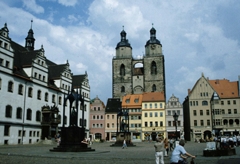
The best approach is to fly into Berlin from where most of the key Luther towns can be easily reached either by hiring a car or taking one of Germany's truly excellent trains. Wittenberg, or Lutherstadt-Wittenberg, as it is now known, is the place to begin. Luther lived in Wittenberg for 36 years, so not surprisingly the town contains a host of Luther sites.
The most important of these is the Luther House Museum. Originally an Augustinian monastery where Luther and his fellow monks lived while teaching at the University of Wittenberg, the house was given to Luther as a wedding present by the Elector of Saxony in 1525. Today it is without doubt the best museum of Reformation history in the world.
Here one finds a huge collection of Reformation books, coins, paintings and other things connected with Luther. You can see where and how Luther lived with his beloved wife Katie, their children and a large number of students who stayed in his home.
Here is where many of Luther's conversations, recorded by faithful students in the delightful Table Talk took place. The museum contains many first editions of books and pamphlets published by Luther, his colleagues and opponents.
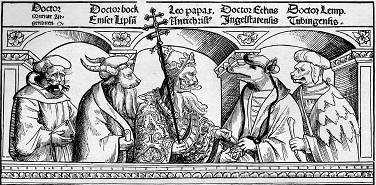
Among the most fascinating items in the collection are numerous 16th century cartoons that were originally published as propaganda tracts by Luther's supporters and enemies. These broadsheets really bring the Reformation alive and can be easily understood -- even if you don't read German -- because Luther is either depicted as a noble defender of the truth opposed by enemies with heads of wild animals or he is shown as a demon in human form. The pictures are truly fascinating.
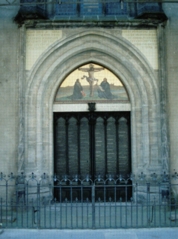
In Wittenberg you can also see the two main churches where Luther preached -- St. Mary's and City Church, where he nailed his 95 Theses to the door October 31, 1517, in an act that changed history. Unfortunately, the original door was destroyed in the 19th century and replaced by a bronze one on which the theses are written out. But, even though this is not the original door, it is the spot where Luther stood.
You can also learn about Luther's closest friends and co-workers in spreading the gospel. A few doors away from Luther's house is the home of his faithful assistant Phillip Melanchthon (1497 - 1560) where you can also see many of Melanchthon's writings -- and a traditional herb garden as it would have been in his time.
The Cranach Museum, devoted to the work of Luther's friend, the mayor of Wittenberg Lucas Cranach the Elder, is not yet complete. But, you can see some magnificent paintings by Cranach in both the Luther and Melanchthon houses, and in the Church of St. Mary, Luther's favourite, and City Church.
Some 95 kilometres southwest of Wittenberg is the small town of Eisleben, where Luther was born in 1483 and died in 1546. You can still see the house where he was born. A short walk away, in the town square, is the Church of St. Andrew where Luther preached before his last illness. Nearby is the house where he died. Here you can see the room he lay sick in and the bed on which he actually died.
Both houses are now museums containing interesting insights into Luther and the Reformation. Visiting Eisleben takes about half a day.
Almost 70 kilometres south of Eisleben lies Erfurt, the scene of the tragic murder of 18 people by a disgruntled high school student April 26. Luther studied in Erfurt from 1507 - 1511. Here you can visit the Augustinian monastery where Luther lived as well as the city's magnificent Dom, or Cathedral, which was first founded in 742 by the British missionary Boniface. This bustling town is dotted with important Christian sites and is well worth at least a day's visit.
All of these Luther towns -- and there are many more in Germany -- are an important part of our history. The 16th century Reformation that Martin Luther began shaped all of our lives by molding European history. Anyone who wishes to understand the modern world can benefit enormously from visiting them.
Irving Hexham is professor of religious studies at the University of Calgary and editor of Zondervan's 'Christian Travelers' series of guide books. Contact: www.christian-travelers-guides.com