
June 2002
Soccer mania, security and evangelism in Korea
BC Christian News, · International
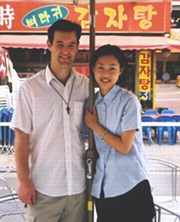
Wayne Taylor, former advertising manager for BC Christian News, has developed a strong affinity for Korean culture, and has been living in Seoul since the beginning of the year. He is currently teaching English as a second language, and sends this account of everyday life as the country hosts World Cup soccer matches.
CHRISTIANITY is thriving in South Korea, with an estimated 25 to 35 percent of the population identified as believers. Lately, however, a somewhat less high-minded kind of religion has gripped the country.
The World Cup is the biggest thing going on in Korea right now. As I recently noted in an email to a friend: "Say, there seem to be little soccer balls hanging everywhere over here. Do you know anything about that? " Of course, I was joking.
But I am admittedly learning more about soccer now than I ever planned. I am a guitar player, who has never really watched TV - let alone TV sports.
But even someone who is not a sports fan can't help but notice that an extraordinarily large group of people is coming together in one place with one common goal.
 |
 |
 |
 |
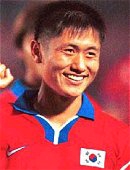 |
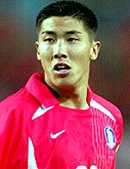
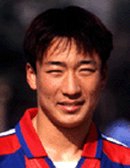
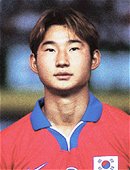
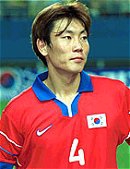
| Members of the Korean national soccer team who have identified themselves as Christians include (top to bottom) Doo-Ri Cha, Tae-Uk Choi, Chun-Soo Lee, Chong-Gug Song and Young-Pyo Lee. |
My first exposure to the impending World Cup was on a visit to Korea was last summer. I was attending David Yonggi Cho's Yoido Full Gospel Church, the largest Christian congregation in the world. I had a couple of hours on Yoido Island, so I went for a stroll with Kyung Ae, my Korean girlfriend.
Near the church is a large park. That day, there was loud music coming from the park - and as I approached, I could see an elaborate array of exotically dressed men and women on a stage. They were in the process of choreographing a majestic grand opening ceremony for the 2002 World Cup.
At that time, the thought had not even crossed my mind that I would be here again during those games, so I was looking around to see if I could buy some cheezy World Cup plastic key chains to take home to someone who would actually care about the event (with no success).
On New Year's Day, 2002, I arrived at Inchon Airport - in time for the second round of soccer mania. Since the last time, the amount of World Cup paraphernalia had increased dramatically. Now there were little World Cup stores at many subway stations; and a plethora of World Cup bumper stickers began to appear on the backs of cars.
Also, many Koreans were beginning to wear replicas of the Korean national team's jersies. 'Korea Welcomes the World,' was the message of the hour.
Now, it is World Cup fever over here! Every corner has some kind of tourist booth.
Most businesses are handing out little keychains and other soccer-related items to anyone who looks like a tourist.
An entire subway car has been painted, and the inside turned into a mini soccer field - complete with astroturf. Apartment-sized soccer balls are floating in the downtown areas, and little soccer ball lanterns hover in a line all the way around the city where I live. At night, I am reminded of the inevitable by these bright pink, yellow, blue, green and white plastic soccer balls in the firmament above.
There have been very few things in Korean history which have put the country in the spotlight like the World Cup. I have been told that the 1988 Olympics left a legacy for the country. I learned recently that Korea is also hosting the Asian Games this year; so it should be clear why expectations are very high for a massive number of tourists to grace this peninsula.
It should also not be forgotten that the residents of Seoul are only minutes away from the border of a country with whom they are technically in a state of war. Since September 11 - and more recently, with President Bush's comments lumping North Korea into his "axis of evil " - there has been mounting concern about possible terrorist attacks on athletic events.
Recently, a news article described South Korea's plans to protect stadiums with surface-to-air missiles and fighter jets; the government will also have trucks near stadiums, designed to detect biochemicals.
Therefore, it should not be surprising that the Christians in Korea have been holding this whole matter up in prayer. At Yoido Full Gospel Church, every prayer - at every service, every week - includes pleas for protection during the World Cup, and for wisdom for the government to handle the games effectively.
What else have Christians been doing in response to the World Cup? Evangelism is at the top of the agenda. There is an interdenominational plan to reach out to the hundreds of thousands of visitors who will be coming to watch the games, many of whom will never have heard the gospel before in their homelands.
There will be a lot of effective witnessing during the World Cup. One thing that is engrained in Korean culture is evangelism. Today I marvel no less than the first day I saw Koreans witnessing. It kind of reminded me of what it must have been like when the Salvation Army was first being established under William Booth.
Right in the middle of Myung Dong, one of the busiest consumer areas of Seoul, I saw a small team of people marching. One person carried a large, colourful banner proclaiming Christ; another one preached the word and sang hymns through a megaphone.
I don't know how effective this 'megaphone witnessing' is; but the mere fact that no one complains or protests this action is a telltale sign of how the gospel of Christ is embedded in Korean culture. I have enjoyed seeing the earth-shattering impact that Jesus has made on this nation - and how the body of Christ in Korea, as a whole, is not afraid of the gospel.
I've also enjoyed the frenzy inspired by the World Cup. For a guy who knew nothing about soccer (except for the pain I experienced when a metal soccer goalpost fell on my legs when I was goalkeeping at the age if 12), I have been really enjoying watching the excitement build.
In conclusion: considering the kinds of assertive evangelism I've seen in this country, the World Cup may indeed bring the 'glory of victory' - in more ways than one.