
July 2002
Vancouver's street women well acquainted with grief
BC Christian News, · Top Stories
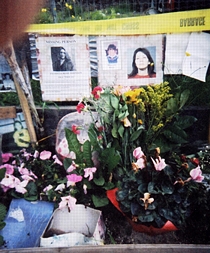
A HANDMADE memorial erected outside the gate of a pig farm in Port Coquitlam bears witness to the 54 women who have gone missing from downtown Vancouver streets in the last two decades. Photos, flowers and poems adorn a section of the fence. At the base of the makeshift monument, a teddy bear sits forlornly.
Just behind the memorial, a fence strung with yellow police tape separates the public from a massive investigation of the property where Robert William Pickton lived until he was arrested last February. He has since been charged with the murders of seven of the 54 women, and will go on trial in November. Meanwhile, a team of archaeology students are sifting through mounds of dirt and rubble, searching for any evidence they can find, such as bone fragments or bits of clothing.
This is probably the most gut-wrenchingly sad story to come out of Vancouver's Downtown Eastside, a neighbourhood that is well acquainted with grief. The fact that women end up on the street at all, selling themselves cheaply to get money for drugs, is tragedy in itself. Virtually every woman and girl -- up to 99 percent, according to police -- who lands on the street is escaping from sexual, physical or emotional abuse say those who work with prostitutes.
"Most of the people who end up downtown are running away from home," says street pastor Randy Barnetson. For the past 10 years Randy and his wife Cheryl have operated the Street Church, a congregation at Main and Hastings, in the heart of Vancouver's drug district, where seven nights a week people can come in for hot dogs and a message of hope.
Sometimes a 'boyfriend,' who turns out to be a pimp, lures a young woman into cocaine use -- and within days she will be addicted.
A handmade memorial erected outside the gate of a pig farm in Port Coquitlam bears witness to the 54 women who have gone missing from downtown Vancouver streets in the last two decades. Photos, flowers and poems adorn a section of the fence. At the base of a makeshift monument, a teddy bear sits forlornly.
Just behind the memorial, a fence strung with yellow police tape separates the public from a massive investigation of the property where Robert William Pickton lived until he was arrested last February. He has since been charged with the murders of seven of the 54 women and will go on trial in November. In the meantime, a team of archaeology students are sifting through mounds of dirt and rubble, searching for any evidence they can find, such as bone fragments or bits of clothing.
This is probably the most gut-wrenchingly sad story to come out of Vancouver's Downtown Eastside, a neighbourhood that is well acquainted with grief. The fact that women end up on the street at all, selling themselves cheaply to get money for drugs, is tragedy in itself.
Virtually every woman and girl -- up to 99 percent, according to police -- who lands on the street is escaping from some sort of abuse -- sexual, physical or emotional -- say those who work with prostitutes.
"Most of the people who end up downtown are running away from home," says street pastor Randy Barnetson. For the past 10 years Randy and his wife Cheryl have operated The Street Church, a congregation in the heart of the city's drug district, where seven nights a week people can come in for hot dogs and a message of hope.
Sometimes a "boyfriend" -- who turns out to be a pimp -- lures a young woman into cocaine use and within days she will be addicted.
"And then he'll turn on the girl and say 'you owe me thousands of dollars,'" says Cheryl. The only way to pay him back is to trade sex for money.
"They're really nice women," adds Bernice Sondrup. She is a longtime worker with Crossfire Ministries, a Vancouver outreach to prostitutes which recently began an initiative in Kelowna. "They're just trapped: trapped in drug addiction and prostitution."
Sondrup, who has had contact with thousands of prostitutes over her 13 years of ministry, says Crossfire volunteers would have talked to every one of the 54.
Scanning a sheet of their photographs, the 63 year old grandmother and former missionary to the Shuswap people reminisces about the ones she knew personally: this one stayed at Rapha Place, the Crossfire safe house; that one was consumed by drugs. "Some of these ladies have accepted the Lord," says Sondrup -- some of them several times, just to be sure.
They were also known to the myriad of other ministries, missions and churches that dot Hastings Street, including the Street Church. "They either came into the church for a hotdog or hung around on the street," says Cheryl Barnetson. "Most of them were known by somebody in our church."
Many of the women had been struggling to make changes. Some had gone through recovery programs, only to relapse; several had become part of church communities.
Cheryl Barnetson remembers a young woman named Olivia who came from northern B.C. Since both Cheryl and Olivia were from the Carrier nation, they had a special bond. One night after the service the two were digging through a box of donated clothes when they each found a pair of shoes to fit them. Olivia, who was seven or eight months pregnant, was so happy with her new black shoes, and danced around before disappearing into the night with a "see you tomorrow."
That was six years ago, and it was the last time Cheryl saw anything of her until her picture appeared among the missing.
Then there was Sereena Abotsway, a young woman who become a regular attender at the Street Church and was baptized in the ocean in 1998. She took her faith seriously, says Randy Barnetson. "She was always up at the front praying."
The Barnetsons remember Sereena as someone who was always quick to pitch in and help. "She exhibited so many Christian characteristics," says Cheryl.
Sereena disappeared last August. In February, Pickton was charged with the first two of seven murders; Sereena's was one of them.
Women do leave the street and live productive lives. Sondrup can list many who, over the years, have gone through recovery, trained in a trade or profession and are now working at good jobs. One has become an accountant, another is training to be a nurse, and a third runs her own business and now volunteers with Crossfire herself. Some have married and settled into stable family life.
It's those happy stories that downtown ministers have to remind themselves of, because when you work on the street, joy comes in small measures, spiked with sorrow.
"I have to go down to the farm," says Sondrup. "I've been putting it off. I find it really painful." Cheryl Barnetson's words are like an echo. "I haven't been out to the farm," she says. "I'm a little bit scared." Visiting the pig farm will bring grief and loss into sharp focus once again.
Meanwhile, the memorial stands at the gate, a sentinel guarding a piece of land that some have come to view as sacred. A poem is neatly written on an upright slice of tree trunk that forms part of a monument: "Red and yellow, black and white, we are precious in His sight. Forever joined in candle light, united together at this site."
Debra Fieguth is a former editor of BC Christian News. From 1989 to 1992, she volunteered for Streetlight Ministries in the Downtown Eastside.