
August 2002
Heaven-haunted: hope for the world-weary
• Mark Buchanan: Things Unseen: Living in the Light of Eternity, Multnomah Publishers, 2002.
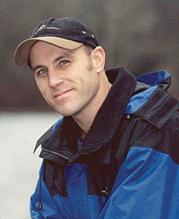 |
MARK BUCHANAN saw the accomplishment of a lifelong dream last year: He published his first book, Your God is Too Safe. The book was endorsed by Regent College greats like Eugene Peterson and J.I. Packer as well as Philip Yancey, and went on to become a bestseller. Recently, it won the 'God Uses Ink' Award for Best Nonfiction book in the Christian Living category. Not bad for a first-time author.
But in his newest book, Things Unseen: Living in the Light of Eternity, Buchanan lets the reader in on a little secret. Holding that first book in his hand, a culmination of 20 years of dreaming and eight of writing, did not fulfil him. It was not enough.
Because, Buchanan says, it was never meant to be. The things of earth, however beautiful, do not contain the "ultimacy" that is "heaven's domain," as he said in a recent interview. Life, in effect, was meant to be disappointing.
In Things Unseen, Buchanan -- who is is now pastor of New Life Community Baptist Church in Duncan, on Vancouver Island -- uncovers the ache within us, the unfulfilled longing for that ephemeral something that earthly experiences point to, but can never satisfy. The instinct within each of us, he says, is that "we weren't made for this world only. We were made for eternity. The world is not enough." Life does not justify living, Buchanan says. Only eternity does.
Buchanan then moves on to replace our insipid pictures of heaven with a more authentic one in which our twin desires to "go home" and to "go beyond" are somehow mysteriously simultaneously fulfilled. "The ahh! of deep satisfaction and the aha! of delighted surprise meet, and they kiss," Buchanan writes.
He speaks, among other things, of heaven being more real than reality, more dense and vivid, like C.S. Lewis's vision of heaven at the end of The Last Battle. In fact, Buchanan's writing draws heavily from Lewis, Tolkien, Eliot, George Herbert and many other academics and artists.
Finally, Things Unseen points the reader to death and beyond, to living well with a heavenly-minded perspective, heaven-bent with eyes fixed on that which is unseen. It is living with the goal, the prize in mind. He points the reader to dying well, to the idea of living our entire lives for the moment of death, which is a passing into the true reality.
But Buchanan does not have in mind a disengaged, detached vision of life here on earth, a neo-platonic denying of earthly pleasures for the heavenly reality. Rather, he argues quite the opposite, that a life well-lived in light of eternity will be more rich, robust and full because it has been freed up from trying to find ultimacy in the things of earth.
Buchanan's newest book is rich with stories, both personal and those of people who have figured significantly in his life. Each thematic section ends with a 'portrait,' a modern-day parable embodying a main point.
In 'Now You Do It,' Buchanan tells the moving story of his juncture as teaching assistant to Dr. Klaus Bockmuehl at Regent while Bockmuehl was dying of cancer.
"I entered pastoral ministry in part because Dr. Bockmuehl, in one of his dying conversations with me, delivered a word so startling that I came to see it as a word of prophecy," he reveals.
Like so many of Buchanan's stories, this one poignantly demonstrates as much about humanity as it does about the nature of God.
Read Things Unseen for its important message, but read it also for its achingly poetic prose, stories told with the humour and skill of the gifted orator that Buchanan is.