
September 2002
'Acting Christianly' in secular theatre scene
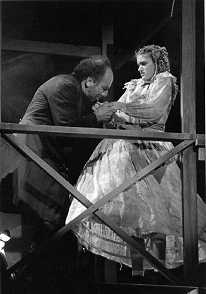
ACTING can be a tough profession at the best of times; and if one is a committed Christian, there are inevitably going to be extra challenges.
"So much of the entertainment industry is clearly unchristian," says Rebecca Codling, "so it's hard to play certain roles, and also to be involved in working with people who don't share your faith. I found this to be true especially when I was younger."
Codling, who lives in Richmond, has been acting and singing professionally for 10 years. She attends Peace Portal Alliance Church in Surrey. She has appeared onstage in Swing, Sweeney Todd, Footloose and Baby, and on TV in A Very Muppet Christmas and The X-Files.
"You're always affected by people's beliefs," she says, "even when they say they don't have specific religious beliefs."
Vancouver's Ian Farthing, who attends Point Grey Community Church, has spent 12 years as a professional actor and singer. In England, he appeared at the Shakespeare Globe, and in Victorian music hall presentations; he came to Canada in 2001. He has appeared in musicals such as South Pacific, and dramas such as The Mousetrap and The Clearing.
Asked what it's like being a Christian in a secular artistic environment, Farthing says: "It's exactly like being a Christian in any other job. I don't have a problem with it. I have a problem with people who term themselves 'Christian artists' -- because often they use divine inspiration as an excuse for mediocrity in their art. If you've been given a gift, then as an artist you have a responsibility to perfect your craft and work to the highest professional standards."
Codling has found some professional situations problematic, such as her first rehearsal for Baby. "My lines included mild profanity, and taking the Lord's name in vain." When she got to some parts of the script, she says, "I had to stop for a second, and think to myself: 'Do I just read this as written?' Because that's only a part I'm playing, it's not me.' Or, do I change the words?' So I changed the words -- and the other people laughed. My director told me afterwards that he knew I was uncomfortable with the language, and to just go ahead and experiment."
Farthing has a different perspective. "Art is about truth, and truth isn't always nice. Art is there to ask difficult, awkward questions. If there is some worthwhile question being asked by a play, I don't have a problem with swearing, nudity or any other things which bother some people."
Despite the opposition to Christian faith evidenced in so many aspects of contemporary society, both actors say they have had rewarding experiences interacting spiritually with their artistic peers.
"I've never spoken to other cast members, saying 'I'm a Christian, and this is what I think,'" says Codling. "But members of the cast have said things to me -- because I don't swear, or because of other choices I've made. They have said things which indicate that they know I'm a Christian."
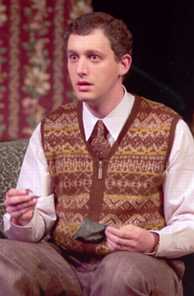
"Actors by their very nature seem to be very spiritual people," Farthing asserts. "We often have a lot of time to talk to each other -- in the dressing room, in the rehearsal room, in the bar -- and often, the subject of faith comes up as a topic of conversation." Like Codling, he prefers "being an evangelist by example, rather than being a preacher. My personal belief is that you provide the strongest witness for you faith by how you acquit yourself professionally in your dealings with your colleagues. It's not necessarily the things you say."
Farthing says that when his fellow actors have become aware of his faith the response has "usually been very positive. They're very open. Often they'll say 'You have your truth and I have mine.' But at least they're willing to listen, and respect your belief."
Faith, says Codling, is a factor in every aspect of her career. "Getting involved in theatre is always a challenge for me. In order to do the best job, I have to focus on it and commit to any role I'm playing. It's a struggle -- because it affects your life. If you're making the role that important, are you taking something away from your relationship with God? For example, if you have to rehearse on a Sunday, you might miss church."
Farthing also places great importance on his belief in Christ. "My faith provides an overview. It gives one a sense of the big picture about life. It's easy for people to get caught up in the show, and become self-obsessed with their work. But as Christians, we theoretically have a head start at overcoming that. Also, it's such an insecure profession. You never know how you're going to pay your bills. So the concept of walking by faith becomes very real."
"In this industry," says Codling, "it's hard to balance your life between your work and your faith. But then, for me, it's not about balance -- because God is the most important thing in my life. You can't serve two masters: money, your job or your art on the one hand; versus God, on the other hand. I never know, when I get into a role, whether I can successfully pull off the part to my standards, and also the standards people put on me. Faith helps me with this kind of uncertainty -- and with uncertainty regarding which parts I do."
Codling concludes: "I feel that God has laid out a path for me. God keeps me humble, and keeps me safe in the places I'm going with my career. I don't have to be afraid about choices, when I know God is in control."
Farthing's next production will be Pacific Theatre's presentation of Lettice and Lovage, beginning September 27. Codling will appear in the Arts Club production of West Side Story in November, at the Stanley Theatre.