
September 2002
Coming of age slowly, artfully
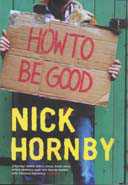
• Nick Hornby: How to be Good, Riverhead Books, 2001.
 |
I saw About a Boy recently, which most people I talk to are staying away from because of Hugh Grant, but which I'm telling them they really ought to see because of Hugh Grant.
But mostly because of Nick Hornby. He wrote the book the film comes from, as well as High Fidelity, the book from which that other film comes. Turns out he's the master of the Slow Emergence of Conscience novel -- about people whose 'coming of age' is a decade or three overdue. The self-preoccupied wake up to the fact that they are not the centre of the universe. Indeed, much hilarity is to be had in the layering of brilliantly rendered dramatic ironies as the characters begin to dimly perceive their shortcomings and misconceptions, long after they have become all too clear to the audience.
Enjoying this last Hornby flick spurred me to pick up his 2001 novel, How to be Good, and I wolfed down this particular serving of soul food like a starving man. This time the central character is a woman, a doctor in her thirties or forties who "lives a good life" -- her career is all about caring for people, she subscribes to conscientious liberal causes, and suffers fairly nobly and uncomplainingly through an increasingly arid marriage with an angry, sarcastic, 'stuck' man. And, oh yeah, she's having this little affair, as well.
Now, I hate to reveal elements of a story that aren't revealed in, say, the first 30 pages -- I'd rather you get the same delicious surprise that the author intended -- but the event that really kicks this story into high gear is the aspect that brings me to tell you about the book (and you can't read the back cover of the book without finding out anyhow), so what the heck.
Just as we're settling in with this woman's low-level soul-searching about the possibility that she might not be as 'good' as she's always prided herself on being, her husband visits a quirky spiritual healer named DJ GoodNews, and returns home every bit as much 'a changed man' as Ebenezer Scrooge in the last pages of A Christmas Carol.
At points, the author takes pains to distance this conversion from a 'conventional' Christian conversion, but the portrayal of a newbornagain babe in the Lord is so spot on, I almost wonder if Hornby wasn't writing about a real conversion to Jesus but covering his tracks to keep some readers from dismissing the validity of the whole business out of hand. Probably not, but I'm not sure I've ever read a novel that so aptly captures my own conversion experience, in all its breathtaking freshness and heartbreaking naivete.
Hornby's choice of the conventionally 'good' viewpoint character is inspired -- we view two awakenings of conscience simultaneously. We are bedside witnesses during two spiritual birth processes, one so sudden and unprepared-for it might almost be premature, the other protracted and difficult and not at all certain of success.
Hornby compounds his usual layering of narrative and viewpoint ironies by viewing two awakenings rather than just one, and his usual comic ironies take on whole new depths of complexity and interest. He's always been an entertaining and readable writer with some fairly self-evident insights into relationships and self-awareness. With this book he becomes something more: he tackles more difficult, perhaps insoluble questions, and without sacrificing his trademark humour, goes beyond irony into paradox and moral quandary.
I venture to say that the novels of this coming of age novelist are themselves coming of age. At any rate, I'm adding this one to my list of beloved books by not-necessarily-Christian novelists who turn their hand to questions of conversion, spiritual redemption, faith in Jesus -- and create books that speak powerfully to my experience (a list that would include Saint Maybe by Anne Tyler; A Prayer For Owen Meany by John Irving; and Life After God by Douglas Copeland).
Can't wait to see the movie.