
September 2002
Signs extols faith, but film is clumsy and unsatisfying
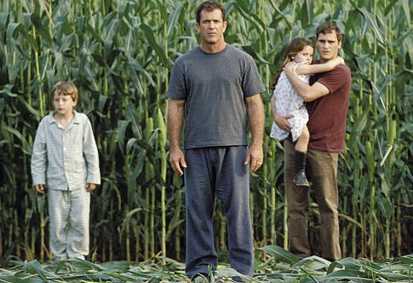
SIGNS is a daring bait-and-switch, in which director M. Night Shyamalan seems to promise his audience a movie about aliens -- and gives us a movie about God, instead.
The film, which stars Mel Gibson as an Episcopal priest who has lost his faith following the tragic death of his wife, is about the need to believe that there is someone out there watching over us, and not just some empty meaningless void; and the film cannily plays with -- and rejects -- the idea that aliens can fulfil this need.
Graham Hess (Gibson) runs a farm, and the film begins with his discovery that his crops have been marked by the same bizarre symbols that have turned up on farms worldwide in the past few decades. Graham's young son, Morgan (Rory Culkin), jumps to the conclusion that it was God who flattened the crops. And when images of UFOs hovering over Mexico City are broadcast on the news, Graham's brother Merrill (Joaquin Phoenix) calls them a "miracle," a sign that can give people hope.
Personally, I have never understood why anyone would assume that aliens have supernatural significance. Perhaps I have seen too many Star Wars and Star Trek movies, but I have always thought that any aliens we might meet would be regular people and full of flaws, just like us, no matter how different their physiology might be.
I am reminded of the Native Americans who assumed Cortez was the second coming of the god Quetzalcoatl, and greeted him accordingly, only to be conquered by his men. The discovery of a hitherto unknown race may be something to marvel at, but it is hardly the sort of thing in which we can place our faith.
What I like about Signs is how Shyamalan exposes the folly of such attitudes. The aliens turn out to have evil intentions for our planet, and Graham and his family struggle to find some way to protect themselves from these intruders. When salvation comes in the end, it is from a completely unexpected source, and we realize the movie is not about the 'signs' made by the aliens (which turn out to be mere navigational aids, anyway), but the 'signs' of God's sovereignty in the world.
It is good to see a summer movie explore such themes; but unfortunately, Signs makes its point all too obviously, and clumsily. As in his last two films, The Sixth Sense and Unbreakable, Shyamalan takes a pulpy premise and treats it as though it were serious drama. But those films were held together by an emphasis on personal relationships; Signs has a broader scope -- and is filled with scenes in which people watch the news or read books and rattle off a bunch of facts about the aliens.
Also, several of the supporting characters have the sort of exaggerated mannerisms that might belong in a Coen brothers movie, but feel out of place in this film; and other characters are given unlikely dialogue that rams home the film's theme that there is no such thing as coincidence.
The awkward exposition, the fitful comic relief, the contrived plot devices -- all these things reminded me of Left Behind and other films produced by and for the Christian subculture. And that was before the film's big climax, which fails both as drama and as science fiction; it is also highly suspect as theology. If I may borrow a phrase from Carolyn Arends, the film ties everything together far too neatly, leaving little room for the 'mess and mystery' of life to be, well, messy and mysterious. It also turns out the aliens are pretty stupid; what alien would step onto a planet as hazardous as ours without wearing protective clothing?
Shyamalan, who was born to a Hindu family and educated at a Catholic school, certainly believes someone is watching over him; he has cited the box office success of The Sixth Sense as evidence that that film was 'guided' by a higher power. But I think films are more rewarding, and more engaging, when they allow for some ambiguity around these themes. Signs is Shyamalan's least satisfying film since Wide Awake. -- PG
THE BELIEVER is a powerful, shocking film about one man's struggle with faith and ideology. Henry Bean's directorial debut won the grand jury prize at the Sundance festival in January 2001, but it couldn't find a regular distributor until earlier this summer, apparently because its subject matter -- it's about a Jewish skinhead who joins a neo-Nazi group -- was considered too controversial.
Danny Balint (Ryan Gosling) is a lot like the restless malcontents of Fight Club: he rages against a consumer culture that reduces everything to commodities and robs the world of its inner worth; he rages against God because he thinks God hates him and he thinks rebellion is the only way to get God's attention; and his relationship with Carla (Summer Phoenix), the daughter of one of his group's leaders, is tinged with masochism.
The film frequently flashes back to a moment in Danny's childhood when he argued with his classmates over the meaning of the story in which God tells Abraham to sacrifice his son Isaac. Danny says the lesson is not that Abraham had faith, but that God is so powerful he can make people do stupid things for no reason; when his classmates accuse him of not believing in God, Danny replies that he is the only true believer in the room, because he refuses to cower before God or make excuses for him.
I happened to re-read G.K. Chesterton's Introduction to the Book of Job just a few weeks before seeing this film, and I was struck by how many of Danny's rants echoed the concerns of Job. But this analogy can only be pushed so far. There is a fine line between blaming God for the world's problems, which Job does do, and cursing God, which Job does not do -- and Danny, by beating up other Jews and planting bombs in their synagogues, crosses that line. Rather than hold out for some sort of answer from God, as Job does, Danny actively makes things worse.
Still, this is a highly challenging film, and it gives the viewer a lot more to chew on, theologically, than there is space to get into here. Be prepared to discuss the film at some length once it's over. -- 14A
--