
November 2002
Wilding 'set the tone' for Vancouver's churches
BC Christian News, · Top Stories
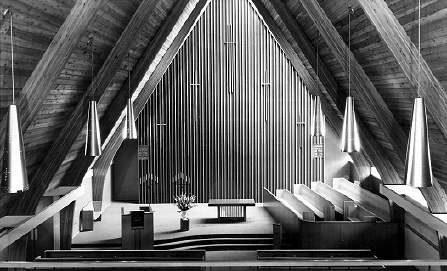
THE MAN credited with revitalizing church architecture in the Greater Vancouver area is being honoured in an exhibit of photos by Simon Scott at Regent College's Lookout Gallery.
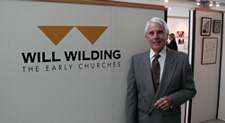
'Will Wilding: The Early Churches,' running until November 16, displays striking images of 19 churches built from 1954 to 1965; in all, Wilding has designed more than 180 churches.
"In the '50s and '60s," says Lookout director Dal Schindell, "Wilding changed the face of what churches looked like -- at least Protestant churches. He seems to have set the tone for that era. It was a modernist equivalent of the way the Gothic style pulls you up -- that's Will's look."
According to Rhodri Windsor Lipscombe, author of The New Spirit: Modern Architecture in Vancouver 1938-63 (MIT Press, 1997), Wilding was a significant figure of the Modern Movement in architecture. "I think his work was very adept at taking the ideas of modernist architecture to create a new language of sacred form in the post-Holocaust era," Lipscombe says.
"The level of destruction of World War II -- from the Holocaust to nuclear warfare -- shattered many aspects of conventional faith. Will Wilding was one of those people, in the post-war era, who was trying to re-understand the sacred -- through very direct architectural means, such as the use of windows and support structures."
Wilding, says Windsor Lipscombe, endeavoured "to rethink what the purpose of design was, to rethink the making and meaning of space." The results, he added, demonstrated "a high level of craft, and a genuinely spiritual dimension. There was an openness in his buildings -- and a solemnity which allowed for ritual and liturgy, without being stuffy."
Wilding's greatest influence was architect Charles Rennie Mackintosh (1868 - 1928) -- who, Wilding says, "had a great sense of decorativeness. His approach had a lot to do with trying to apply human scale to any given architectural situation." Mackintosh "always liked lots of natural light. He was also very concerned with the final décor."
When Wilding began working with Greater Vancouver churches, "many had fixed ideas, and wanted to stick with their heritage." On the other hand, he says, "There were those that said 'go for it' -- and in those instances I was able to use my creative abilities, with the influences of Mackintosh. In most cases, the response showed a willingness to move away from the staid, historical type of church."
His purpose, he says, was "to look anew at the atmosphere of a church -- at forms, colours, materials, stained glass windows. I wasn't wanting to produce a glorified Safeway. I wanted people to know it was a house of worship."
The period documented by the exhibit, Wilding adds, was an exciting time. "There was a sense that 'this is a new day' -- and it was related to what was happening in the evangelical church."
Most of all, he concludes, "I was interested in the sacredness of what was going on in the churches, and I wanted to enhance the sacredness."