
December 2002
Christian on-air media expanding, unifying
BC Christian News, · Top Stories
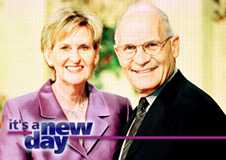
TRINITY TELEVISION (TTI) recently announced official approval for Canada's fourth Christian television station. It will be a second NOWTV channel, opening next year in Winnipeg.
The Winnipeg station will follow the unique model TTI is using with its B.C. NOWTV station, airing parable-like movies and sitcoms along with news magazine-style broadcasts such as 60 Minutes, says Jeff Thiessen, the company's senior vice president.
The Winnipeg channel will feature a higher percentage of drama over news, he adds, but will retain the station's live call-in discussion shows after both dramatic and news programs.
The station is pioneering new ground with the format. "We're doing something no one else in the world is doing," Thiessen says, explaining that TTI made an extensive evaluation of the effectiveness of religious broadcasting around the world before launching the Abbotsford station last year.
The study discovered that most Christian television was not attracting a strong audience among either Christians or non-Christians, because the two groups tend to watch the same type of TV.
Parables
 |
Airing dramatic programs that act as parables engages both Christians and non-Christians on a spiritual level, Thiessen believes, creating a healthy forum for questioning and spiritual searching. Watching a good film challenges assumptions and fosters dialogue, helping people ask the right questions which will "open their hearts," he says.
"Story-telling is the most effective way to talk to non-Christians about God," he adds, noting that Mark's gospel says Jesus spoke to the crowds "only in parables." Shows like Touched By an Angel and Promised Land are examples of this type of programming. Thiessen says he is intrigued by Houston pastor Chris Seay's recent book The Gospel According to Tony Soprano, which builds on this theme by examining how The Sopranos TV series illuminates the human condition and the need for a saviour.
Thiessen adds that the station has no plans to air the program at this time, however, citing its violent content.
The emphasis on dramatic and call-in show programming seems to be working for NOWTV, whose B.C. call-in programs attract up to 35,000 calls per month. Thiessen adds that the station is "just beginning" to see the effectiveness of its format, and will need several years to evaluate programs like Pure Sex and Relationships, which has shown great success so far.
"I'm hoping we're the arm of the church extended to help the church create opportunities to talk to people," he says -- as opposed to becoming an electronic version of the church, a style that has proven unsuccessful in U.S. Christian programming. He likens the station's mission to a self-supporting version of the Campus Crusade 'Power to Change' campaign -- which, he says, raised levels of spiritual awareness when it ran in the Lower Mainland.
"Nothing makes my heart happier than to see Kraft and Campbell's Soup paying for Pure Sex and Relationships -- a show that is talking to teens about sex and abstinence," he adds.
New era of diversity
The announcement of the new station, in combination with an ever-growing number of Christian radio stations, indicates that Canadian Christians are seeing the results of a shift within the Canadian Radio-television and Telecommunications Commission (CRTC) that began nearly 10 years ago.
Erik Fredeen, organizer of the Christian Media Roundtable associated with the Evangelical Fellowship of Canada, notes that initially, a significant amount of Canadian radio was owned by religious groups. However, after various broadcasters became intolerant and critical of one another, the Canadian government intervened in 1932, banning religious broadcasting.
Not until nearly 70 years later did the CRTC begin to soften its position, largely through the lengthy licensing process of television station CJIL, the Miracle Channel, in Lethbridge, Alberta; and the efforts of CHRI Christian Radio in Ottawa, for which Fredeen works as an account manager.
These stations paved the way for other stations to submit similar single-faith programming applications. Ten years later, there are now four Christian television channels and 22 Christian radio stations, each with a slightly different licensing agreement and role within Christian broadcast media.
CTS TV in Burlington, Ontario, for example, is licensed as a religious television station that must maintain what the CRTC describes as 'balanced' programming. For CTS, which sells air time to the popular 100 Huntley Street Christian broadcast, this means 20 hours per week must be devoted to a non-Christian religious point of view, determined by the percentage of the broadcast area population adhering to other faiths.
Both CTS TV and 100 Huntley Street are owned, however, by a single-faith parent company, Crossroads Communications. The station is commercial, but nonprofit.
Lorne Freed, director of programming for CTS, says the channel markets itself as "family-friendly programming" that provides both spiritual programming as well as dramas and sitcoms which reflect moral and ethical values.
100 percent Christian
The Miracle Channel, however, was able to obtain licensing for Christian-specific broadcasting, and is a non-commercial, viewer-supported station.
Offering their signal free to cable stations, the Miracle Channel broadcasts "100 percent Christian programming" according to their mandate. Now reaching 2.2 million homes in their third year on direct-to-home satellite, the Miracle Channel is quite literally a "lifeline" for many Christians in remote areas of the nation, says Gordon Klassen, vice president of broadcasting for the station.
Miracle's mission statement is to help change the spiritual climate of the nation, Klassen says, something he believes the channel is accomplishing. During a recent phone-in program with the channel's president, Dick Dewert, callers testified, some through tears, how the station had made an impact in their lives. Many indicated that through watching Miracle programming, they had recognized and been healed from a sense of offence against the church, and had now returned to attending a local church.
A French-Canadian woman shared how she had been freed of an anti-English sentiment by realizing through Miracle broadcasting that many English-speaking Canadians are brothers and sisters in Christ, Klassen said.
Christian programming is "very unifying," he concludes -- a statement which shows just how far religious broadcasting has come in 80 years.
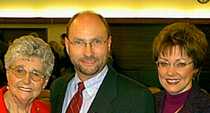
Top: Willard and Betty Thiessen, founders of Trinity Television. Right: Rhonda Glenn, co-host of Crossroads Communications' 100 Huntley Street. Left: Miracle Channel founder Dick Dewert November 13, with his wife and mother, after receiving the Commemorative Medal for the Golden Jubilee of Queen Elizabeth; the award was given in recognition of Dewert's pioneering work in faith-based television.