
December 2002
Christmas in Stalag Luft III
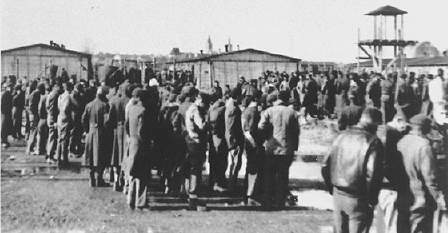
Desmond Montague, a long-time member of St. Paul's Catholic Church in Richmond, passed away in 1998. A prisoner of war during World War II, he wrote the following account of Christmas in a famous prison camp.
SNOW WAS FALLING steadily as we made our way across the compound to attend midnight mass in a small building which served as a theatre. The night was pitch black with intermittent shafts of bright light penetrating the darkness, which did little to benefit one's night vision.
Searchlights were mounted atop the guard towers and were positioned strategically so the rotating beams of light would cover every inch of the prison camp enclosure. The stark contrast between the darkness and the sweeping beams of the searchlights created an illusion generally produced by strobe lights, but in slow motion.
In this situation it was apparent that all of our fellow prisoners were experiencing varying degrees of nostalgia, as memories of past Christmases at home were recalled.
The joyful sounds of church carillons welcoming the faithful to attend midnight mass were replaced here by the booming of Russian guns, now perilously close to our camp.
We were conscious of being under constant surveillance, yet the guards managed to keep a low profile. The dog handlers kept their Dobermans and German Shepherds on short leashes, while maintaining a respectable distance from the motley group of air force officers from Canada, Great Britain, Australia, South Africa, Ireland and New Zealand. It was apparent that this sad-looking group was intent on upholding the solemnity of the auspicious occasion, to commemorate the nativity, the birth of Jesus Christ.
The theatre-cum-chapel was cold and dimly lit. The seats had been fabricated over a period of time by the prisoners, using wood from packing cases salvaged from Red Cross shipments. The rows were tiered in a professional fashion, enabling everyone in the theatre's audiences to have an unobstructed view of performances. The altar was arranged at the centre of the stage. To the right of the altar, near the stage exit, was a piano and bench.
The size of the congregation exceeded all expectations; every seat in the auditorium was occupied. Four seats in the front row were occupied by German officers resplendent in their Luftwaffe uniforms. There were also many last-minute compulsive converts bent on participating in the solemn soiree. Seated prominently near the front of the auditorium were two avowed skeptics whose presence gave credence to the old saying, "There are no atheists in foxholes."
There were four men in the congregation who were particuIarly motivated to attend mass and to offer special thanks to God because of their recent intimate encounter with death. These four were the last escapees to make their way out of the tunnel during the famous 'Great Escape.' Seventy men from Stalag Luft III gained temporary freedom; only three of them made it back to England. Some of the recaptured airmen were placed in other prisoner-of-war camps thought to be escape-proof; these four had been returned to Stalag Luft III after spending a number of weeks in solitary confinement.
The shocking news of the murder of 50 of these escapees was known by all at the camp. German authorities maintained that the men had been shot while evading recapture. It was documented later that Hitler personally gave the order for the execution to take place, and his elite SS corps of assassins murdered the men en masse. The average age of this exceptionally courageous group of air force officers was 23. Their names were posted on the camp bulletin board the day of my arrival at Stalag Luft III. Their deaths were, no doubt, on everyone's minds at the mass.
"In nomine Patris, et Filii et Spiritus Sancti. Amen."
At precisely 12 midnight, the celebrant began the mass with the sign of the cross. It was apparent that the two altar boys, both fighter pilots, needed little coaching in the performance of their duties. Probably less than five years before they had been serving mass in their parish churches back home.
The dignity and the spiritual aura of the mass generated a profound feeling of peace and goodwill among members of the congregation. The frail-looking priest gave a brief sermon, the principal theme being peace and the necessity of praying more fervently for peace. Each time he mentioned the word peace, the muffled sounds of Russian artillery seemed more pronounced, accentuating his remarks. The sermon ended with the plea to "Love God and love your neighbour."
The French-Canadian priest, a missionary belonging to the Missionaries of Africa, had been a passenger on a cargo vessel bound for his mission in Nigeria. The ship had been torpedoed just south of the Azores, and only three men, one of them the priest, had survived the dreadful ordeal. A compassionate U-boat commander had taken the survivors on board. The U-boat proceeded to Brest, its home port, where the three captives were turned over to the naval authorities for transfer to prisoner-of-war camps. Our humble missionary was sent to Stalag Luft III; during his incarceration, he turned down offers of repatriation on two occasions.
During communion, 'Ave Maria' and 'Panis Angelicus' were sung by a young navigator. He had a magnificent tenor voice and was accompanied by a gifted pianist whose wartime occupation was bomber pilot. Holy communion was small pieces of black bread.
The 'Ite, Missa Est' (Go, the Mass is Ended) seemed to provoke a bittersweet reaction. The recessional hymn was 'Silent Night,' sung with gusto and feeling by everyone in the auditorium. The voices of the German officers were distinctly audible above those of all the other singers. 'Silent Night' (Stille Nacht) was their song, having been composed by a countryman, Franz Gruber, 126 years earlier.
The airmen walked back to their huts in silence, so as to prolong the ecstasy of this extraordinary midnight mass.
Glory to God in the highest, and on earth.
Peace toward men of good will.
-- Courtesy B.C. Catholic