
December 2002
Spotlight on Handel's lesser-known works
AS GEORGE Frideric Handel's won-drous Messiah bursts forth from myriad venues this month, it is a good time to consider some of his lesser known works.
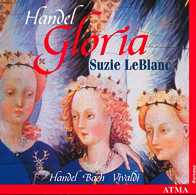 |
• Suzie LeBlanc: Handel - Gloria, Atma, 2001.
The main focus of this CD is Handel -- with music by his two most famous contemporaries, for contrast. Gloria in Excelsis Deo was found in the collection of London's Royal Academy of Music in 2000, and educated speculation places the composition between 1704 and 1707. While some academics have misgivings, the work has been attributed to Handel. It created quite a stir when it was made public last year; The Times of London prematurely hailed it as "the new Messiah." But the work clocks in at only 16 minutes, and has very sparse instrumental accompaniment. Nevertheless, it is certainly of a sufficiently high quality to have been composed by Handel.
Canadian soprano LeBlanc is excellent. While she doesn't have the high profile of some singers, she has garnered a lot of critical respect, and recorded a wide range of material on some 30 releases. She does a fine job with the Handel Gloria, as well as 'Domine Deus,' a lovely aria from Vivaldi's Gloria; and 'I Gladly Eat My Most Humble Bread,' from Bach's Cantata #84. And I guess one can't get away from Messiah entirely: 'Rejoice Greatly, O Daughter of Zion' is one of Handel's hits -- a difficult aria, given a fine performance. The singer is accompanied by the Academie Baroque de Montreal, who also excel on several instrumental pieces.
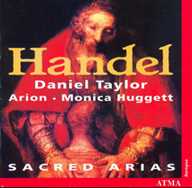 |
• Daniel Taylor: Handel - Sacred Arias, Atma, 2001.
Countertenors aren't generally my cup of tea; call me a purist, but I prefer the natural female voice when it comes to the higher realms of vocalization. However, the use of eerily high male voices is a time-honoured classical practice, and Daniel Taylor is outstanding. These excerpts from Handel's English oratorios -- mostly originally written for female voices -- provide an excellent showcase.
'O Lord, Whose Mercies Numberless,' from Saul, is a comforting tune sung by David to pacify Saul, who is jealous of the praise David has received; 'Almighty Power,' 'Bless'd be the Lord' and 'What Though I Trace,' from Solomon, are celebrations of the building of the first Jewish temple; and 'As with Rosy Steps' is from Theodora -- an oratorio based on a 17th century story set during the early 4th century persecution of Christians by the Emperor Diocletian. And wouldn't you know, Messiah turns up again. 'But Who may Abide,' quietly admonishing at first, gets quite powerful by the final line, which is urgently repeated several times. It's an interesting choice of material, featuring mostly contemplative pieces. Taylor resisted the temptation to do Handel's more bravura arias; clearly, he could easily do very well with the flashier stuff. -- David F. Dawes