
December 2002
Talisman Energy capitulates to Sudan critics
BC Christian News, · International
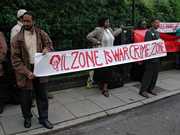
AFTER BATTLING church groups, Sudanese activists and human rights advocates for the past several years, Talisman Energy has finally sold its widely condemned oil operation in Sudan.
The Calgary-based company announced October 30 that it had reached a deal with an Indian company, ONGC Videsh Ltd. Talisman will make a profit of $1.2 billion from the sale. Since 1998; Talisman had owned 25 percent of the oil interests represented by the Greater Nile Petroleum Operating Company.
Critics of the company have long insisted that Talisman has aided and abetted Sudan's hard-line Islamic regime in a vicious war against Christians, animists and moderate Muslims.
"Shareholders have told me they were tired of continually having to monitor and analyze events relating to Sudan," Talisman CEO Jim Buckee stated. He conceded that the criticism directed at the company's activities had had an effect, stating: "Talisman's shares have continued to be discounted based on perceived political risk in-country and in North America to a degree that was unacceptable for 12 percent of our production."
During its stay in Sudan, Talisman has sponsored various humanitarian projects; Buckee stated that the company would continue with those activities.
KAIROS, an ecumenical coalition including Christian Reformed, Presbyterian, Anglican, Mennonite, Lutheran, Quaker, United Church and Catholic organizations, issued a forceful response: "With mixed feelings, KAIROS has received the news of Talisman Energy's intention to sell its assets in Sudan -- a country where oil development is virtually synonymous with civil war and gross violations of human rights, and where foreign companies like Talisman are clearly profiting from armed conflict."
"This has been a long hard struggle, but we knew it would come eventually," said Mel Middleton, a Christian activist working with Alberta-based Freedom Quest International. However, he cautioned: "While we welcome this move, we know it will never absolve Talisman for its irresponsible acts in Sudan. We will continue to press for accountability and for reparations to be paid to the tens of thousands of victims of Sudan's oil fuelled genocide."
On the other hand, Charles Frank, business editor for The Calgary Herald, came to Talisman's defence. Frank extolled Talisman's work in Sudan, and lamented: "One of the few real voices of moderation in one of the world's most discordant, violent countries has been silenced. Of course, that probably isn't what the international coalition of church-led peace activists who have prayed for this day will be saying." Frank contrasted Talisman with the Chinese, Malaysian and Indian companies still remaining in Sudan, asserting: "You can bet their chief executives won't be asking for a sitdown with Sudanese government officials to talk about building hospitals, funding orphanages or offering other kinds of humanitarian aid -- as Talisman did during its four-year stint -- in the war-ravaged south."
A follow-up Calgary Herald editorial, however, painted a somewhat less flattering picture of the company. Insisting that "anything for a dollar cannot be the highest principle of capitalism," the editorial asserted that income generated by Talisman and other oil companies "[has] financed the National Islamic Front government's genocidal war against non-Muslims living in the south of the country. Talisman did nothing illegal, but with (by some counts) more than 2.5 million people killed by the regime and an additional five million displaced, one must wonder what kind of discussion took place in the boardroom."
Talisman, KAIROS maintained, "has blatantly walked away from its responsibilities in Sudan. Had Talisman listened to church and other shareholders, and properly incorporated a human rights framework into its business plan, it might have played a constructive role in transforming oil development into a force for peace -- rather than the instrument of death it has become.
"Talisman often claimed that another oil company would be less inclined to respect human rights in Sudan. But it is difficult to imagine abuses more serious than those already being committed by Sudanese government forces in concessions licensed to Talisman. According to reports issued by independent human rights experts, violations included attacks on civilians by helicopter gunships re-fueled and re-armed on airstrips on Talisman's concessions, and the forced displacement and killing of people in concession areas under exploration."
KAIROS also dismissed Talisman's much-touted humanitarian initiatives. "Despite the company's stated commitment to fund community development projects through to 2005, expert analysis has demonstrated that the projects were of little benefit to southern Sudanese anyway, and were engineered more as a public relations ploy by Talisman."
Middleton stressed the fact that Sudan's problems are far from solved. "The oil-driven scorched earth policies of the government, of which Talisman was a key financer, will continue. But it will do so without the moral cover being provided by Talisman Energy."
He also decried what he perceived as negligence on the part of mainstream news outlets. He asserted that a variety of atrocities, including the bombing of hospitals and attacks on feeding centres, "have all been considerably under-reported or virtually ignored in the Canadian press -- which has chosen, instead, to focus more on whether Talisman was going to sell its holdings in the country." More detailed reporting on Sudan, he said, "would have embarrassed Talisman energy -- so the media has kept it quiet."
"Irrespective of its apparently lucrative departure," KAIROS concluded, "Talisman will not disappear from the watch list of responsible investors. Civil litigation on behalf of Sudanese displaced from the oil fields is ongoing in the U.S. Activists and lawyers in the U.S. and Canada are apparently exploring whether Talisman executives and board members could eventually be charged with crimes against humanity."