
January 2003
Meeting the 'cargo cult' chief
SIXTEEN years ago, while living in the Lower Mainland, I was hired to haul a load of garbage to the dump.
Part of the load was an old box of books. I decided to keep them, not knowing that one would change my life forever. I took them home, and later that winter threw them in the fireplace for fuel. My wife Abby, noticing that they were old, quickly ran and saved some from the fire.
One of these books was a rare original copy of the autobiography of missionary John G. Paton, published in 1889. I immediately started reading it, marvelling at the sacrifice and courage Paton's life displayed.
Paton and his family arrived on the island of Tanna in Vanuatu (formerly New Hebrides) in 1858. His wife Mary Ann and their infant son died of malaria only four months after arriving. In spite of his great loss and constant danger from cannibals, Paton stayed to share the gospel. I read his inspiring story many times, and often dreamed of retracing his footsteps.
In June 2001, my dream came true. Abby and I were planning to celebrate our 20th wedding anniversary in Hawaii -- but at the last minute, we decided to go to Vanuatu.
This 83-island nation is in the South Pacific, between Fiji and Australia. More than 100 languages are spoken among the population of about 190,000.
Upon arriving on the island of Tanna, we hired a guide to take us to Port Resolution, where Paton had been stationed. I was looking for the graves of his wife and son, but no one knew where they were.
After some exploration, I found a man fishing from the shore of a bay. He said he was Chief Narua of Port Resolution. He took us to the graves -- which were at the end of an overgrown, unmarked trail.
I told him a story of how angels had protected Paton, and mentioned that the great Chief Nowar, Paton's most trusted friend, had saved his life many times.
Chief Narua was very excited and told us he was the great, great grandson of Nowar. I told him I would return in two years with a copy of Paton's book. Later, my guide and interpreter Philemon said: "Send me the book, and I'll read it to him. He'll be dead in two years." When I returned to my home in Crawford Bay, B.C., I sent the book.
Last September, I felt called to go back and give out Bibles written in Bislama (their common language). We had seen the need on our first visit. We had already started a fund with a quarter that Abby found on the ground. God multiplied it -- through our community, Sunday school, interested friends and churches from far and near -- to more than $7,600. After purchasing 705 Bibles from the Bible Society of the South Pacific, I was off to Tanna.
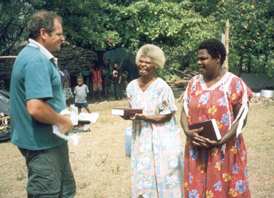
The native pastors exclaimed with joy: "This day, September 28, 2002, makes history. Never before have Bibles come for free to this island." There was much excitement, because the people are very poor.
I learned that Chief Narua had died the month before. So I sought out Philemon to ask if he had read the chief the Paton book I had sent. He said Narua's son Werry had read it to him.
Werry told me his father had given his heart to the Lord after hearing the Paton story. Chief Narua's last words were: "There must be a church built in Port Resolution and everyone must go to church." The last church blew down in 1910 and had never been rebuilt. A few Christians now meet under a tree and are praying for a building.
Before becoming a Christian, Chief Narua was a member of the Jon Frum Movement, one of the so-called 'cargo cults.' This group originated during World War II, when U.S. Marines came to the island. These materially poor natives saw the great wealth of the West, and coveted it for themselves.
They believe their hero, Jon Frum, will return one day with cargo for them. It is unclear who he actually was. The people believe Jon Frum's spirit lives in a live volcano on Tanna, with thousands of other spirit followers. Every Friday night, there is a ceremony to worship Jon Frum. Approximately 5,000 cargo cult members are centred around the Tanna volcano.
I was warned that if one went unannounced to the cult area one could be arrested by their security personnel. So I appealed to a local leader. He informed me that a visit was impossible; he said the cult's leader, Chief Isaac Wan, was completely closed to the things of God.
But I knew God wanted me to go, and when a local pastor said he would take me, I quickly said yes. I expected a breakthrough, because many people were praying back home.
We went unannounced to Wan's village at the base of the volcano, where the ash constantly falls and the ground shakes violently. Upon arrival, security people met us and children said they would take us to the chief in the jungle, for he wasn't at home. The suspense built, as we waited to see if he would appear.
After some time, he came -- with a friendly smile and a gracious greeting. He invited us back to his village. We were taken right into his grass hut, to the astonishment of everyone. He promptly gave me a gift. I was able, through my interpreter, to share my faith. I prayed with him, and told him how I had met Chief Narua only one year before. Then he shared his philosophies of life with me, while everyone listened intently.
I had previously wrapped up a Bislama Bible to present to Narua. When I learned of his death, I knew God had chosen someone else to give it to. Days before visiting Chief Isaac Wan, I had felt in my spirit that the Bible was for him. He joyfully accepted it. As we left, he was smiling -- and his son said he would like to go to church next Sunday.
The native pastors later commented about the chief: "This has never happened before. You can now go see him any time that you like. He is now your friend."
Looking back, I find it amazing that a book destined for the dump led to such an extraordinary demonstration of God's power.
Dave and Abby Dever are planning another trip to help the poor of Vanuatu next November. For more information, contact them at devers@telus.net or Box 33, Crawford Bay, BC V0B 1E0.