
January 2003
Two Towers: a spectacular fight for survival
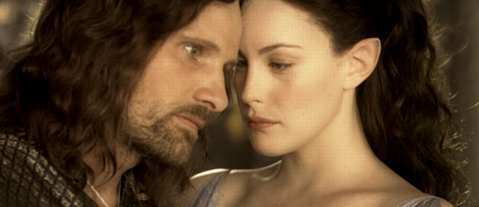
HORSE LOVERS will get a huge kick out of The Two Towers, the second installment in Peter Jackson's adaptation of J.R.R. Tolkien's fantasy trilogy The Lord of the Rings. Unlike the first film, which was mostly about hobbits and wizards, the second film is largely about humankind and its fight for survival -- and our heroes spend a great deal of time surrounded by equine iconography in the besieged kingdom of Rohan, and bonding with the steeds they ride.
Both films are marvels of high-tech movie-making, but they also reflect a deep love of natural beauty, from majestic animals to snowcapped peaks. The breathtaking New Zealand scenery far surpasses the synthetic backdrops we have come to expect from, say, the Star Wars and Harry Potter films.
Towers also highlights the environmentalist aspects of Tolkien's books: Saruman (Christopher Lee), the rogue wizard who has allied himself with the dark lord Sauron, openly talks of consuming the natural world "in the fires of industry" -- and his devastation of the forest inadvertently puts him at odds with the Ents, a species of ancient living trees.
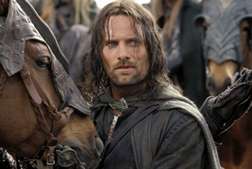 |
The battle at Helm's Deep, which closes the film, is a thrilling setpiece graced with moments of comic relief. But there is something about the simple moral dimensions of this battle -- humans good, orcs bad -- that perhaps should give us pause in these war-on-terror times. There is friction between humans, dwarves and elves; however, if the heroes have any dark tendencies, these can usually be blamed on someone or something else -- Sauron's Ring, Saruman or whatever.
The one person in this film who wrestles with inner demons as much as outer ones is Gollum (Andy Serkis), the pitiful creature who once owned the Ring and now wants it back. Hoping to snatch the Ring for himself, he offers to guide Frodo (Elijah Wood), the hobbit who now bears the Ring, and his friend Sam (Sean Astin) into Sauron's realm, which is the only place where the Ring can be destroyed. Sam is suspicious, but Frodo puts up with Gollum out of empathy -- he can feel the Ring corrupting himself, too, and he hopes it is possible to be redeemed from its evil influence.
There is, of course, something to be said for characters who embody the best virtues -- and one of the reasons I, for one, keep returning to these stories, is because I consistently leave them wanting to be a better person.
Fortunately, Jackson is as good a director in the film's more character-driven moments as he is in its more spectacular scenes -- and despite the greater liberties he takes with the story this time, The Two Towers could well leave you itching for the final chapter. 14A
THERE ONCE was a time when Australian director Bruce Beresford was associated with powerful political and spiritual dramas like Breaker Morant and Tender Mercies. Lately, however, he's been making films like the boilerplate revenge thriller Double Jeopardy, as well as smaller films which reduce their subjects to easily digested character types. His latest, Evelyn, is one of the latter -- a feel-good, crowd-pleasing, Capra-esque dramatization of a landmark Irish court case.
Set in the 1950s, Evelyn tells the story of Desmond Doyle (Pierce Brosnan), a single, out-of-work father whose children are taken from him because neither the state nor the church believe he can meet his children's needs. Determined to get his children back, Desmond sues the government. Since we all know he's going to win in the end, Beresford wisely avoids inflating the film with fake dramatic tension; instead, he fills it with humour, so much so that it is almost a comedy.
The film doesn't clarify how involved the Catholic church was in setting up the law Desmond challenges; but the individual priests and nuns we meet seem like decent folk, except for one token hypocrite. Rather than pit Desmond and his family against the church as a whole, Beresford -- whose films have often reflected a religious sensibility -- portrays the Doyles as devout Catholics who critique the authorities by appealing to the church's most foundational beliefs.
At times, especially whenever Desmond's daughter Evelyn (Sophie Vavasseur) looks at the sunlight and sees "angel rays," the film has an artificial, saccharine quality that undermines whatever lessons it is trying to teach us about history and family. But if you're prepared to just sit back and enjoy the show, Evelyn isn't the worst way to spend a couple hours. G
More reviews at www.canadianchristianity.com/film