
February 2003
Is another Gulf War inevitable?
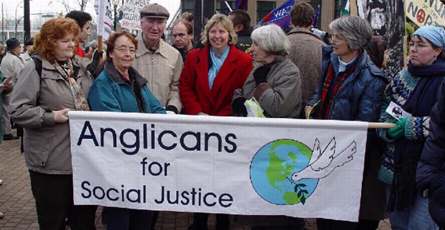
THE POSSIBILITY of another Persian Gulf War has been on a lot of people's minds lately, as America and Britain continue to build up their forces in the Middle East.
Acting on the assumption that Iraqi dictator Saddam Hussein has direct connections to the Al Qaeda terrorist network, president George W. Bush and prime minister Tony Blair insist that war against Iraq is unavoidable if Western countries are to be protected from terrorist attacks. With equal vehemence, opponents of the buildup insist that United Nations weapons inspectors be given more time to search for proof that Iraq is hiding weapons of mass destruction. Christians have weighed in on both sides of the issue.
"We believe that renewed war on Iraq will not deliver lasting disarmament," the Canadian Catholic Bishops' conference stated January 23. "War is most likely to deliver more of what it always does -- lost lives, environmental destruction, physical and psychological damage for both victims and aggressors, wasted resources, threats of widened political instability and increased terrorism, more hatred, and re-energized extremism."
On the other hand, several key American evangelicals -- including author Charles Colson, Campus Crusade for Christ founder Bill Bright and Richard Land of the Southern Baptist Convention -- have pledged their support to Bush. Several months ago, they sent the president a letter stating:
"Disarming and neutralizing Saddam Hussein is to defend freedom and freedom-loving people from state-sponsored terror and death . . . Further delay in forcing the regime's compliance would be reckless irresponsibility in the face of grave and growing danger."
Pre-emptive strike
In Christianity Today, Colson recently wrote: "Had the allies had the weapons, would a pre-emptive strike against the Nazis have been justified before they overran Poland? In hindsight the answer is clear, as it was to the Christian pastors who were executed for conspiring to kill Hitler . . .
Colson concluded: "As Christian scholar Darrell Cole writes, 'The Christian who fails to use force to aid his neighbour when prudence dictates that force is the best way to render that aid is an uncharitable Christian. Hence, Christians who willingly and knowingly refuse to engage in a just war . . . fail to show love towards their neighbour as well as towards God.'"
Colson's view is shared by Christian commentator Andrew Sullivan:
"It's important to remember why we're fighting Saddam. The answer is September 11. Those who want to find some specific evidentiary link between Al Qaeda and Saddam don't begin to fathom what war is. It is not the pursuit of one distinct goal after another, depending on the exigencies of international law or diplomacy. That's called foreign policy. War, in contrast, is the attempt to destroy an enemy. The enemy is Islamist terrorism and its state sponsors.
"Strategically, the overthrow of the Saddam regime is absolutely central to this objective. It will deal another psychological blow to the reactionaries who want to ratchet Islam back a few more centuries and wage war on the free societies of the West. It will remove one huge and obvious source of weapons of mass destruction potentially available to the enemy. It will provide a military base from which to continue the war against Al Qaeda . . . and it will reassert the global hegemony of the United States and its Anglosphere allies. That's why we fight."
Christian support for the war is not limited to American evangelicals. Donald Demarco, a Catholic professor of philosophy at St. Jerome's University in Ontario told The B.C. Catholic: "The U.S. is at war with terrorism, with Al Qaeda, and indirectly with Iraq. The UN has agreed there is a war against terrorism, as well as against those who shelter it."
Further, Demarco maintained that the U.S. president "is taking pains to corroborate his very, very strong suspicion that Saddam Hussein has nuclear weapons that he plans to use. He has been objective enough to allow the UN to begin inspecting Iraq -- so I think it is premature, if not unfair, to accuse Bush of being a hawk, of initiating an unjust war."
Regarding the fact that so many people are virulently opposed to Bush, and appear to be giving Hussein the benefit of the doubt, Demarco commented: "Saddam has used chemical warfare against people in his own nation. What has Bush done that parallels the treachery of Saddam?" To those who oppose war on the grounds that civilians will be massacred, he responded: "Innocent children will be killed if Iraq uses nuclear or chemical weapons or germ warfare."
Christian opposition
Despite such sentiments, however, most high-profile Christians who have made public statements -- ranging from evangelical author Tony Campolo to Anglican archbishop Michael Peers -- have expressed opposition to the war. Some evangelicals find it troubling that the push for war has any Christian support whatsoever.
James Kwantes, who travelled to Iraq in 1999 as an Abbotsford News reporter with a Mennonite Central Committee peace delegation, reflected upon the current situation in a recent issue of the Christian Courier:
"This Christmas, Chaldean Catholics and evangelical and Armenian Christians in Iraq celebrated the birth of the Christ child with the shadow of war looming over their country, again. Meanwhile, conservative Christians in the United States interspersed prayers for 'peace on earth' with prayers of support for their Commander-in-Chief, himself a Christian, who spent the Christmas holidays sending troops, fighter jets, battleships and aircraft carriers to the Persian Gulf."
Kwantes' concern is shared by Ken Marr, a U.S. citizen living in Victoria, who has been especially disturbed by some American media outlets. "On Republican Radio . . . . you can listen to pro-war rant by Oliver North and other hosts, interpersed with anti-abortion announcements, and invitations to visit Seattle area churches. It is truly bizarre to listen to." Marr contends that some facts are being obscured in the current rush to war.
"While Saddam Hussein is without question a person who has committed tremendous evil, he has done so with the direct assistance of Western countries that have sold him weapons and all of the ingredients used for chemical, nuclear and biological weapons."
"This war is a completely manufactured 'crisis' to re-establish American control of the oil fields of Iraq," stated Lynn Wytenbroek, a professor of English at Malaspina University College, who chairs the Malaspina Faculty Association's Human Rights Committee.
"There is no way, as biblical people or even simply moral human beings, that we can condone the deaths of even one person, let alone the mass destruction of the hundreds of thousands of Iraqis who have already been killed, over greed . . . This is simply a war about greed and power, two of the three temptations Satan faced Jesus with in the wilderness."
Christian opponents of the war increasingly question the justifications being given for the current buildup.
"There's a case for preventive military action," Trinity Western University (TWU) political science professor John Redekop said. "Saddam is a threat -- that's clear. Some suggest that he's behind the attack on the World Trade Centre; but there's no evidence of it, that I've seen -- just conjecture."
Further, he said, "I haven't seen clear evidence that Iraq is marshalling weapons of mass destruction."
Regarding whether the U.S. would act against Iraq without UN authorization, Redekop cautioned: "That would be seen in much of the Islamic world as a war between Islam and Christendom."
"The U.S. case against Iraq is riddled with fallacies, unproven assertions and outright deception," declared Kwantes. "There are no documented links between Al Qaeda and Iraq, and Osama bin Laden has professed his hatred for Saddam Hussein -- whom the Al Qaeda leader regards as a secular and despotic hypocrite who shamelessly uses Islam for political purposes."
"Bush's argument for a just cause is quite weak since he is essentially calling for a pre-emptive strike," stated Mark Charlton, TWU professor of political science. "While admittedly the regime in Iraq is odious and needs to be watched carefully, there is little evidence that Iraq poses more of a threat than it did three or four years ago."
Just cause?
Increasingly, Charlton says, "President Bush goal seems to be 'regime change' in Iraq and he is willing to use the threat of war to bring about such change. Unfortunately, this sets a bad precedent for the international community. Do we threaten to invade the territorial sovereignty of every regime that we do not like? If we claim this right for ourselves, how we can deny it to others?"
"The proposed U.S. war against Iraq cannot, under any circumstances, be considered a 'just' war," contends Wytenbroek. "Indeed, it cannot even really be considered a war, as a war requires two reasonably equal opponents. At very best, this can be considered a military invasion by a large, powerful aggressor against a foe that has little or no means of defence."
Iraq, she insisted, "certainly does not have any resources now, after 12 years of constant sanctions and bombings that have left a largely prosperous, middle class country decimated."
She added, "Even if Saddam Hussein is harbouring any weapons of mass destruction, he is watched too carefully by the international community to ever be able to use them . . . Any use of such weapons would bring instant retaliation against Iraq of a magnitude that would annihilate the country. Saddam may be a bad man, but he is not stupid."
"American military doctrine," Charlton said, "has shifted towards a position that American military engagement should take place only if there is a preponderance of force which will minimize American casualties in order to limit the political fallout. This leads to a strategy of warfare which seeks to inflict massive casualties on the opponent -- often done from a distance, with remote control. This should raise troubling ethical questions for Christians in North America."
The worldwide church, Wytenbroek said, "in all its denominational varieties, should unite to speak out against the war publicly. . . . After all, we say we worship the Prince of Peace. So we need to act on that faith and speak out for peace, especially against so heinous a war. As individuals, we must do whatever we can to impede the war effort, from peace marches to civil disobedience."