
March 2003
Prof wins upstream battle in fish technology
BC Christian News, · Top Stories
TWU chemistry professor helps develop microscopic detection system for determining fish-hatchery stocking success.
By Diane Coulter
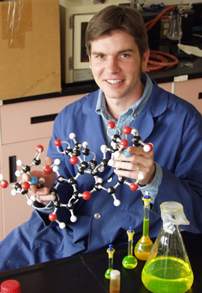
TYING helium balloons to fishes' fins might sound more like folklore than science, but it is a documented method used by U.S. Fish and Wildlife Service scientists of yesteryear to track the migration route of salmon.
While technology for tracking fish has improved over time, current methods of clipping fins or placing metal wires in the snout remain expensive, time consuming and invasive. However, with help from Trinity Western University chemistry professor Chad Friesen and a group of upper-level students, fisheries managers will soon have access to a revolutionary procedure for detecting hatchery fish after their release.
It began in Pennsylvania in 1995 with the invention of a device which resembles a flashlight with a box at one end. Biologist Jerre Mohler of the Northeast Fishery Center in Lamar, Pennsylvania, designed the detection device so that when aimed at fish that have been imprinted with a chemical dye, the fish fluoresce, or glow, with a green tinge.
Western Chemical Inc. of Ferndale, Washington, was immediately interested in manufacturing the device commercially and turned to TWU's Chad Friesen to produce a chemical that would be harmless, inexpensive to reproduce and invisible to the naked eye once attached to the salmon.
With an industrial chemical background, Friesen was familiar with taking a target molecule, synthesizing it, and developing a large scale process to reproduce it. But with a heavy teaching load and other projects in the works, Friesen needed some assistance. "Over the course of this two-year project, Western Chemical has paid to have four students work with me in order to speed up the delivery time," Friesen says. "Our goal was to find a fluorescent tagging compound that was 99.99 percent pure and then make enough of it to tag a million fish."
The student workers were disheartened with the lack of immediate success. "Our first few submissions were complete failures," says Friesen. "The chemical didn't 'stick' to the fish."
But as a former top scientist with Dupont, Friesen knew that setbacks are par for the course, and the challenges associated with the project gave him an ideal opportunity to mentor students and help them cope with a difficult task.
"Even when you're dealing with a long term project you have to find satisfaction in what you're doing every day. You need to see that self-esteem comes from other places, and not from one particular project," Friesen says.
Friesen and his team eventually discovered that, when triggered by the flashlight device, the right chemical compound would bind harmlessly to the calcium found in fish scales and then either fluoresce or emit a defined wavelength of light.
Western Chemical is currently waiting for FDA approval on the compound trade named Se-Mark. For the moment Friesen is able to turn his attention to other projects, but with the commercial market already clamouring for the chemical, he is anticipating requests for different 'tag' colours for use with other aquatic species.