
April 2003
Obscure Easter musical gems
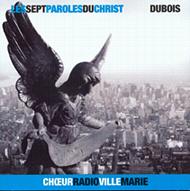
• Simon Fournier: Dubois -- The Seven Last Words of Christ, Fidelio Audio, 2002.
 |
ONCE a notable figure on the French classical music scene, Theodore Dubois (1837 -- 1924) was eclipsed by the likes of Saint-Saens, Faure, Debussy and Ravel.
Dubois, a prolific composer and versatile composer, is best remembered for this Good Friday oratorio. Created in 1867, it was performed at one church annually, for almost a century. It's easy to see why: it's a gem.
The piece combines the recorded sayings of Jesus on the cross with meditations on those seven concepts. Highlights include the 'First Word' ("Father forgive them, for they know not what they do"), which is enhanced by the effective use of the choir, portraying the crowd calling for Jesus' blood; and the 'Third Word' ("O woman! here behold thy beloved Son"), during which the soprano soloist sings Stabat Mater, the time-honoured lament for Mary as she watches the crucifixion. The piece is accompanied only by an organ, providing a very spare and sombre -- but still inventive -- atmosphere.
Quebec conductor Simon Fournier coaxes fine work from the Radio Ville-Marie Choir and organist Regis Rousseau. The outstanding soloists, demonstrating strength and sensitivity, are tenor Marc Hervieux; baritone Gaetan Laperriere; and soprano Monique Page, who is especially affecting.
• Les Talens Lyriques: Leo -- Miserere, Decca, 2002.
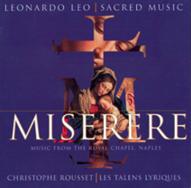 |
Leonardo Leo (1694 - 1744) was maestro di cappella for the chapel of the royal court in Naples. Among other things, he composed operas; but in the final years of his life, he focused mainly on sacred music, such as these contemplative works for Ash Wednesday, Lent, Passion Sunday and Good Friday. Melodically and harmonically rich, they feature long solo passages counterbalanced by ensemble singing employing polyphony.
Throughout, Christophe Rousset ably directs his Les Talens Lyriques early music ensemble, featuring five vocalists -- who excel as soloists, and also blend especially well in the sections featuring polyphony.
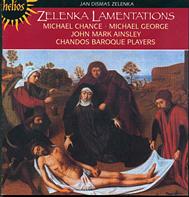
• Chandos Baroque Players: Zelenka -- Lamentations, Helios, 2002.
 |
Czech composer Jan Dismas Zelenka (1679 -- 1745) had his admirers -- including J.S. Bach. Like Bach, Zelenka fell into obscurity by the 1730s. But unlike the staunchly Lutheran Bach, Zelenka wrote church music in the Catholic tradition.
The compositions on this CD are based on the Lamentations of Jeremiah, which focus on the destruction of Jerusalem. In keeping with his Jesuit spirituality, Zelenka emphasizes the elements of repentance and conversion. The prophet's cry to the chosen people, to "turn to the Lord your God," is here used to draw the listener to Christ.
This cycle of three Easter compositions features two-part Lamentations for solo male voices. The Maundy Thursday and Good Friday Lamentations are suitably sombre; they are in a minor key, and the bass soloist conveys the gravity of repentance. The Easter Eve Lamentation, however, is in a major key, which conveys a distinctly upbeat feel; and the high tones of tenor and countertenor emphasize the soon-coming resurrection.
The CD showcases the superb talents of tenor John Mark Ainsley, bass Michael George and countertenor Michael Chance.
• The Cathedral Singers: Carla J. Giomo -- Were You There? GIA Publications, 2003.
Those who prefer a more contemporary Easter experience should check out this new release. GIA describes Carla Giomo's work as "a new service for Holy Week," designed as a "meditation on the life and death of Jesus." It combines passages from Luke with choral versions of spirituals and hymns. The CD also features the composer's Vespers.
The Risen Christ is the guiding principle behind this CD by the Canonesses of the Holy Sepulchre in New Hall, England. Among other things, Eternal Light (Deutsche Grammophon, 2001) features chants for the Easter season; the CD was a hit, rising to number two on the UK pop charts. The nuns' perspective is summarized thus: "The gospel account of the resurrection tells us of the women who were the first to be made aware that Christ had risen, and were the first to be sent to take that message to others. This is the tradition to which we owe our spirituality as a community, and we seek to follow in the footsteps of those women." Contact: www.newhall.org.uk