
May 2003
Christian hero worship and the celebrity platform
BC Christian News, · Top Stories
IF THE Christian community in North America had a public relations manager, she would be working overtime this spring.
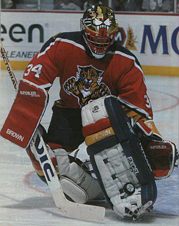
The faith has gotten some bad press lately. The most glaring example is ex-NHL goalie (now ex-junior hockey coach and team owner) John Vanbiesbrouck.
In March, 'the Beezer' gave up his spot as bench-boss of the Sault St. Marie Grey Hounds when the public learned that he had used the 'N-word' -- an action commonly known in sports circles as 'dropping an N-bomb' -- when referring to black team captain Trevor Daley as a "nigger."
Vanbiesbrouck is one of a handful of professional hockey players who have been very public about their faith. But the goalie who won the Vezina Trophy as the leagues top goal tender in 1986 has now shelved the role-model badge he wore so well up until that day.
This isn't to say he just woke up one morning and decided to spout racial slurs -- we can't really know what's inside his heart. But the world knows what came out of his mouth. And now the phrases 'devout Christian' and 'racial slur' are being linked together behind Vanbiesbrouck's name in newspapers and TV broadcasts around the world. In fact, mainstream media rarely mentioned the goal tender's faith . . . until now.
Miami Herald writer David J. Neal started his March 11 column by saying: "Monday, I heard many people point out that former Panthers goalie John Vanbiesbrouck is a devout Christian, as if to show religion's hypocrisy. I could only think that Ku Klux Klan members think of themselves as devout Christians, too."
Within the Christian community we quickly embrace celebrities as leaders and role models because of the notoriety they've achieved. In a lot of cases, that connection has merit.
Markus Naslund isn't a cheap-shot artist, so we point at him and say to our kids: "Do what he does." We do this not simply because he says he's a Christian, but because he's showing how a Christian can succeed in a brutal game without, well, being a brute.
However, we also embrace Christian celebs because of who they are in society's eyes. Often, the deeper issues of faith and the person are ignored. In those cases, the person becomes a figurehead, a brand spokesperson.
How the faith of the basketball player, the race car driver, the rock star, the actor or the director has positively influenced the world around them is only a second thought to the greater notoriety, greater legitimacy that comes from associating their names with our camp. They've made it, so there must be some element of their faith that has been instrumental in propelling them into the limelight, right?
Only when a celeb does something negative, something that makes headlines (as in the Beezer's case) do the real discussions of character, commitment and redemption often take place.

The community has touted a long list of celebs that have become Christians or rededicated their lives in adulthood -- Bono, Alice Cooper, Jane Fonda, Deon Sanders and Evander Holyfield are a few recent examples. And while some of those names truly exhibit the life-changing power that comes from making that commitment, others are standing on shakier ground.
For instance, March 29, Planned Parenthood -- a multimillion dollar organization that fights for abortion rights -- presented Jane Fonda with the Margaret Sanger award, the group's highest honour, for her dedication to the cause.
While Fonda's highly publicized decision to accept Christ at a Baptist church in Atlanta has made her a natural example of Hollywood 'redemption,' the actress's continued ties to a cause that goes against what most evangelicals consider a fundamental of the faith will confound the general public. To further muddy the waters, an American pro-life organization released a statement that callously referred to Fonda as "Hanoi Jane" ( a moniker she was pegged with after her 1972 visit to Vietnam as an anti-war protester) -- proving that they weren't above taking public potshots at a fellow believer.
While Fonda is linked to Planned Parenthood, former heavyweight champ Evander Holyfield is linked to unplanned parenthood -- of the extramarital kind. As a result, any preaching coming from his corner now falls on deaf ears.
Dave Klassen, national pro-director for Athletes in Action, knows a lot of sports stars on a first-name basis. Klassen is chaplain for the BC Lions, and also played that role with the Vancouver Grizzlies before the team left town.
He says everyone -- pastors, teachers, athletes, actors -- has a platform to speak from. Some have bigger audiences than others. Problems arise when celebrities, trying to live up to the extreme pressures to perform in both the private and public aspects of their lives, begin to compartmentalize each area as a coping mechanism.
Klassen refers to these compartments as "pockets" or "life circles" that people draw around their faith, their job, their family life,their friendships, hoping that the circles won't cross too much. "It's not good enough to be a basketball player who is a Christian," he says. "The guy has to be a Christian who happens to play basketball. There's a difference."
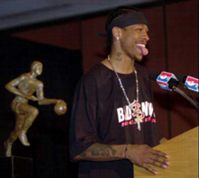
The chaplain says there was a lot of hoopla when Allen Iverson-- the talented NBA point guard who has had numerous run-ins with the law during his career -- sported a 'What Would Jesus Do' (WWJD) bracelet on the basketball court. "People were saying 'Allen Iverson became a Christian, Allen Iverson became a Christian,'" he recalls. After a call to a colleague, Klassen learned that an NBA chaplain was handing out the bracelets, and Iverson simply decided to put one on.
In many ways, those popular bracelets signify the difference between the selling of the gospel and the personal life-changing role of a person's faith. A player can wear it on the outside, like Nike shoes or Bauer skates, and the brand recognition -- the linkage between the successful athlete and Christ -- is there. It's the easiest thing in the world to do, really. But making a deeper connection between Christ's power in one's life and the way it influences every aspect of a person's character is not such a simple matter.
When it comes to the double-edged sword of cultural relevance, the Christian community walks a fine line. We want everyone to hear the gospel, to be changed for the better by it. And in our world, sports and mass media heroes have a voice that echoes into nearly every corner of society.
That voice, however, is moot -- if the person doing the talking is merely a spokesman for the 'product.' And if a celebrity is peddling a product, our admiration for that person is merely hero worship.
Yet, when our community focuses on the steak instead of the sizzle, we can stand behind our celebs when they, as Klassen aptly puts it, "use their platform as a form of worship."