
July 2003
Book details ties between past sins and present woes
BC Christian News, · Top Stories
IT SEEMED simple enough at the time.
Faytene Kryskow and her friends at the Vancouver House of Prayer started out compiling a few research notes on the history of Vancouver, as a way of gaining a better understanding of the city they were constantly praying for. They had no idea of the wealth of material that would aid their cause. After a quick tour through City Hall, newspaper archives and history books on the region, Kryskow came up with enough information to fill more than 110 pages.
Vancouver: Notes for Informed Intercession, now in its fifth printing, details the people and events that have formed what Kryskow believes to be the spiritual framework of present-day Vancouver.
The self-published book is really a combination of notes on events and people, and commentary on why they were significant. The book also identifies areas that Kryskow calls "repentance points," which she and her cohorts believe need to be addressed.
"Vancouver and B.C. are an entire region founded on a 'taker' mentality . . . Everyone that came here in the beginning was asking 'what can I get? The gold rushers [and] fur traders all had a spirit of avarice," says Kryskow of one of the more prominent themes in the area's history. The greed and racism that overshadowed the city's early days are two main elements that have borne negative consequences for decades.
Kryskow points to the 'anti-Asian' riots of 1907, where an angry mob of Caucasians -- estimated as large as 15,000 -- descended on both Chinatown and 'Japtown' (as it was called then) and destroyed businesses, as an example of hatred that has had lasting effects on the evolution of Vancouver.
The good, bad and ugly are laid out in a detailed 10-page timeline that starts with Musqueam and Squamish families populating Burrard Inlet (pre-1774 exploration) and continues through to the B.C. Liberals apologizing to First Nations for how they have been treated (2003).
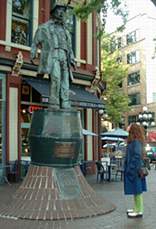
In between is everything from 'Gassy Jack' Deighton's first saloon license to General William Booth, founder of the Salvation Army, visiting the city in 1895.
The book also has its whimsical moments, such as a page titled 'Things That Make You Go Hmmmm . . .?' Some sample entries:
"The Vancouver Fire . . . breaks out by a 'freak squall' at the exact same time that 5,000 natives are gathered just across the inlet to dedicate the new church building there. The church had been built two years earlier and [was] already in use. For some reason they waited until June 13th, 1886 to dedicate it, and the fire breaks out . . . not the same day only, not the same week only . . . but at the exact same time. Hmmmm . . .
"The first city murder happens in Gastown in 1868. Most murders today in the city happen within a 6 -- 10 block radius of this location. Hmmm . . ."
"This information will help the church to pray with focus and target areas that have been resistant to the light of God," writes Sara Maynard, director of Vancouver House of Prayer, in her introduction to the book.
In a section called 'The Bad News: Ungodly City Themes and Repentance Points,' Kryskow lists specific examples of greed, extreme racism, idolatry, injustice towards the poor, blatant immorality, spilled blood and misogyny that have to be addressed by present and future generations.
Dealing with racism, Kryskow does see a silver lining. She points out that her research really impressed upon her the fact that Vancouver was founded by two major immigrant populations. "God put the Chinese and the British here at the same time so that we could walk together," she says, adding that she used to think that the Chinese only started coming here in the 1970s.
Intercession and 'spiritual mapping' are both terms that charismatic Christians are more comfortable with than those who belong to other wings of the church. But Kryskow says the idea of making amends with the past is something which resonates with all Christians, regardless of one's denomination or worship style.
"On a base level, as a church, we are called to make things right. That's the definition of justice," she says. "I just want to stress that this [history] matters. We know that we are living on the foundations that have been laid by the past."
And the history books are not just full of negative events. Kryskow says Vancouver's first church building, Union Church, was built cooperatively between Methodist missionaries and natives.
A feature of that church was its 'revolving pulpit,' where Presbyterian, Methodist and Anglican pastors took turns preaching. "We started it right,"she says.
To obtain a copy of the book, contact: 604-737-7455 or fkryskow@yahoo.ca