
July 2003
Christians tackle B.C. cutbacks
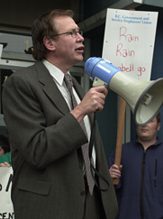
THIS PAST month, the B.C. government backed off from plans which would have affected some of its most vulnerable citizens. According to various reports, the government had been considering cutting an estimated $222 million next year, from programs benefitting abused and disabled individuals.
Since taking office in 2001, premier Gordon Campbell and his government have initiated a program of radical reform and budget cuts, primarily to health care, education, welfare, and legal aid. The cuts will amount to an estimated $3.6 billion over three years. Many Christian observers believe the government has a blatantly anti-poor, pro-business agenda. Others, however, maintain that the Liberals' economic policies represent good stewardship.
The .B.C. Liberals, said Robert Kissner, "have embarked on a social experiment, with few safeguards other than rhetoric. I think their approach to cutbacks is essentially dishonest. There's been no debate, no review by any professionals -- and in fact, they've ignored the advice of the best professionals, especially in the area of human resources."
Kissner, who attends St. John's Shaughnessy Church in Vancouver, is president of the B.C. Association of Social Workers. He spoke June 20 at a rally co-sponsored by the B.C. Government Employees Union. The purpose of the gathering, held outside the office of Family and Child Development minister Gordon Hogg, was to protest the layoffs of 25 auxiliary child protection workers.
Impact of cutbacks
"People are suffering and dying because of lack of access to medical services," said Robert Goos, chair of the Faith and Society Committee of the Evangelical Lutheran Church in Canada. Churches and other nongovernment agencies, he added, "are experiencing greater demand for help."
Henry Bucher of Vanderhoof NeighbourLink Food Bank echoed these concerns. "Every town and city is experiencing significantly increased demand on the food bank. People with no income are now showing up, as are seniors -- who never did in the past."
"The cumulative impact of the changes over the next year or two will be very grave," said Annie McKitrick, executive director of Surrey Social Futures. "For example, the cutback in shelter allowance means that many more people over the next years will be unable to find housing that they can afford. Already in Surrey, we are hearing more and more stories of evictions and people on the street."
"The damage done can be very personal and not seen in a public way," said Walter Paetkau, a retired Abbotsford social services employee. "There is a hidden cost to these personal stories: more dysfunction in the home; the stress of having to cope without help; not having means to care adequately for children; [and] having a major part of income going into caring for special needs."
Donna Stewart, a Mennonite spokesperson for the Vancouver-based Multifaith Social Justice Coalition (MSJC), expressed similar sentiments. "Most people on income assistance are not healthy, not educated enough to get proper jobs." Some, she said, "have other invisible handicaps: no work experience, an abusive background, et cetera." Others "will commit suicide, abandon children, make unwise live-in arrangements -- or turn to prostitution or crime."
"We have watched our arsenal of social programs being cut, slashed and burned, in a blitzkrieg of changes that we have been unable to confront," said Kissner. "We in the social services field will have fewer -- and inferior -- tools to do the job. We also know that we will confront greater problems with these lesser tools -- and that we are very likely to be blamed as our new, gutted and hamstrung interventions fail. We are like a doctor robbed of his penicillin in the middle of dealing with his most serious cases. Faced with such a situation the doctor's professional ethics would require him to raise the alarm over the theft, the harm and the need."
Economic ideology
Critics also express concerns about the financial reasoning behind the budget cuts.
"In spite of the failure of similar economic policies in other jurisdictions," said Goos. our government persists in cutbacks to pay for the debt created by tax breaks which largely benefited wealthy individuals and corporations." This approach, he contends, "is ideologically driven -- and is a response to the business agenda."
While conceding that "there is a genuine desire by the government to make B.C. a more economically sound province," McKitrick lamented: "There is little compassion for those who, for whatever reasons, cannot actively participate in the economy."
"What's particularly upsetting," said Kissner, is that they're creating the concept of the undeserving poor; whereas in reality, B.C. has an economy that will never reach full employment."
"Giving themselves a big fat raise as soon as they get into power -- and then making elaborate expensive plans for the Olympics, and then chopping away finances from the poor and medical services and education -- only shows that they favour big business and the already rich," said Gloria Kieler, of Vancouver's Living Waters Mission. "But The rest of us are considered some kind of burden cutting into their profits." Maintaining that this reasoning will actually worsen economic conditions, she added: "A community cannot ignore its poor, sick and uneducated without causing its own downfall."
Silver lining?
Some observers, however, see a silver lining in the government's policies.
Derek Morton, chair of the Burnaby-based Denominational Health Association, said the government "has been supportive of health care provided by faith-based organizations. We are pleased that they value the contribution that churches have made . . . Our members have always operated under the principle of 'stewardship of resources,' seeking to provide the best possible care for the least cost; we expect the government to work with similar constraints, toward the same goal."
Walter Bergen, head of an Abbotsford-based organization called Invest Your Values, said the current government is simply responding to economic damage done by the provincial New Democratic Party (NDP). "The previous government increased spending [on social services] faster than the growth of the economy." As a result, "expenditures outpaced revenues. Rather than making prudent financial decisions, the previous government mortgaged our future with deficit financing."
BCCN also spoke to Liberal MLA Kevin Krueger, a practicing Baptist. Controversy over the cutbacks, he declared, was "largely stirred up by people who make their living providing the described social services in various ways." He said the effects of the cutbacks have been exaggerated. "The number of people who actually feel they aren't receiving the services they need seems to be pretty small." Further, he said, "We've had tens of thousands of people come off the welfare rolls." The Liberals, he added, "promised to balance the budget by the end of our third budget cycle, and we're on track to do that."
Krueger insisted that "many good things will result from the changes that our government is implementing." Citing health care, he said: "We did cut 40 percent of the administrative costs out of the massive health services budget -- which is over 10 billion dollars, the biggest budget of any ministry by far. We cut that out, but we put all that money directly into patient care services."
Faith, Krueger insisted, was at work in the government. "There are many Christians in our caucus . . . I have loved the Lord all my life, and I believe very strongly that we are doing the right things -- and I wouldn't support them if we weren't."
Christian action
Both supporters and opponents of the government agree that Christians have a vital role to play.
"Christians must continue their charitable work of feeding the hungry, clothing the naked, freeing the prisoners," said Goos. "But [they] should also be lifting up scripture's messages: that our concern for orphans and widows, and our treatment of the less fortunate in society, will determine how our society will be judged."
"This is a timely occasion for the church to seize the opportunity before it -- to stand in the gap as an advocate and service provider for those in need, where appropriate," said Gary Klassen, western regional coordinator of World Vision NeighbourLink.