
August 2003
Early music, choral riches
BC Christian News, · Arts
• The Sixteen: The Voices of Angels, Coro, 2001.
| Image not preserved |
MUCH of the English sacred music of the 15th century was lost when Henry VIII ordered the ransacking of Catholic monasteries. One of the most notable surviving manuscripts from that period is The Eton Choirbook, and this CD features key selections from it. There are two very substantial versions of Salve Regina, one by Walter Lambe and the other by Richard Davy. Another highlight is John Plummer's Magnificat, which starts with a few lines of plainchant before bursting into glorious full polyphony. The most ambitious work is Davy's exquisite treatment of the Virgin birth, In Honore summae Matris (In Honour of the Most High Mother) -- which, according to the liner notes, "must rank among the most inventive works ever devised by an English composer." The music has a beautifully clear sound, and is impeccably sung by The Sixteen, under Harry Christophers.
• The Tudor Consort: Peter Philips -- Cantiones Sacrae Quinis Vocibus, Naxos, 2001.
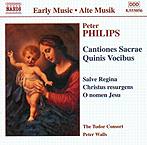 |
Along with William Byrd, Peter Philips (1561-1628) is considered one of the great English Catholic composers of sacred music, and a key figure in the Counter-Reformation. To avoid harassment for his Catholicism, Philips lived in exile; he worked in Rome, where he became familiar with Palestrina's music, and mastered the polyphonic form. These pieces are from an important 1612 collection of motets. Among the more interesting pieces are Feast of the Circumcision, which is slow and reverent, gaining in speed during the final chorus of noels; Passiontide, which begins very subdued, gaining in intensity and variety; and Easter Sunday, which starts simply, gathers more and more harmonic lines as the celebratory aspect of the piece grows, and features lengthy passages of joyful Alleluias. The music is beautifully, and beatifically, sung -- primarily tranquil, but never dull.
• Emma Kirkby & Gothic Voices: Hildegard of Bingen -- A Feather on the Breath of God, Hyperion, 2000.
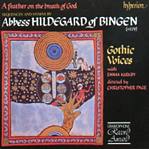 |
Hildegard (1098-1179) was abbess of a community of nuns affiliated with a Benedictine monastery near the town of Bingen in Germany. She was renowned in her time as the 'Sybil of the Rhine'; she wrote scientific treatises, and was also consulted on diplomatic matters by royalty and ecclesiastical authorities, including various popes. But she was primarily known as a visionary, and the devotional music in this recording was taken from a collection of poems and musical compositions entitled The Symphony of the Harmony of Celestial Revelations. One typical example of her imagery is found in Columba Aspexit, a tribute to St. Maximus: "You are strong and beautiful in rites / and in the shining of the altar / mounting like the smoke of perfumes / to the column of praise." This is a reissue of an award-winning 1983 release, featuring soloists Emma Kirkby, Margaret Philpot, Emily van Evera, under the direction of Christopher Page. Outstanding singing all round.
• Discantus: Jerusalem, Opus 111, 1999.
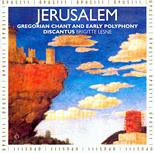 |
Polyphony is generally associated with later composers, such as Palestrina, Desprez and Ockeghem. This CD shows the breadth of multi-harmony composition from the earlier years, ranging from the 5th to the 13th century. There is good solo work on I was Glad, and O Zion! Clap your Hands, Form Choirs. Solo vocals are juxtaposed with plainchant, or unison singing, in By the Waters of Babylon and O Jerusalem, Golden City. The polyphony is particularly lovely in Be Glad, O Jerusalem, and quite spirited in Let the Choir of the New Jerusalem. The most memorable piece is Judea and Jerusalem, Fear Not, which skillfully combines passages of polyphony and plainchant. Given the plethora of chant CDs featuring male choirs, it is very refreshing to hear an all-female ensemble doing this kind of music. Fine work, directed by Brigitte Lesne.
• Consortium Carissimi: Carissimi - Ten Motets, Naxos, 2001.
Giacomo Carissimi (1605-1647) spent the bulk of his career in Rome, as maestro di cappella at the Basilica of Sant' Apollinare, one of the most prestigious centres of liturgical music. He was much admired in his time, but most of his original music manuscripts are now lost; however, a lot of copies made by his students still survive. O Vos Populi ('O You Nations') is quietly celebratory, with a solemn underpinning. In te Domine Speravi ('In You, O Lord, Have I Hoped') feels both hopeful and imploring. The most entertaining piece is Lucifer. It begins with the devil's premature boast, that he will set his throne "higher than God's stars"; God's response, lowkey at first, takes on a distinctly exuberant quality when he calls his angels to "condemn the proud to the fires of hell." Most of this music, however, has a sweetly lyrical quality.
• Capilla Flamenca: The Alamire Manuscripts, Naxos, 1999.
Subtitled Polyphonic Treasures for Charles V, this CD features selections from a collection of almost 50 choir books, compiled by one Petrus Alamire. It features works by Josquin Desprez, Pierre de la Rue and Adrian Willaert, as well as several lesser known people. Highlights include the fast and intricate Mater Floreat ('May the Mother Flourish'); and Plus Oultre ('Even Further'), which features an interesting arrangement of harp and strings. There are, however, a few too many instrumental interludes -- mostly somewhat bombastic, pipe-dominated items; considering that there were some 850 pieces to choose from, the CD's producers should have just concentrated on vocal selections -- and the album could have been at least 15 minutes longer. Nevertheless, the music is very well sung, and the CD presents a good overview of Alamire's work.