
September 2003
Coupland's masterful Nostradamus flawed by stereotypes
BC Christian News, · Arts
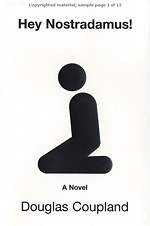
• Douglas Coupland: Hey Nostradamus! Random House, 2003.
 |
THERE'S LOTS to like in the latest novel from the Vancouver writer whose debut 1991 novel Generation X became a rallying point for a decade's-worth of post-Baby Boomers. Best of all, he continues the spiritual probings of his powerful 1994 book, Life After God.
This story centres around an invented Columbine-like massacre in North Vancouver's Delbrook Senior Secondary in 1988. We first view the events through the eyes of Cheryl, a student who witnesses the shootings.
It's heady stuff: this young woman has had an authentic conversion to Christ, and Coupland is at his best showing the world with the fresh wonder of someone newly reborn:
"I loved the world, its beauty and bigness as well as its smallness: the first thirty seconds of the Beatles' 'Lovely Rita'; pigeons sitting a fist apart on the light posts entering Stanley Park; grilled-cheese sandwiches and the sound of lovesick crows on the electrical lines each May.
"The world is a glorious place, and filled with so many unexpected moments that I'd get lumps in my throat, as though I were watching a bride walk down the aisle -- moments as eternal and full of love as the lifting of veils, the saying of vows and the moment of the first wedded kiss."
And I admire the way Coupland has captured not only the glory of this character -- she is utterly alive -- but also balanced it with an awareness of her naïvete.
The first half-dozen pages are masterful in the number of reversals the author springs on us, and ever so deftly.
When the author moves forward a decade and shifts his point of view, he is just as convincing taking us inside three other characters whose spiritual journey is profoundly affected by those terrible events.
They are fascinating for their humanness, their inconsistencies and transformations, and the way we come to care about them for all their failings.
In some instances, that's a pretty impressive accomplishment particularly in the case of the father, Reg, whose toxic brand of religion renders him monstrous.
It seems to me that Coupland does much less well with some of his secondary characters, particularly the members of 'Youth Alive!' -- clearly a stand-in for Young Life. This gang doesn't get an ounce of sympathy, nor is there the least bit of nuance or humanity in their portrayal.
Why is Coupland able to portray Christians as human beings when he tells things from their perspective, but otherwise can only offer standard issue, two-dimensional caricatures of self-righteous religious fanatics? A significant flaw in an ambitious book.
I suppose it's possible that, writing for an audience likely to be skeptical (or outright antagonistic) to the Christian elements of his story, Coupland intentionally creates characters who embody the worst of religious faith and expresses the same anger toward them that his readers may feel generally toward Christians -- thereby "earning the right to be heard" (a Young Life maxim) when he treats other Christians (or Christian beliefs or experiences) with sympathy. Still, as with Barbara Kingsolver's Poisonwood Bible, I think the book would have been much stronger without the stereotyping.
That aside, it's always exhilarating to discover another book that to some degree 'gets it right' when dealing with Christian faith.
This book has a prevalent sombre tone: even the life-affirming Cheryl says "Even those of us who try to live a good and true life remain as far away from grace as the Hillside Strangler or any demon who ever tried to poison the village well. What happened that morning only confirms this."
But as much as Coupland gets the "All have sinned and fallen short of the glory of God" part right, he constantly juxtaposes moments of bea-uty, small epiphanies, touches of goodness and transcendence.
People come into these lives who are themselves divine gifts, bringing grace or healing, speaking necessary truths, or simply offering friendship.
One measure of a story is whether its characters undergo change, and how convincingly that transformation is portrayed.
Coupland sets out his intentions with an opening passage from Corinthians: "Behold, I tell you a mystery; we shall not all sleep, but we shall be changed. In a moment, in the twinkling of an eye, at the last trumpet; for the trumpet will sound, and the dead will be raised imperishable, and we shall be changed."
It is a real accomplishment to have achieved much of what he set out to do: in a world where terrible evils happen, to show us that kind of transformation, in all its paradox and mystery.