
September 2003
Fascinating insights into the Dead Sea Scrolls
BC Christian News, · Top Stories
• James VanderKam & Peter Flint: The Meaning of the Dead Sea Scrolls, Harper San Francisco, 2002.
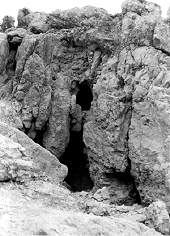
THE STUDY of the renowned documents found at Qumran -- better known as the Dead Sea Scrolls -- is endlessly fascinating, as this recent book emphasizes. It is co-authored by two of the recognized leaders in Scrolls research: James VanderKam of the University of Notre Dame; and B.C.'s own Peter Flint, co-director of the Dead Sea Scrolls Institute at Trinity Western University.
The authors explore key issues surrounding the Scrolls, and draw important conclusions. The Qumranites, they maintain, were indeed Essenes, as had long been assumed. While rooted solidly in Jewish tradition, the sect had some unique beliefs: notably, their conviction that two Messiahs -- one a king and the other a priest -- would arise in the last days. Flint and VanderKam ably assess differing theories about the identities of these figures.
Regarding the Scrolls' relationship to the early Christian movement, the authors draw the following conclusions: there is no evidence that there were New Testament documents at Qumran; it is plausible that John the Baptist may have associated with the Qumranites; and there are intriguing connections between the Book of Revelation and apocalyptic Qumran scriptures.
They also assess contrasting theories about a controversial document called the 'Son of God' text: some scholars believe it refers to a messianic figure, while others contend that it describes an evil ruler. While the authors conclude that there is no clear evidence of a direct connection between Jesus and the sect, they give some credence to the theory that the Gospel of Luke may have drawn some of its descriptions of Jesus from this mysterious text.
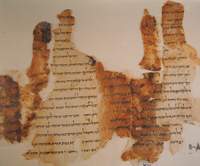 A portion of the 'Temple Scroll,' written by the Essenes at the Qumran community. |
The writers assert that portions of the Scrolls bolster the view that Jesus drew some of his key inspirations and terminology from the same Jewish traditions the Qumranites drew upon; thus, they dispute the views of some academics, such as the Jesus Seminar, who maintain that Jesus was strongly influenced by Greek philosophy.
They also dispose of some of the more outlandish theories involving Jesus and scrolls, particularly those proposed by John Allegro (notorious author of The Sacred Mushroom and the Cross) in his book, The Dead Sea Scrolls and the Christian Myth; and Australian, Barbara Thiering, who wrote Jesus and the Riddle of the Dead Sea Scrolls.
The book also gives a good, concise account of the discovery of the scrolls; the key scholars who worked with them in Israel; the controversy over the alleged suppression of significant documents; and the final release of all the previously unpublished scrolls. Overall, this fine book is a very valuable contribution to scrolls scholarship.
• Jodi Magness: The Archaeology of Qumran and the Dead Sea Scrolls, Eerdmans, 2002.
This book should also be of interest to Scrolls afficionados. Magness has participated in a wide variety of archaeological excavations in Israel and Greece, and is considered an expert on the subject of Qumran. Her book is aimed at the general reader rather than the scholarly community, and presents an overview of the role of archaeology in understanding the significance of the Dead Sea Scrolls. Magness evaluates the practical and ceremonial purposes of the different constructions at the Qumran site; demonstrates what can be gleaned from architecture and pottery; examines the spiritual nature of the sect which copied and collected the Scrolls; and assesses the evidence for the presence of women at Qumran.
One of the caves at Qumran, near the Dead Sea. Right: A portion of the 'Temple Scroll,' written by the Essenes at the Qumran community. Photos: Dead Sea Scrolls Institute