
September 2003
Marriage and the state
'MILLIONS FOR MARRIAGE' will be the rallying cry for many Christians nationwide this month.
Organizers of 'Sanctity of Marriage Week,' scheduled September 1 -- 7, hope to have more than a million people lobbying for traditional marriage outside the constituency offices of all Members of Parliament across Canada. The event clearly indicates that legalization of same-sex marriage is compelling Christians to re-examine the relationship between church and state.
In response to recent court decisions legalizing same-sex marriage in Ontario and British Columbia, Prime Minister Jean Chretien has drafted a bill that would change the civil definition of 'marriage' to 'the lawful union of two persons to the exclusion of all others,' but would also permit religious groups to refrain from performing such marriages.
To ward off court challenges should the bill become law, Chretien has asked the Supreme Court of Canada to rule on its legality. A decision is not expected for at least a year, and Parliament may not get to vote on the bill until 2005. Meantime, it is already a possible election issue, and many Christians are actively seeking ways to prevent the bill from becoming law.
Charles McVety, president of Canada Christian College in Toronto, is one of the organizers of the Sanctity event.
Marriage, he says, "is the foundation of our society; and number two, it's the foundation of Christianity -- and by attacking marriage, you therefore destroy the foundation."
McVety adds: "By attempting to redefine marriage, the government is grossly breeching the separation of church and state. In a free democracy, we are free from the state describing or dictating the ordinances of the chuch. They do not have the right to dictate or define baptism or communion or worship or marriage."
McVety says his rally is supported by a broad range of religious groups, including Pentecostals, evangelicals, Christian & Missionary Alliance churches, Catholic bishops, and even Jews and Muslims.
The Vatican has also stepped into the fray, calling on Catholic lawmakers to vote against any legislation that would permit same-sex marriage.
Several Canadian bishops have criticized Catholic politicians such as Chretien and his likely successor, Paul Martin, for giving their support to same-sex marriage. Bishop Fred Henry of Calgary even said he was praying for Chretien "because I think his eternal salvation is in jeapordy."
But not all churches are opposed to the federal government's plan to redefine marriage.
Kevin Bourassa and Joe Varnell -- the gay couple whose wedding at the Metropolitan Community Church (MCC) in Toronto two years ago got the Ontario court case rolling in the first place -- have begun a campaign urging Catholics to withhold their offerings from the church until the bishops change their tune.
Ian Taylor, a Toronto-based gay activist who also plans to marry his partner within the MCC, told the Ottawa Citizen he didn't want to encourage anti-Catholicism, but he had to oppose the lobbying of conservative Catholics because "it's a matter of one Church trying to impose its beliefs on, in our case, another Church."
The United Church of Canada has also come out in favour of same-sex marriage. Tim Stevenson, a Vancouver city councillor and a minister with the church, presided over the first legal gay marriage in B.C. outside the courthouse in downtown Vancouver, and the national church passed a motion at its general council meeting in Nova Scotia last month endorsing same-sex marriage and asking the government to do the same.
The debate could also complicate matters for the Anglican Diocese of New Westminster, which began blessing same-sex unions in May. Bishop Michael Ingham has insisted all along that "marriage" is the sacramental union of a man and woman, and that the priests under his jurisdiction are not "marrying" same-sex couples, but only "blessing" them.
So, what if a gay couple wants to have the civil marriage certificate and have their union blessed in an Anglican church, too?
Diocesan spokesman Neale Adams says the bishop has not yet indicated whether Anglican priests, who are licensed by the state to issue civil marriage certificates, would be allowed to issue them to gay couples. "We have not discussed this, it has not come up, and the bishop has not stated an opinion about it," he says.
For their part, Michael Kalmuk and Kelley Montfort, the first same-sex couple to be officially blessed in an Anglican church, have said they have no plans to get a civil marriage license. Kalmuk told the CBC he and Montfort did not "depend upon a government" to give their relationship security, but he said the legalization of gay marriage was good news "for other people who aren't as connected in a spiritual way, or within a church."
Pagan culture
This is not the first time that Christians have struggled to reconcile their understanding of marriage with that of the broader culture.
Marriage in pagan Rome was a private social contract that either partner could abandon with little fuss; divorce and remarriage were common. But the church, which had no formal ritual of its own at first, insisted that marriage was for life.
Widows in pagan culture were often pressured to remarry -- the emperor Augustus even had them fined if they failed to find another husband within two years -- but the church exerted no such pressure on them. If anything, Paul and others discouraged remarriage, thus allowing rich widows to keep their husbands' property, while poor widows were cared for by the church.
In the early 200s, Bishop Callistus of Rome -- what we would now call the Pope -- caused a scandal among his fellow clerics when he ruled that Christian women could live in "just concubinage" with Christian men without entering into marriage.
Callistus made this rule because upper-class Christian women who wanted to marry within the church often had to settle for men of inferior rank, but by doing so, they lost many of their legal privileges. Callistus allowed such couples to live together with the blessing of the church even though they were not married in the eyes of pagan law.
It was not until after Christianity became the state religion that a tradition began whereby married couples would follow the civil ceremony by going to a church and asking for the blessing of a priest. In places like Russia, this custom of having two separate ceremonies continues.
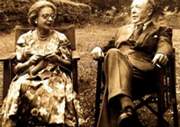
Sixty years ago, C.S. Lewis responded to the increased secularization of western culture by writing, in Mere Christianity, that there should be a "sharp" distinction between state-sponsored marriage and religious marriage, and that Christian voters and Members of Parliament should not impose their views on marriage on British society.
"My own view is that the Churches should frankly recognise that the majority of the British people are not Christians and, therefore, cannot be expected to lead Christian lives," Lewis wrote.
"There ought to be two distinct kinds of marriage: one governed by the State with rules enforced on all citizens, the other governed by the Church with rules enforced by her on her own members. The distinction ought to be quite sharp, so that a man knows which couples are married in a Christian sense and which are not."
Thirteen years after writing this, Lewis kept this distinction in his own life by marrying his own wife, Joy Davidman, twice -- once in a civil ceremony, and once again in a religious ceremony several months later, as depicted in the movie Shadowlands.
To Lewis, the first marriage was a pure formality designed to give Davidman and her two sons British nationality and thus prevent them from being deported. It was not until after the second marriage, before a minister of the church, that Davidman moved into Lewis's home and they began to live as man and wife.
Effect on churches
It remains to be seen what effect the legalization of same-sex marriage in Canada will have on churches that follow traditional teachings about human sexuality.
Many Christians are concerned that, if Parliament or the courts decide gay couples have a right to marriage, then ministers could be compelled to perform same-sex marriages against their will.
McVety says he is not reassured by Chretien's assertion that religious groups will have final say over what marriages they do or do not approve, given that it is the courts, and not Parliament, that seem to be making the laws these days.
"If the Supreme Court of Canada finds it is discriminatory not to marry two men, then of course logic would tell you that they would force clergy to marry two men no matter what Jean Chretien says," McVety says. "So his words are meaningless."
Other Christians are not so concerned. ChristianWeek columnist Marianne Meed Ward wrote a controversial article defending gay marriage on the basis that it is "better to marry than to burn with passion."
Meed Ward says conservative clergy already have the right to turn down requests for marriage for all sorts of reasons, including moral and religious ones.
"Gay couples will be just one more ceremony to decline, if you so choose," she says. "So the fear that ministers will _have_ to perform gay marriages is misplaced and fear mongering by those who suggest it."
Politicians and faith
It also remains to be seen how politicians will try to incorporate the religious element of this discussion into their own positions.
The Canadian debate over same-sex marriage has spilled over into the United States, where politicians tend to be more comfortable with religious language.
President George W. Bush has said that marriage needs to be protected because it is "holy", while Senate Majority Leader Bill Frist said he favoured a constitutional amendment declaring marriage to be the union of a man and woman because marriage is a "sacrament" that should be enshrined in law as a "legal entity".
In Canada, Members of Parliament have been more reluctant to let their faith determine their public policy. Chretien and Martin, for example, have both said they place their public duty as legislators above their private faith as Catholics.
And during his own short run for the Liberal leadership, deputy prime minister John Manley, a devout Presbyterian who has said he is "about as traditional as it gets," told reporters the state should honour all "life commitments" regardless of "whether they are same sex, or different sex, or whatever," so long as clergy were not compelled to bless relationships that they did not believe were right.
John Stackhouse, professor of culture and theology at Regent College, says this sort of reticence unfortunately feeds into a Canadian mindset which says religious people can "sound off" on various issues but must never let their faith shape their actual policies. "In fact," he says, "in a democracy, people can appeal to any criterion they want.
Politics is the art of trying to bring as many people on board while recognizing that you can't get everyone to agree with you on controversial matters, says Stackhouse, so politicians should not shy away from the religious principles that are supposed to guide their decisions.
"If you vote for Paul Martin and you know he's a Roman Catholic, you expect him to vote as a Roman Catholic, and not as somebody who simply tries to represent everybody, because nobody _can_ represent everyone," he says. "So I find Paul Martin's response quite disappointing."
'Civil unions'?
As many as 70 Liberal MPs have indicated they will vote against the new legislation if and when it comes to a vote in Parliament. Some of them, however, would support a law establishing 'civil unions' whereby gay couples could legally register their relationships but would not be considered officially 'married'.
Others, like Liberal caucus chair Stan Keyes and Progressive Conservative leader Peter MacKay, have gone further and said government should remove the term 'marriage' from its laws altogether and replace it with 'civil unions' that would be open to gay and straight couples alike. This way, they say, religions would be free to define 'marriage' as they see fit.
"Marriage is universal," Keyes told the Ottawa Citizen, "but in law, in legislation, when you're creating definitions, why not use a term that everybody can live with?"
However, not all Christians like this idea. McVety says 'marriage' should remain in Canadian legislation and not be replaced at all. "That proposal is doing away with a fundamental institution that our society is built on, and I have to ask the question, 'Why?'" he says.
Justice Minister Martin Cauchon has also rejected these proposals, saying the federal government has a constitutional obligation to provide marriage for all couples, including gay couples, who do not want to be married within a religious setting.
To replace marriage with civil unions "would abrogate our responsibility under the Constitution to define marriage," Cauchon told the Ottawa Citizen. "It would also deny the rights of Canadians who do not choose a religious ceremony."
But Iain Benson, executive director of the Centre for Cultural Renewal and an advocate of 'civil unions', says Cauchon has got the law all wrong. "There is no state requirement to offer 'marriage' of whatever sort," says Benson.
"The state cannot be under an obligation to offer 'marriage' when that concept is religious in nature," he says. "Civil 'marriage' has never been marriage but a civil compromise to give benefits outside religion. That would still exist, under the 'civil union' name, in the current regime."
For its part, the Canadian Alliance is hoping to force a vote on same-sex marriage as soon as Parliament returns this month, even though the Supreme Court is not expected to rule on Chretien's draft bill until next year.
The Alliance plans to introduce a new motion that would be based on a 1999 motion which defined marriage as "the union of one man and one woman to the exclusion of all others" and said Parliament would "take all necessary steps within the jurisdiction of the Parlianment of Canada to preserve this definition of marriage in Canada."
That earlier motion passed 216-55 and was supported by many Liberals -- including Chretien -- and Alliance house leader John Reynolds has said he hopes the new motion will pressure the Liberal government to abandon the word "marriage" in its legislation regarding same-sex unions.
In the meantime, there are the protests to arrange. McVety says he hopes 3,000 people will rally outside each MP's office across the nation September 7. He says he believes this goal can be reached, can concludes: "I believe it will be the largest protest in the history of Canada."
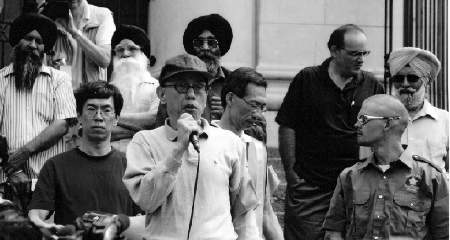
K-John Cheung of Canadian Alliance for Social Justice and Family Values Association spoke about recent challenges to traditional marriage to an estimated 10,000 people August 16, at a rally on the steps of the Vancouver Art Gallery. Pro-gay hecklers interrupted the otherwise peaceful protest. (Note: the Alliance has no connection to the federal political party).
Action for marriage
• September 6: National Marriage Sunday at various churches across Canada. Sermons will focus on the meaning of marriage. Pastors are also being asked to go to their local MPs' offices at 3 pm, to have brief prayer meetings.
• September 7: 'Millions for Marriage' rallies at MPs' offices across Canada. The gatherings will be the finale of Sanctity of Marriage Week, sponsored by the Canada Family Action Coalition and various family and religious groups. The campaign will also include a 'Sanctity of Marriage Sabbath/Sunday.' Info: www.sanctityofmarriage.ca
• September 12, 6-9 pm. God Keep Our Land Prayer Rally at the steps of the Vancouver Art Gallery.