
September 2003
A refreshing eMinistry to the 'Net Generation'
BC Christian News, · Top Stories
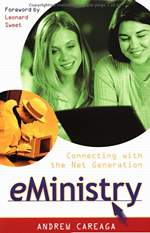
• Andrew Careaga: eMinistry -- Connecting With the Net Generation, Kregel, 2001.
 |
I HAVE read far too many books by people who have only recently discovered electronic communications, and then come up with the same bright idea: "Hey! I could use this to spread the gospel!" They then reinvent the wheel, and make the same mistakes over and over again.
Careaga's book is a refreshing change. He has spent serious time on the net, and knows his subject. His basic argument is that kids of the Net Generation think differently than Boomers, or even 'Generation X' -- and that, therefore, churches must tailor evangelism to their ways of thinking.
Careaga argues that this is the first postmodern generation, marked by relativism, eclecticism and pragmatism. Thus, churches which try to appeal to the Net Generation on the basis of authority, or even reason, are simply speaking the wrong language. The Net Generation isn't interested in 'Thus saith the Lord,' or even 'This is true.' They are, however, interested in 'This is real' or 'This works.'
I have a few quibbles. Careaga makes disparaging remarks, like: "Even the most progressive online ministries seem to be clueless about the nature of the internet culture they hope to influence." But he is sending a mixed message, because he speaks positively of some sites. If nobody's getting it right, then where did these sites come from?
Careaga also portrays pre-Generation Net people as technologically inept. But there are plenty of 'old fogies' who are perfectly comfortable with computer technology.
In my generation, being smart was uncool, so the technically adept got labelled 'geeks' and 'nerds.' (Some have suggested that the titles of computer self-help books for 'Dummies' and 'Idiots' are a subtle revenge by nerds on the 'cool kids' who tormented them in school and now need their help.) I have long felt that the supposed incompetence with computers of many Boomers and pre-Boomers is really learned helplessness inspired by the fear of becoming a nerd.
If you see this as a trivial quibble, take that as a sign of how hard I had to look to find flaws in this book. I also commend Kregel's proofreading; unlike another book from a major publisher which I read recently, in which somebody "poured" over source material, Careaga correctly "pored" over it.
Careaga demonstrates an understanding of the language, culture, benefits and threats of the Internet, and points out the potential impact each of these has on ministry online. I highly recommend this book to all such ministries.
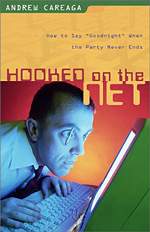
• Andrew Careaga: Hooked on the Net: How to Say 'Good Night' When the Party Never Ends, Kregel, 2002.
 |
Like me, you've probably had co-workers -- who have observed you working excess hours at your computer -- loudly proclaiming: "You're addicted to computers!" It's annoying, because you're just doing your job. But there's always that sneaking suspicion that they just might be right.
Since most jobs involving computers entail a myriad of little tasks, there's always room for self-doubt: how much of the way we work is really necessary, and how much do we -- consciously or unconsciously -- rearrange our work day to maximize online time?
It's a painful question to face, and working in ministry doesn't make you immune. In fact, it can make the question even more painful -- because the time you waste isn't just being taken from your employer, but from God.
Careaga isn't out to lay guilt trips. In fact, he doesn't even answer all his own questions, because the fact is that even the experts disagree on fundamental questions, such as whether it is even possible that computers, or the internet, are 'addictive' in any meaningful sense of that word.
Yes, there are plenty of examples of people who have gotten so wrapped up in being online that it's downright scary, and Careaga lists several of them.
However, it can be argued that the kind of people who get 'addicted' to being online have addictive personalities, and would get obsessive about something else if they didn't have computers.
Careaga digs up a whole bunch of facts -- some quite surprising -- on heavy online use. He covers online gaming, pornography, shopping and swapping music files -- in essence, the four aspects of the internet which have proven to trigger compulsive behaviour most frequently. He also dis-cusses the nature of addiction, the link between heavy online use and depression, and Christian answers to addiction.
Careaga does not shy away from painful truths: Christians, even clergy, have gotten hooked on online pornography. But he also points out less obvious truths: people who get into online pornography do so because of the illusion of anonymity.
The temptation was there all along; but while a minister would risk public exposure walking into a sleazy 'adult' bookstore, the internet can bring all kinds of images right into the privacy of your study.
This is not always a comfortable book to read, but I believe it is a timely and important one. Sweeping problems under the rug just allows them to fester. Therefore, the accountability that Christians should hold one another to includes our activities online. Careaga may not give all the answers, but he asks -- and prompts us to ask -- the right questions.
Greg Slade founded CAMsoc (Computer Aided Ministry Society), dedicated to helping Christians utilize computers effectively.
Contact www.associate.com/camsoc/