
October 2003
The challenge of Revelation
BC Christian News, · Arts
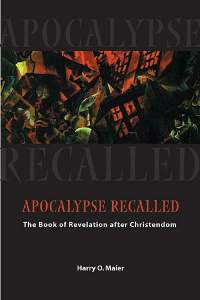 |
• Harry O. Maier: Apocalypse Recalled – The Book of Revelation after Christendom, Fortress Press, 2003.
THE BOOK of Revelation, aka The Apocalypse of St. John, inspires a wide variety of responses – from fascination to fear.
Harry Maier, an Alberta-born and raised Lutheran biblical theologian who teaches at Vancouver School of Theology, has both a keen academic interest in the book, as well as a strong, personal identification with it.
"My earliest memories are of fire," Maier writes, describing what 'apocalypse' meant in his own young life. "I knew before I was five that the Canadian citizens of the town where we lived burned down the German Lutheran church during the Second World War, and had forbidden worship in German."
When his family talked of such things, it would bring back memories of old country terrors. Maier heard about the horror of exploding bombs, and of how the earth shook and the sky screamed during air raids. These stories were told by parents and grandparents – with an immediacy that conveyed the fact that they had happened recently.
"Apocalypse gave me eyes to see the world," writes the author. He believes the Book of Revelation – far from something to be avoided, as some have done – is a book to be understood by Christians living in modern times.
Maier believes Revelation is not only worth studying in depth – but more importantly, that it forms an indispensable resource for helping first-world Christians find their place in the contemporary world and to reflect on the role the church is to play in Canadian society.
Apocalypse Recalled captures the excitement of Revelation for readers who might be inclined to ignore this last entry in the biblical canon. While Revelation tends to intimidate the Christian mainstream, the public secular imagination is profoundly captivated by apocalyptic themes. The popularity of TV's X-Files, the Matrix films and the Left Behind book series bear witness to significant popular interest in such biblical subjects.
Maier's study won a first place award last June, for best book in leadership and philosophy at the Canadian Christian Writers Competition at the 19th God Uses Ink conference in Guelph, Ontario.
"The Book of Revelation has often been read as a set of endtime scenarios, glorifying a vengeful God and predicting and even fomenting apocalyptic violence," he writes. "Yet it continues to exert a profound hold on the dreams and visions, fears and nightmares of our contemporary, first-world, secular culture."
The author insists that, however much one is skeptical of its misuse or awed by its influence, Revelation still harbours a powerful and important message for Christians today.
Avoiding both the dry bookishness of an academic, and the superficial experience-based approach employed by too many modern communicators, Maier writes with both a wealth of reading in many fields as well as deeply personal insights. His book doesn't speculate about the end of the world, nor was it written to provide comfort for Christians who see society going to hell in a handbasket.
The Book of Revelation was first written to confront the Roman Empire of its day. In Maier's view, it was also written to challenge Christians who are too enthusiastic in their support of economic and military might – including those who support today's remaining Superpower.
Maier believes that his experience as a young German Lutheran immigrant, growing up in post-World War Two Alberta, gives him a perspective that can help many Canadian Christians deal with today's spiritual challenges.
"The task of the sidelined Christian church is not to transform or manage culture," he says, "but to trouble it." Apocalypse Recalled seeks to liberate the imprisoned John of Patmos and use his controversial text to awaken a sleeping, culturally assimilated church, to revitalize its faith in the Christ unveiled in the sidelined Book of Revelation.