
January 2003
Musical greatness with a low profile
BC Christian News, · Arts
DOWN through the history of classical music, some gems have been relegated to oblivion. Meanwhile, the market is flooded with multiple versions of the more famous works. Some record labels, however, are rediscovering the music of undeservedly obscure composers.
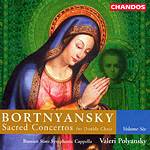 |
• Valery Polyansky: Bortnyansky - Sacred Concertos, Chandos, 2002.
Dmitri Bortnyansky (1751-1825) was one of the first significant Russian composers. Among other things, he spent time in Italy, composing operas. His most important sacred music was written during the last years of the reign of Catherine the Great. The concertos on this CD were generally sung in church at the end of the liturgy.
Highlights of the album include the gentle opening of I Will Praise Thee; the beautifully celebratory opening of The Heavens Declare the Glory of God; the quiet proclamation of holiness which begins Who Shall Ascend into the Hill of the Lord; and the finale of Come and Behold the Works of God, an exuberant proclamation of God's protection. In sum, most of this music could be described as sweetly majestic - and at times irresistably joyful. Valery Polyansky conducts the Russian State Symphonic Cappella.
• Patrick Peire: Fiocco - Missa Solemnis, Naxos, 2003.
Venetian composer Joseph-Hector Fiocco (1703-1741) was known primarily for his sacred music. From its sprightly opening, his Missa Solemnis in D is very reminiscent of the style of J.S. Bach, right down to the use of bright trumpets. But the difference is that this effect is sustained through most sections of the work; whereas Bach tends to use his trumpets much more sparingly - in isolated movements, mixed in with a wide variety of other moods.
Nevertheless, this mass does have some variety - notably in the sombre 'Crucifixit' movement; but of course, with the 'Resurrexit,' out come the trumpets again. Overall, this music is far too upbeat for the title 'Solemnis'; but it's a very appealing work, and the light approach to the mass is refreshing. Patrick Peire conducts the Capella Brugensis and the Collegium Instrumentale Brugense.
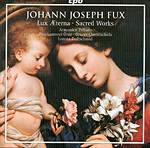 |
• Lorenz Duftschmid: Fux - Sacred Works, CPO, 2003.
In his time, Johann Joseph Fux (1660-1741) was held in high esteem as a composer by his contemporaries. The Hungarian was known for his influence on the teaching of music theory, and also achieved renown as kapelmeister to Holy Roman Emperor Charles VI. Over more than 30 years, he produced some 400 pieces of church music. This CD includes music for Advent, and portions of a Requiem.
Graduale in Missa pro Defunctis begins with plainchant, which leads to a lovely blossoming of polyphony and organ. Ave Regina Caelorum also opens with plainchant, then goes into a violin accompanying soprano soloist Mieke van der Sluis; she also excels on Sonata a Santo Sepolcro. Another highlight is Ave Maria Choraliter, with an alto solo by Carlos Mena. Lorenz Duftschmid ably directs the Armonico Tributo ensemble.
• Harvard University Choir: Beach & Thompson - Choral Music, ASV, 2002.
The music of Amy Beach (1867-1944), considered the first notable female American composer, has been unjustly neglected. This remarkable artist began writing music at age four, and was primarily self-taught. While she was mainly known for her orchestral music, her choral compositions were outstanding. Among other things, this CD includes several of her best short pieces: the lovely Evening Hymn; Lord of All Being, which conveys a genuine sense of awe and reverence; and Te Deum, a magnificent tribute to God.
The most ambitious work here is Help Us, O God, which goes through remarkable shifts of mood: it begins with loud, exalted imploring; halfway through, the tone changes to one of worship; then it becomes a plea for redemption; and it returns to the imploring tone at the end. All told, outstanding stuff - as good as the best.
The CD also includes works by Beach's compatriot Randall Thompson (1899-1984), probably best known for a choral work entitled The Peaceable Kingdom. He impresses here with the uplifting, soaring passages of The Eternal Dove; and the exalted celebration of The Best of Rooms.
• Michel Piquemal: Ropartz - Le Miracle de Saint Nicolas, Naxos, 2001.
Born in Brittany, Joseph-Guy Ropartz (1864-1955) was known both as a poet and composer. The title piece of this CD deals with a legend of St. Nicolas, recounting how he brought three boys - murdered by a butcher - back to life. While it's a solid work, two others are more interesting. Psalm 136 has a somewhat sombre orchestral opening; choral elements enter, lifting the music somewhat; the piece takes on a dire and powerful tone, as the exiled children of Israel call for retribution against Babylon; it ends in a gentle mood.
Nocturne is a setting of a poem by Ropartz. At first, the music seems overly powerful for the lyrics, which express gratitude to God for the simple joys of a spring evening; but then, a gentle violin calms things down; there is another intense period, and then a gentle ending. While the tone may seem inappropriate at times, the music is gorgeous. Michel Piquemal directs the Choeur Regional Vittoria d'Ile de France.
• Choir of St. John's College, Cambridge: Berkeley - Sacred Choral Music, Naxos, 2003.
British composer Lennox Berkeley (1903-1989) was a friend of several noted composers, including Poulenc and Britten; and he also made his mark as a teacher - numbering John Tavener among his pupils. As a composer, he was mainly known for a variety of instrumental pieces, and a number of sacred compositions. This is an interesting collection of pieces; some are in Latin, and some in English. Berkeley favours spare and elegant writing, frequently using melodic lines which make subtle shifts. There are varied moods; but aside from some exuberant exceptions, the music is slow and dignified. Highlights include Magnificat, Missa Brevis and Nunc Dimitis. The standout is Crux Fidelis, which is effectively mournful without being ponderous. Altogether, this is quite lovely, imaginative and assured choral writing.
• Claritas: Marenzio - Iniquos Odio Habui, Etcetera, 1999.
Luca Marenzio (1553-1599) was considered a major composer in his time, known primarily for his madrigals. For his sacred work, the Italian composer tended to prefer setting some of the less well-known scriptural passages. Highlights of this CD included two surviving portions of a mass entitled Iniquos Odio Habui ('I Hate Vain Thoughts.') O Quam Gloriosum est Regnum features a complex interweaving of several vocal lines; one of the longer piece, Salve Regina, evokes a quiet exaltation; the lyrical Magnificat emphasizes a sense of devotion. The eight singers of Claritas are well named - the music is indeed sung with great clarity. While the major choral works of famous composers, with their huge choruses, tend to be the ones which get the most notice, this music makes a pretty good case for small ensembles.
• Geoffrey Webber: Christ Ascended, Guild, 1999.
Beginning with a prohibition introduced in 1524 by the reformer Huldrych Zwingli, organ playing was banned from Swiss churches until the early 19th century. The same legalistic spirit stunted the growth of musical composition; consequently, it wasn't until the first half of the 20th century that Swiss sacred music really came into its own. This album reflects the renaissance which resulted, offering a cross-section of notable composers - and appropriately, several organ pieces. Choral highlights include Paul Muller-Zurich's 'Christ Fuhr Auf gen Himmel' and 'Um Frieden'; eight 'musical proverbs' by Adolf Brunner; and Othmar Schoeck's 'Ze Einer Konfirmation.' Geoffrey Webber conducts the Choir of Gonville & Caius College Cambridge.
• Antoni Wit: Kilar - Choral and Orchestral Works, Naxos, 2002.
Known mainly for film scores, contemporary Polish composer Wojciech Kilar has also produced some fine sacred music. This CD features an adventurous instrumental entitled Krzesany; it has a dynamic, propulsive quality -- dissonant but not abrasive -- with passages of exhilarating turmoil. Most of Exodus is orchestral; towards the end, choral chanting takes over, praising God. The most interesting work is Angelus, a version of 'Hail Mary.' It begins with a barely audible chorus reciting, gradually gaining in volume as a rumbling sound is heard underneath it; the music then erupts into full orchestra. A tranquil soprano solo follows, then several stirring passages, followed by the repeated invocation of Jesus' name; towards the finale, a crescendo resolves into a very peaceful passage, and the ending returns us to the very quiet chanting. Antoni Wit conducts the Cracow Philharmonic Chorus and Polish National Radio Symphony Orchestra.
• Noel Edison: Psalms for the Soul, Naxos, 2000.
With the exception of Hubert Parry, Lennox Berkeley, David Willcocks, Herbert Howells and Charles Villiers Stanford, this CD presents mostly obscure composers. All of the composers featured were organists, and that instrument accompanies most of these pieces. Highlights include Herbert Sumsion's They That Go Down to the Sea in Ships, which musically goes from rough to calm sea; and Sir Edward Bairstow's The Lamentations of Jeremiah - which is particularly effective in its imploring refrains of "Jerusalem, Jerusalem." The major work here is The Reproaches, by John Sanders. It is a quiet and sombre a cappella work, encompassing material from both the Old and New testaments; a poignant, exquisite composition Fine work from Noel Edison's Choir of St. John's, from Elora, Ontario.