
January 2003
New ways of 'doing church'
OVER ADVENT, people across Germany did something very out-of-character for most of them: they went to church. What drew them was the novelty of stepping inside the world's first polyvinyl inflatable church. Invented by a British entrepreneur, The Daily Telegraph reported, it "has a blow-up organ, altar and candles and plastic 'stained-glass' windows."
Although its original intent was to promote a chain of nightclubs, a German priest who bought one of them discovered that it drew people who had perhaps not darkened the door of a traditional church for years. He decided to take it on tour.
"It allows us to take God's message everywhere, and reach people who usually don't go to church," said Gerhard Maier, the bishop of Stuttgart.
"The whole idea is to surprise people and meet them at places where they wouldn't expect to find a house of God."
And while the thought of worshiping in an inflatable church may seem undignified to some, its success underscores a growing universal awareness that God is leading his church in some new and surprising directions, as it seeks to reach a postmodern culture. The end result, say many observers, may well be a radically transformed church.
"People have rejected what we've shown them as the church, but I'm not sure what we've shown them has to be the only way that we do church," says Cam Roxburgh, senior pastor of Southside Community Church in Surrey and B.C. regional coordinator of Church Planting Canada.
"For too long we've defined 'local church' as a place where I go on Sunday morning to attend a religious service, and oftentimes the bigger the better. I don't want to rip that apart, because so many good things have been done through that model, but I'm not sure that's the approach that's going to win the day in our country over the next generation or two."

Recent polling bears out that concern. According to one survey, 77 percent of Canadians said that having an inner spiritual life was important.
But only 48 percent agreed it was important to belong to a religious group - a figure that rose to 65 percent among young adults.
Roxburgh believes part of the answer lies in motivating the church body to go out and consciously build relationships. "We've got to be a group of people who infiltrate neighbourhoods - and that's bound to make 'church' look a whole lot different," he says.
"So why can't it look like a series of home churches, or be held in a coffee shop more than under a steeple?"
"We must learn to live without a building," says Vancouver-area church planter Tom Tan. "Right now, churches are leaving the city. We have to go back to the city to reach the lost there. And facilities are expensive for a city church."
It is a way of "doing" church that can take many forms. In Montreal, for example, a group of Quebec Roman Catholics began meeting in October with the blessing of the archdiocese for a non-traditional Mass called the "Repas de Fraternite." As The Montreal Gazette reported, they gather for "family-like meals" that also include "Scripture readings, singing and discussion, often in the absence of a priest. . . ."
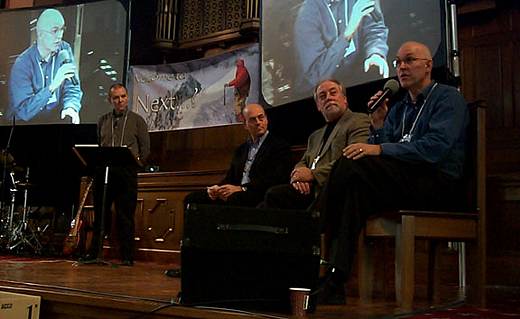
Dr. Eddie Gibbs, who teaches church growth at Fuller Theological Seminary in Pasadena, California, was one of the featured speakers at the National Church Planting Congress held November 19-21 at First Baptist Church in Vancouver.
He says such "intensely eucharistic" meals - in homes, but also in restaurants and cafés - are becoming a key feature of these new churches.
"In the context of the meal, the bread is broken and the wine is blessed," he says. "It is a participation; it is a means of grace. It can be powerfully evangelistic, because we are engaging with cultures which are rich in symbolic action. We've got to re-discover the power of symbol and the power of metaphor.
"And we're always just glancing sideways and making room, because there are lots of lonely people out there."
New churches are also springing up on university campuses, as students show a renewed interest in developing their spirituality.
"It is quite broadly characteristic of post-modernity and the emerging generation, where the skepticism of all things institutional - government, business and the church - continues to be very high," says Murray Moerman, director of national church planting strategy for Outreach Canada.
Yet to the unchurched student, he adds, most of these churches will seem no different than a Christian club. "If you pop your head into one room or the other, it still looks like 30 people sitting haphazardly on various kinds of furniture in a relaxed way. They're both involved in Bible study groups, worship, discipleship.
"The way that you can tell the difference," says Moerman, "is that the church views itself as permanent and intending to reproduce, whereas Christian clubs tend to view themselves as seasonal, and therefore not as focused on leadership and reproduction."
But these changes are not occurring entirely without controversy, especially when it comes to how best to reach Canada's growing immigrant population.
"Most church planters have been taught the homogeneous principle, that people want to worship God with their own people, and the best way to plant churches is on ethnic grounds," says Dr. Sam Owusu, who pastors the Calvary Worship Centre in New Westminster. "I think it's wrong, it's not biblical."
Owusu believes Scripture mandates all of God's people to worship together. So in his church, while different ethnic groups do meet for Bible study and fellowship in their native languages, English is the sole language of worship.
"If we see a language group that is quite big, we translate the sermons or whatever into that language. That's difficult, that's a lot of work, but that's the way of the cross," he says.
For many people, multicultural worship does not come naturally, Owusu concedes - himself included. "When I sing my African songs, something stirs within me," he says.
"But God does not call us to do what comes naturally, but what comes supernaturally. Christ has come to create a culture of His own.
Christ is calling us to break the barriers."
Roxburgh, who is personally sympathetic to Owusu's vision, believes both sides need to work harder at coming together.
"Some of it's the fault of ethnics - they don't want to come to the table and talk, they want to do their own thing," he says. "But some of it's our fault - we haven't learned to dialogue and communicate well, and so we have our own structures and we try to force them into our structures.
We've got to address that."
Yet it would be wrong to assume, says Gibbs, that as a result of all these new things that God is doing in and through His people, the church which many Canadians have been familiar with for decades has outlived its usefulness.
"Amongst our aging population are many people who experienced as much change as they can emotionally handle," he points out. "So I do believe we need a safety net, because you can't inflict more change, especially if your spouse has died, the kids have left, and your one remaining anchor is the church tradition in which you have grown up."
Still, says Roxburgh, this new church movement appears to be gaining some momentum in Canada. "God's doing something. There are stirrings, and that's very exciting.
"We may not lead the way in terms of being creative [compared to the new church planting movements in other countries], but I think the culture is ready and poised for some new things."
But Tan worries that most denominations are not yet willing to release church planters to follow the Lord's leading. "They call it accountability. I call it control," he says. "We have to recognize the folks called by God to plant and launch them. But the sad fact is that some do not know what to do with them."
Dr. Ray Bakke, executive director of International Urban Associates, which networks with urban-based church and mission leaders around the world, echoes that sentiment.
"I thought the barriers to mission were the big, bad cities," he wrote in a recent article. "But 90 percent of the barriers to reaching cities are not in the city at all; they are inside our churches, things like, 'Our bishop would never let us get away with that,' or, 'They'll call us liberal if we do that,' or, 'We can't do that, the seminary didn't prepare me for that.'
The barriers are inside our structures: the knowledge base, the intimidation factors of our churches - these are the things that keep us from reaching cities."
Gibbs agrees, though not entirely. "There are some institutional churches that find their identity and their security in their traditions. And at that point, they become highly resistant," he says.
"But then there are other churches in mainline traditional denominations that get it. They see that maintenance is no longer an option, that they must engage in mission and are prepared to pay the price to do whatever it takes to re-engage their cultural context."