
March 2004
Community profile: Firefighters more than they seem
A few months ago, grade 10 students at Fraser Valley Christian High School in Surrey participated in 'We're Part of Something Bigger,' a program whose purpose was to produce profiles of people in their community who significantly influence society. This is Jonathon Esmeijer's contribution.
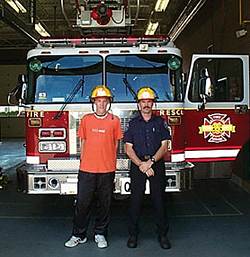 Fraser Valley Christian High student Jonathan Esmeijer with firefighter Brian Green. |
MAJESTIC they come, jumping out of the fire engine after saving people's lives.
The firefighters of Hall 18, located on the Fraser Highway in Surrey, are hard-working people whose main goal is to help others in a state of emergency.
Brian Green, a firefighter nearing 40, told me that his vocation is not really what it seems. "Being a firefighter is not really a job, it's actually a lifestyle."
It is non-stop training for disasters. Currently, they only fight fires about 10 percent of the time. Most of the calls are medical emergencies involving first aid.
Firefighters also go to community and charity events. On these occasions, they come in their fire engines, and show off what they can do. They set up the equipment for the public to examine, and for the children to play with.
For Green, this is a career; and for he and most of his colleagues, being a firefighter is a calling. You need to have a purpose to be one. In some ways, a fire hall is also like a fun place to go whenever you feel like helping people. It's hard work being a firefighter, and you have to do lots of training exercises just to get there. You also have to be able to carry at least 180 pounds -- just to qualify to go to the training camps.
Green himself looks like he can carry at least 250 pounds with those thick, strong arms and his muscular torso. He stands about six foot one, and weighs at least 180 pounds.
Green likes this job, because he likes helping people; it's his way of giving something back to the community.
A usual day for Hall 18 is as follows: The firefighters arrive at the station at 8 am. The driver of the engine during the night shift consults his replacement about anything significant which may have happened during the night, and then the night shift leaves. Then the day shift checks over the engine and cleans it. After that, they have a break and they discuss what's going to happen during the day over coffee. Next they do the daily chores. On the day I was there, a Sunday, they washed the kitchen from top to bottom.
After the chores, they do a drill to keep up their skills. Then they have lunch and talk about the rest of the day's schedule; after lunch, they work out or sleep until four o'clock. Then they work in the planning room to prepare for further emergencies.
The big fire engine at Green's hall is called a Quint. It can carry up to six people, and has many other capabilities. Green has been a firefighter since the age of 20, and said he has never seen anything like this truck before his hall acquired it. He says that it is the most advanced vehicle available.
Some of the features include an electrically raised ladder with a hose on the end, two electric generators, the 'jaws of life,' a metal cutter, electric saws, 500 gallons of water, 500 gallons of foam -- and much, much more. They also have a second truck called a Tanker, whose sole purpose is to carry water to places that have no fire hydrants. It can carry up to four people.
In the firefighting business, the levels of respect come with seniority. The longer you've worked there, the more respect you have. At first, Green worked as a radio dispatcher for a year and a half; after that, he worked as a volunteer firefighter, and then as a paid firefighter. Now he works for two day shifts and two night shifts -- and then he gets four days off.
The entire crew is essentially a family, Green told me, and the station is like a second home. When stressful things happen, the firemen band together to give each other moral support.
Some rescue missions can be very troubling. The worst scenario for Green is when there is no way to save a person from death. One of these scenarios came up for him when he was called for a structure fire emergency.
The crew arrived and found the building engulfed in flames; they could not get inside. Trapped in the building were two boys. Green and the others could do nothing to help; they had to stay and watch as the boys perished in the fire.
After this event, he replayed it over and over in his head, wondering how he could have saved the kids. But he came to the conclusion that there was nothing he could have done -- and if he had done anything differently, he might have been hurt or killed.
The life of a fire fighter is not easy. You have to be mentally tough, and realize that bad things may happen; you also need to know that, when things have gone wrong, at least you tried.
Firefighters have different perspectives on fires than other people do. A person whose house has been totally demolished will be hysterical, thinking that their lives are totally irreparable. A firefighter will look at the same house, and think: "If the house is still standing, nobody has died and the flames are out -- then all is good." When Green shared this with me, he called it 'black humour.'
The firefighters of B.C. receive my thanks for all the hard work that they put into their job.