
March 2004
Passion disturbing, inspiring and challenging
BC Christian News, · Arts
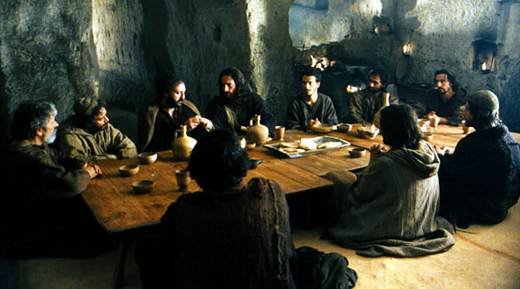
 |
EVERYTHING you know about The Passion of the Christ is wrong.
For more than a year, the film's most vocal critics have said that Mel Gibson's movie about the death of Jesus is anti-Semitic, while its most vocal supporters have said no, it's only an accurate representation of scripture and history. In truth, the film is neither.
First, the charges of anti-Semitism. It is true that Gibson's film tends to divide the Jewish race into those who follow Christ and those who try to have him killed; and it is true that The Passion, like many other films in this genre, is too soft on Pontius Pilate. This contradicts the image of the callous, vicious figure described by the Apostle Luke and Philo, a Jewish philosopher of that era. This has the unfortunate effect of making the Jews seem just that much more responsible for Jesus' death.
However, Gibson's depiction of Christ's trial before the Sanhedrin includes two Jewish leaders vehemently protesting against the mistreatment of Jesus, just before they are driven out of the chamber by the high priest's cronies. Gibson also goes out of his way to emphasize the Jewishness of Jesus and his followers: the first time we see his mother and Mary Magdalene, they recite a key passage from the Passover seder, about being set free from slavery; and when the Roman soldiers force Simon of Cyrene to carry Jesus' cross, one practically spits the word "Jew" at him. While Gibson could have gone further with this than he did, he never lets us forget that the Jews at this time were the victims of oppression.
In addition, a look at Gibson's earlier films reveals that he is anything but anti-Semitic. In his 1993 directorial debut, The Man without a Face, Gibson plays a classics tutor who feels dehumanized by his community, partly because one side of his body is covered in burn scars -- and the first Shakespeare passage he recites is Shylock's "Hath not a Jew eyes?" speech from The Merchant of Venice. Thus, Gibson draws an implicit link between his marginalized character and a Jewish character who also feels cut off from society.
So we can conclude that both Gibson and his film are a lot more complex than their critics give them credit for. But The Passion is also more complex than its supporters seem to recognize.
It is quite telling that the only way many Christians know how to defend a work of art is to assert that it is an 'accurate' adaptation of scripture, as if to minimize its artistry or creativity. It is even more telling that many Christians make this assertion even when the work of art in question contains several elements that are quite definitely not accurate.
In his portrayal of the crucifixion, Gibson rejects modern historical scholarship wherever it interferes with the details of his medieval vision. He also erroneously identifies Mary Magdalene with the woman caught in adultery; and whereas Luke tells us that an angel visited and strengthened Jesus in the Garden of Gethsemane, Gibson has Satan pay Jesus a visit and taunt him instead. There isn't necessarily anything wrong with these sorts of artistic decisions -- but they are not exactly "accurate".
And of course, Gibson puts a lot of violence in his film that is nowhere to be found in the gospels. Some of it comes from the visions of Sister Anne Catherine Emmerich, a 19th-century stigmatic nun; but much of it seems to be Gibson's own invention -- so much so that you can't help wondering whether Gibson, who won Oscars for producing and directing the gory medieval revenge epic Braveheart (1995), is indulging his more sadistic side.
As Hollywood Worldviews author Brian Godawa rightly points out, every film about Jesus is a product of its time -- and that is as true of The Passion as it is of the others. But The Passion is also a highly personal film, so it also reflects Gibson's own artistic and theological inclinations. And in order to fully appreciate this film, we will have to talk about it in those terms.
To help put the film in a broader artistic context, here are a few points to consider.
First, recent war movies like Saving Private Ryan, Black Hawk Down and the Gibson-starring We Were Soldiers have gone out of their way to be more violent than the movies that came before them -- but why? Is a film more truthful just because it is bloodier than the others? Martin Scorsese's The Last Temptation of Christ and the Visual Bible's Matthew were also once hailed for their grisly crucifixion scenes; does the law of diminishing returns apply to the violence of Jesus films, too?
Second, just as Braveheart was about nothing if not the definition of masculinity, Gibson has said he wanted his Jesus to be more manly than the others -- that is, to be more tough. Jesus commits the film's first violent act, as he crushes a snake underfoot, and he practically invites a second round of flogging by standing up straight and showing the soldiers he can take their abuse. Has Gibson perhaps reinvented Jesus in his own masochistic image?
Third, as Thomas Hibbs argues in his excellent book on nihilism in pop culture, Shows About Nothing, recent films have tried to find a sense of meaning by boldly proclaiming the existence of evil. If evil exists, then good must exist too, right? Gibson's film, with its vivid depiction of human and demonic cruelty, seems to fit that pattern -- but should a movie about Christ settle for that sort of message?
Fourth, the film's poster says, "Dying was his reason for living" -- and there is some truth to that. But did not Jesus rise from the dead? Did he not say that he came so that we might have life abundantly? Frederica Mathewes-Green notes that the church fathers tend to speak of Jesus' death within the broader context of his Incarnation and Resurrection -- so might it not be more accurate to say that living was Jesus' reason for dying?
Finally, note this film's use of flashbacks and point-of-view shots. Traditionally, films about Jesus have protected his divinity by objectifying him and keeping him at a distance. More recent films have explored his humanity by treating him more subjectively: we see his dreams and hear his thoughts. But they have also tended to lose sight of his divine authority. How does The Passion deal with these matters?
It is by asking questions like these that we can go beyond merely 'using' this film as a ministry 'tool' -- and truly engage with both the art and theology of Mel Gibson's disturbing, inspiring and always challenging cinematic vision.
* * *
Speaking of unusual and controversial Bible movies, several interesting foreign films based on the Old Testament have come out on DVD in recent months.
Genesis (Kino Video, 1999), a French-Mali co-production directed by Cheick Oumar Sissoko, is a fascinating interpretation of those oft-neglected chapters in which the sons of Jacob exact their revenge against the people of Shechem, after the prince of that city rapes their sister Dinah. In exploring the nature of sibling rivalry and tribal warfare, Sissoko mixes the biblical chronology around a bit so that he can also touch on the brothers' hatred of their half-brother Joseph, as well as the conflict between Jacob and Esau (renowned African musician Salif Keita).
The film boasts some superb images of the African landscape, and Sissoko underscores the role that genealogies and stories about ancestors play in shaping tribal identity, as well as the role that women play in this story. In one scene, an indignant Dinah talks back to her rapist's father and tells him what a real prince would do if he truly loved a woman; and when the men of Shechem line up for their mass circumcision, a female bystander cannot help but laugh and say, "What a great time I'm having!"
Last year also saw the release of two films by Israeli director Amos Gitai, which draw parallels between biblical stories and the present day. Golem - The Spirit of Exile (Facets, 1992) changes ancient Moab to modern France, and its depiction of the marriages of Naomi, Ruth and Orpah is at times frankly erotic -- which underscores the grief these women feel when their husbands are taken away from them, killed in a hate crime.
It is striking to compare this film to The Story of Ruth, a 1960 Hollywood production in which Ruth, the 'foreign' woman, was played by an Israeli actress and Naomi, the Israelite woman, was played by an American. Gitai, of course, reverses this, as well he should: his Ruth is very European, while his Naomi is very Jewish. Boaz, however, is played by Sotigui Kouyate -- the African actor who plays Jacob in Genesis.
Gitai's other film, Esther (Facets, 1986), is a more straightforward adaptation; but it does incorporate some modern elements -- implying that the Israeli government's treatment of Palestinians could be considered comparable to the cruelty inflicted upon the Jews by the Persians. The film ends with the actors recounting their own stories of being forced to move from one country or culture to another. Worth a look, for the discerning viewer.