
April 2004
Glimpses of faith in Asia
BC Christian News, · International
Vancouver resident Norman Olson is touring Asia as a volunteer with Canadian Food for the Hungry International, and sends the following account:
Philippines
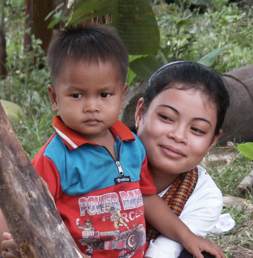
The countryside is so beautiful that it's no wonder Francis Coppola filmed Apocalypse Now here. I have never been in such a social society. It doesn't take long to make friends here; the people are so eager to enjoy life.
The front page of The Philippine Inquirer is always filled with the antics of the politicians who go by colourful names like Joker, Ping and Wimpy. A recent article rated the Philippines as the third most corrupt country in the world. An air traffic controller got so fed up recently that he and another fellow barricaded themselves in the control tower to draw attention to the corruption. They exclaimed that they weren't terrorists -- but they were shot dead.
China
I took the train out of Hong Kong into Shenzhen, expecting to find a backward village. What I found was a boomtown unlike anything I had seen before.
It made Calgary during the oil boom look like penny ante stuff. Shenzhen has been designated a special economic zone within China, allowing all manner of capitalistic enterprise; freeways, stadiums, skyscrapers and shopping centres are all being built, as the city throbs with activity.
Guilin is a completely different world. The laid back pace and the many parks and historical sites make it a natural place for tourists -- most of whom are Chinese. I stood out like a giraffe in a herd of cattle.
On a boat trip on the river Li, I saw steep outcroppings of limestone mountains, called karst. They sprout out from the countryside like mammoth goosebumps. Many of them have caves with stalagmites, which have names such as 'Dragon gamboling,' 'Pillar supporting the sky' or 'Ice Cream.'
Vietnam
Western tourists in China are few and far between. In Hanoi, you can't help tripping over them in the old quarter. I also found the Chinese much more reserved; the Vietnamese don't hesitate to approach you.
In Hanoi, the people in the old quarter practically live on the sidewalk. They perch on plastic stools and cook their meals over hot embers. Crossing the road as a pedestrian is best done slowly, so the many motor scooters can veer around you.
The faith community here is so international that it could be a miniature Willingdon Church. It is monitored -- but basically left alone, as long as there is no overt proselytizing. I wasn't surprised to see a man videotaping the congregation. I was relieved to learn that he was doing it for his friends back in Kuala Lumpur.
Thailand
An area of Bangkok frequented by backpackers was more like Commercial Drive in East Vancouver than anything I'd seen yet in Asia. Khao San Road was chock full of tattoo and piercing salons, people getting their hair done in dreadlocks; everything and anything was for sale on the pedestrian-only street. One evening there was a festival which turned into an unplanned scene from North Vancouver's Under the Volcano festival -- as hippies replaced the Thai students at dusk with juggling, walking on their hands, kung fu sticks and costumed dancing.
Laos
I saw people beating stalks of rice against the pavement -- a community effort, involving everyone from grandmothers to a naked child. Although Laos is the poorest of the countries I have travelled through, progress is being made. Tourism is providing a decent income for many. Now the former king's palace is a museum complete with things such as Richard Nixon's gift to the king in 1973: a piece of the moon from an Apollo mission, and a note saying that the flag of Laos had made it to the moon and back!
Cambodia
The temple complex of Angkor Wat is very impressive. A bas relief entitled 'The Churning of the Ocean of Milk' tells the Hindu story of gods stirring the sea to produce an elixir of immortality.
Intricately carved people on either side of the god Shiva look like they are in a tug-of-war, and beneath them fish are seen breaking in two from the turmoil above.
The king's estate in Phnom Penh is enormous. One building, called the Silver Pagoda, has more than 5,000 silver floor tiles.
Contrast this with the nearby backdrop of the absolute poverty. I saw beggars, the aged, and mothers with children -- girls who don't look old enough to be mothers.
One image of helpless destitution stuck with me: a man with his legs amputated, lying on a mechanic's dolly -- using shoes with hard soles on his hands to propel himself over a potholed and garbage strewn road.
The genocidal Khmer Rouge regime still impacts this country greatly. Millions were killed; many Cambodians lost parents, uncles, aunts or grandparents during that dark reign.
The killing fields consist of large, dug-out holes. Bound prisoners were trucked to them in the middle of the night, clubbed to death and then pushed into unmarked mass graves.
A stupa (Buddhist marker to commemorate the dead) in the midst of these holes is piled high with skulls. I examined the skulls more closely; they were all cracked with a zigzag line along the top.
I noticed a group of Koreans praying silently near the stupa. One of their leaders explained they were praying that 10 percent of the population would become believers.
Despite Cambodia's dark history, there is a light of hope in the Cambodians I have met -- who have gladly chosen Jesus against the tide of the Buddhist culture here, radiant in the new life they are experiencing.