
April 2004
Malibu Club: Millionaires' Mecca is now serving Christ's cause
BC Christian News, · Supplement
The following article was adapted from Through the Rapids: the History of Princess Louisa Inlet (Sitka 2 Publishing, 2003), written by Charles William Hitz.
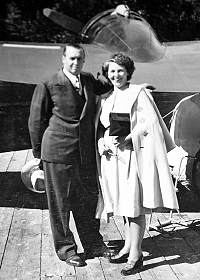
IT WAS ETHEL, Tom Hamilton's wife, who fell in love with the area right away, particularly the small island halfway down the inlet. Tom is reported to have said "It's yours" - and with those words, started something which would impact Princess Louisa Inlet for decades to come.
Hamilton was a man of ingenuity and unusual talents who was especially successful in the aviation field. Princess Louisa Inlet and the Malibu Club became his new adventure. The original idea had begun as a simple cabin on the island his wife loved but, in typical Hamilton fashion, it evolved into something more. It would be an achievement in design, and would allow him to enjoy the majestic place with his friends and family. But it would also end in total financial failure and abandonment.
Hamilton wanted the place to become a 'Mecca for Millionaires.' It was to be patterned after Jasper National Park, an area similar in its size and beauty.
Tom financed most of the construction out of his own pocket. He had estimated the cost at $75,000; but when completed, it would approach one million dollars.
Construction started in early 1940. Once it was finished, Tom finally settled on the name of his resort, naming it after his yacht, the Malibu. The Malibu Club would be expensive, and developed only for those who could easily afford it. Hamilton wanted to attract the rich, famous and attractive - in particular, the Hollywood movie stars and directors, rich industrialists, captains of industry and chic popular socialites who were exclusive by nature, expected the very best and were willing to pay for it. Malibu was to be a club conducted along the lines of private membership. But Tom was also intent upon developing it into a seasonal recreational place for yachters and their families.
Tom Hamilton was part of this select community and he worked hard at promoting and showing off his resort in order to attract the high-paying customers. He was excellent at marketing and selling aircraft parts, and promoting the resort proved to be no different.
The marketing blitz concerning Malibu was at full speed prior to the official opening in July 1941. The local newspapers of Vancouver ran stories and pictures of Tom holding a large salmon at the inlet. (In reality the fish was caught down in Pender Harbor).
Tom also promoted the fact that his roots were Canadian, his mother having been born in Ontario. Unfortunately, he also expounded how great the weather was at Malibu, forgetting that many of his guests were from southern California and Malibu was significantly farther north. The weather would come as something of a surprise to them, as they expected it to be just as warm as southern California.
The official opening of the Malibu Club in Canada resort was on July 16, 1941 and the theme was the 'Malibu Potlatch.' It was a festive time, featuring native dancing, log rolling, a clambake, and lots of entertainment.
That first night and the remaining summer proved extremely successful, as Hamilton's marketing storm had brought many yachters and celebrities to the resort. The future looked bright and hopeful for Hamilton's vision of the inlet. Unfortunately, the surprise Japanese air attack on Pearl Harbor forced him to suspend his plans.
The second official Malibu opening was celebrated in July of 1946; Hamilton invited a number of well-known industrialists and Hollywood celebrities. Once again, yachting magazines and Vancouver newspapers were full of news about Malibu, and listed guests at the resort each week for all of that summer and clear through the facility's closing. The Malibu guest book from 1946 to 1950 would include the names of such notables as hotel magnate Conrad Hilton; and Hollywood stars such as Ann Miller, Alexis Smith, Robert Cummings, Bing Crosby, Bob Hope, William Holden, Barbara Stanwyck and Robert Taylor.
Unfortunately, because of the weather and the remote location, not all of the guests enjoyed themselves. For example, Stanwyck was not impressed with her stay, mainly due to bad weather - and Mr. Hamilton. At the time, Stanwyck was one of Hollywood's highest-paid actresses, known for films like Double Indemnity, The Lady Eve and Stella Dallas. After two days at Malibu she asked the pilot to fly her out first thing in the morning. She was fed up.
Hamilton had completely annoyed her, forever hounding her to pose for pictures for him at the club. In addition, he had arranged for a photographer to meet her when she landed in Vancouver. Hamilton had made it a point to photograph every well-known guest at the camp so he could market the high class clientele who came to his resort. In Stanwyck's case, it made her crazy.
In addition to driving some of his guests to distraction, Hamilton also frustrated his personnel. He was an idea person, and tended to micro-manage his staff; according to some of them Malibu was in chaos when he was running the camp. When he was away and Mrs. Hamilton was in attendance, everything ran very smoothly.
To be a guest at Malibu was fun, entertaining and formal. Guests could sail, boat, fish, water ski, hike, hunt, read, shop, golf or whatever they wished, as long as they could afford it. However, although his many patrons paid a high price to stay there, Hamilton would not reinvest portions of this revenue into maintenance unless absolutely necessary. He was cost-conscious almost to the point of being a miser. Freight, both perishable and non-perishable, would be stored in his Vancouver office until the next paying customer chartered the plane, and it could often be a week or two before it would be flown Malibu.
The saddest chapter of Malibu's history was when Hamilton literally abandoned the resort in 1950. For the next two years, Malibu became a place where time stood still. Food was left in the pots and pans in the kitchen, tables were still set and supplies were untouched in the stores and cabins, exactly as the day it was left. It was exposed to all the elements Mother Nature could throw at it.
Young Life
Jim Rayburn, founder of Young Life, the nondenominational Christian youth ministry, had envisioned the need for camps in his ministry. Because he loved the outdoors, and because it helped his young friends 'get away from it all,' he made camps a priority for the organization. In 1952, he toured Malibu, and became determined to buy it for his ministry.
If Hamilton was the master builder of Malibu, then Jim Rayburn would become its soul. He would be the one to give the resort a purpose other than existing just for the rich and famous. It would be a resort for teenagers. It would set the tone for current and future Young Life camps.
In the summer of 1953, Hamilton was a guest of each of the three Young Life camps in Colorado, and he saw first-hand how Young Life would use his resort.
Hamilton was likely impressed not only with Rayburn, since they were both cut from the same mold as visionaries, but also with the whole aspect of Young Life's dealings with youth. Hamilton had always had an interest in young people, and had enjoyed being involved with setting up youth activities at his home in Lake Arrowhead, California. He even planned a couple of weeks dedicated to youth at Malibu while he ran the resort.
Negotiations between Hamilton and Rayburn began in late 1953. Hamilton started out by stating the highest possible price, one million dollars - an unheard-of sum for a struggling ministry like Young Life. But Rayburn was confident something would work out. And it did. On the second day they were told the price had dropped to $400,000 and by the morning of the third day Hamilton had further lowered the amount to $300,000. Rayburn accepted the offer.
Countless faithful contributors donated small and large amounts to help Young Life with the mortgage. Hamilton would become the ultimate benefactor by declaring the mortgage was 'paid in full' - well before it was paid off.
Once again Hamilton had made a lasting impact on the history of Princess Louisa Inlet - this time in the lives of countless young people.