
May 2004
Masked and misunderstood: The Ballad of Jack Fate
BC Christian News, · Arts
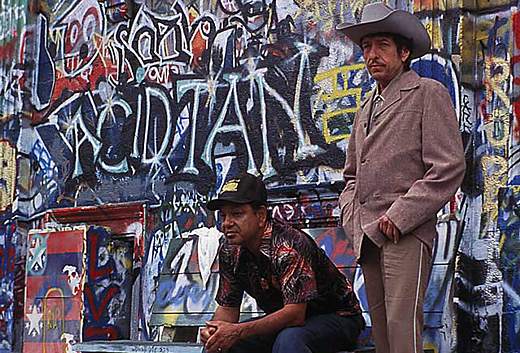
HANDS DOWN, the least appreciated - and most misunderstood -- film of 2003 has to be Masked and Anonymous (M & A). Now that it's been released on DVD, it's time for a fresh assessment of this unfairly maligned little gem.
When it first hit the theatres, most film critics clearly didn't have a clue what to make of it. Some savaged it as a muddled and pretentious mess, dismissing it as a 'vanity project' for its co-scripter and star, Bob Dylan. Many of the reviews demonstrated an outright nastiness, far out of proportion to the film's faults.
Most tellingly, several referred to the singer's most notable previous film-making effort, 1978's Renaldo & Clara (R & C) heaping scorn on Dylan's cinematic ambitions. Considering that R & C was one of the most audacious and creative experimental films ever made, these reviewer have shown how little they really comprehend either Dylan's artistry or truly great film-making.
A typical comment came from San Francisco critic Richard von Busack, who wrote that M & A "is so egregious it makes me temporarily forget how much Dylan means to me." One must ask in response: if Dylan supposedly means so much to this guy, why didn't he give the film more of a chance? Fortunately, some critics did just that.
One such writer is online critic Nick Davis, who astutely picked M & A as one of his five nominees for last year's best picture. The film, he writes, is "the great neglected movie of 2003, a rambunctious, provocative, genre-defying and constantly surprising experiment -- that occasionally lands with a thud, but much more often soars on wit, tunefulness, and a piquantly contemporary sense of ire and dismay." Moreover, Davis nails the reason why the film was such a critical and box office failure: M & A, he states, is "happily, scrappily disobedient to audience expectations."
Dark satire
Set during a civil war in an unnamed country (which is clearly intended as an alternative version of the contemporary United States), the film is a dark satire dealing with the corruption of the entertainment industry, yellow journalism, the limits of violent revolution and the rapacious abuse of political power. Supported by a cast featuring some of Hollywood's top actors, Dylan plays the lead role of washed-up troubadour Jack Fate -- who is sprung from jail to headline a dubious benefit concert organized by his sleazy ex-manager, Uncle Sweetheart (played by John Goodman). As one would expect, a key element of the film is Dylan's music. The highlights are live performances featuring Jack Fate and his band, doing 'I'll Remember You,' 'Down in the Flood,' 'Drifter's Escape' and the dynamic 'Cold Irons Bound.' They also do two non-Dylan items: a traditional tune called 'Diamond Joe'; and that renowned anthem of America's southern rebels, 'Dixie.'
While these performances are everything a fan could want, the way Dylan's songs permeate the film's soundtrack is even more interesting. There are more than a dozen particularly well-chosen cover versions of classics such as 'One More Cup of Coffee,' 'Senor' and 'It's All Over Now, Baby Blue.' Several are done in languages other than English, emphasizing the worldwide impact the composer's music has had.
Particularly entertaining are an intense Japanese take on 'My Back Pages,' by the Magokoro Brothers; and 'Come Una Pietra Scalciata' -- an obscure little ditty better known as 'Like a Rolling Stone' -- featuring Italian rappers Articolo 31 (and the sampled voice of some shmoe named Dylan). Another highlight is an a cappella version of 'The Times They Are a'Changing,' sung unaffectedly by a young black girl.
State of the Union
The script is, by turns, poetic, blackly humourous and philosophically insightful. The writers are listed as Rene Fontaine and Sergei Petrov - but it's an open secret that those are pseudonyms for Dylan and director Larry Charles (best known for his TV work on Seinfeld and Curb Your Enthusiasm). In a nutshell, one could describe the film as President Dylan's 'State of the Union' address, set among the metaphorical sword-swallowers and fire-eaters in the songwriter's own peculiar three-ring circus America.
It's a pretty bleak place, replete with run-down buildings and impoverished people, where power is held by sinister TV executives and a dying dictator. The leader is about to be replaced in a bloodless coup by a psychotic named Edmund (Mickey Rourke), who has big plans for dissenters:
"We are giving people a new identity, and erasing the collective memory," he says in his first speech. "We are rewriting the history books . . . There will be no more violence in the organized media. Real actual violence will take the place of manufactured violence . . . We will fill the football stadiums. We will have evil-doers from the prisons trampled by wild elephants, mauled by uncaged bears, pecked to death by screaming eagles."
The script takes an equally dim view of armed revolution. Fate meets the Soldier (Giovanni Ribisi), who talks of how he once fought to overthrow the government - and then became disillusioned with the corruption embodied by the rebels. He tells Jack: "I switched sides - and nobody noticed." The meaninglessness of the civil war is concisely explained by Sweetheart's partner, Nina Veronica (Jessica Lange): "I don't know what they're fighting about. Do the Hindus, Jews, Arabs, Irish, Muslims, Buddhists know what they are fighting about? The last person who actually knew that was killed years ago."
M & A also features some vicious satire of the 20th century's most over-rated decade. Jeff Bridges plays Tom Friend, a journalist obsessed with the 1960s who repeatedly badgers Fate with questions about Woodstock, Janis Joplin, Jimi Hendrix and Hugh Hefner. It is a mark of the film's complexity that, even though the journalist is clearly a nasty piece of work, the script and the acting convey some compassion for him when tragedy strikes.
Another 'Dylanesque' aspect of M & A is embodied in the cameo appearances of some actors. In places, the film is very reminiscent of one of his more surreal songs -- such as 'Desolation Row' or 'Dignity' - in which oddball characters with strange names populate stranger landscapes. One critic, John Beifuss, put it quite well, stating: "at every cut in the action, you expect a gray flannel dwarf to scream."
Most notable in the oddball department are: the Animal Wrangler (Val Kilmer with a southern accent), who waxes poetic about the beauty of animals and the hopeless depravity of humans; and the ghost of Oscar Vogel (Ed Harris in blackface, with a banjo), who represents the history of American mass entertainment, from the minstrel shows of the 19th century to the McCarthy era.
Spiritual realities
The film also deals with spiritual realities. Tom Friend's girlfriend, the wonderfully named Pagan Lace (Penelope Cruz) is frequently shown in agitated prayer, invoking Christ as well as a bizarre combination of several other faiths; a news item reports that scientists have detected screams coming from a realm of eternal punishment, beneath the earth's surface. Sweetheart is fond of the Book of Genesis, at one point exclaiming "Behold, the dreamer cometh"; elsewhere, he attributes his excessive weight to the fact that he's been "eating from the tree of knowledge of good and evil." He also gets the movie's best line: "Does Jesus have to walk on water twice to make a point?"
Christ is mentioned in only one other place, when a bus driver comments on the rebels: "They have no ideology. They'd push both Jesus and Judas aside." I was a bit disappointed that there were so few such references, considering the importance of Christian faith in many of Dylan's songs and performances. (However, this omission was more than compensated for in the soundtrack CD -- see below). Overall, M & A presents faith in much the same way it treats idealism, love, and family ties: with both mockery and respect. This is exemplified in a monologue by a fiery radio preacher (voiced by director Charles):
"Would you swear on a Bible? I'd swear on a Bible . . . a book of treachery, murder and genocide. Of course I'd swear on that . . . The Christians are relinquishing nine-tenths of the world to the devil. The false Christianity that you subscribe to is nothing more than the cult of the virgin . . . It's time to ask yourselves, people: Are you humble before God?"
Irreverence pops up in several other places, such as when Sweetheart trots out the circus freaks who will entertain the audience between musical numbers during the benefit: a magician, a ventriloquist, 'Ella the Fortune Tella,' and a 'Shooting gallery of world leaders' - including appropriately costumed ringers for Abraham Lincoln, Mahatma Gandhi and the Pope (whom Sweetheart refers to as 'John Paul Deuce.')
Clever details
Much of the fun in watching the film is in the clever details. Sweetheart's office is in the Midas-Judas Building. Neighbouring offices house Wild Insect Cryogenics; Dr. Benway, psychiatrist (a reference to the maniacal character from William Burroughs' Naked Lunch); and Dr. Sardonicus, dermatologist (evoking Baron Sardonicus, a sadistic villain with a disfigured face, from an old horror movie.)
There are also ample references to Dylan's work. Jack Fate's band is called Simple Twist of Fate, and prime-time TV shows are called Empire Burlesque, Not Dark Yet, Hurricane and It's Alright Ma. The same network also broadcasts shows called: God's Mistake; Terror Tots; Apocrypha; The New Glossalia; Slave Trade; I Love You; I Hate You; I Kill You; Fall of the House of Usher; Day of the Locust; Parable of the Sower; and Masked & Anonymous
The acting is uniformly strong, with kudos especially going to Bridges, Cruz, Rourke and Lange. Many of the critics had serious problems appreciating Dylan's performance - generally, it seems, because they simply won't accept the fact that he can be anything other than a singer/songwriter. While he is obviously playing a character modeled on his personality and career, it's not fair to say he is only 'playing himself,' as many reviewers would have you believe.
Dylan may have a somewhat limited range, but anyone who thinks he can't act should recall the many press conferences he's given, where he's shown himself to be the master of the put-on. He has also given credible performances in other films, including the mediocre Hearts of Fire, and the outstanding Pat Garrett & Billy the Kid - not to mention the various roles he played in R & C. He portrays Fate as a tightly-wound, cryptically world-weary, seldom-smiling sort who is hiding a lot of pain. He is especially effective in a scene with Edmund, his head turned away in offhand contempt throughout their conversation; and the intense concentration on his face during the Soldier's monologue almost hijacks the scene from Ribisi.
Speaking of stealing the show, however, the top acting honours go to Goodman, whose Uncle Sweetheart is a wonder to behold -- the ultimate all-American huckster as a force of nature.
M & A is not perfect, of course. It is willfully obscure at times, occasionally overdone, a bit too cynical for its own good, and contains an overabundance of Dylan trivia. Also, some of the script editing choices should have been rethought. For example, the original script (available online) had this classic passage: "We're talking about a war with no technological spinoff. Where the fighting is over a small piece of mud, the gateway of the afterlife, the burial site of Arthur and Guinevere." The final version keeps only the first line, which becomes an isolated and obscure thought without the rest of the text. Overall, however, the film is a masterful combination of social observation, sharp parody, bad puns, subversive commentary and whimsy.
Deleted scenes
The DVD includes a 'making of' documentary, and several scenes which were omitted from the final cut: an expanded version of a confrontation in a bar; the tale of the Bad Boy of Shutterbugs; a superb Jack Fate performance, of 'Standing in the Doorway'; a hilarious Sweetheart monologue about 'Alexander the damn Great'; Tom Friend's account of a horror story in his past; and Jack Fate's encounter with the alluring Lady in Red, in which he utters the immortal line: "I got a radical hostility toward sensuality" (unfortunately, the scene omits the followup line in the original script, where Jack says: "Bikinis infuriate me").
They're all excellent scenes. I highly recommend playing them as one continuous section (which - despite a few repeated moments -- actually adds substantially to the film, if you insert this set of scenes right after 'I Remember You' fades out).
Also, a word about the aforementioned soundtrack CD. While it is a pity that the sizzling 'Drifter's Escape' was left out (not to mention the fact that Dylan apparently recorded well over a dozen songs that were excluded from the film), the album has some nice surprises: specifically, two fine gospel songs which were not included in the film.
Shirley Caesar's 'Gotta Serve Somebody' is the title track from the wonderful collection of Dylan's gospel compositions which was one of last year nicest surprises; and 'City of Gold' is a never-before-released classic, delivered here by one of the great black gospel groups, the Dixie Hummingbirds. Incorporating bits of dialogue from the movie, the soundtrack is presented as a further extension of M & A; so the gospel songs are clearly intended as an integral part of the overall message.
More than anything else, Masked and Anonymous represents something very important, artistically: the return of one of America's most original cinematic talents to active film-making, after far too long an absence. Rent it, watch it - then go back to the store and buy it. Hopefully, the response to the film will prompt some enterprising soul to finally make Renaldo & Clara available on DVD