
Fleecing the flock
Is it ungodly to be skeptical? The BC Securities Commission says there are hundreds of BC Christians every year who could have avoided being scammed if they had simply been prepared to ask a few honest questions before handing their money over to a con-man attending their church.
By Jeff Dewsbury
THIS SUMMER, whenever a serious crime takes place, whether murder or fraud, the same old, tired phrases will be trotted out on the nightly news -- " he was a nice guy. He was neat, clean cut . . . I never would have thought he was capable of this kind of thing."
But even with the 'nice guy' cliché imbedded in our minds we, the public, are still caught off-guard whenever a trusted member of a church congregation has been charged with bilking people in a financial scam. The wolf in sheep's clothing is a biblical analogy long ago adopted by mainstream society, to describe predators who gain people's trust and then exploit them.
In the case of financial fraud, the origin of the term is fitting, since faith groups are often the community of choice for those with greedy appetites and the ability to learn the lingo, cultivate relationships or even exploit the governing model of a particular denomination.
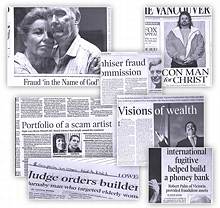
The B.C. Securities Commission (BCSC) -- which registers and keeps watch over those who sell securities in the province -- first noticed the unique challenges of dealing with faith communities when they investigated Gary Stanhiser, who infiltrated the Seventh Day Adventist community in the Fraser Valley and eventually rustled away $11 million from 300 investors. The con artist, who presented himself as an ex-pastor and who was an unregistered financial advisor, calling himself a 'Christian investment counsellor,' put a lot of the money in penny stocks and risky ventures.
The rest of the money simply disappeared. "We encountered victims reluctant to talk about an episode where they were taken," says Mike Bernard, communications manager with the BCSC.
"But there was also a reluctance based more on a cultural outlook, coming from a deeply religious community." Investigators noticed there was a 'gap' between their strictly secular view of the situation and the issue as seen through the philosophy and values of a religious community.
Not long after that incident, two Fraser Valley chaplains -- John C. Haycock, an ordained Presbyterian serving as chaplain at MSA hospital in Abbotsford, and Seamus Mackrell a Roman Catholic priest with a chaplaincy in Chilliwack -- decided to use their personal connections and knowledge of the Christian culture to help educate believers about scams that infiltrate congregations.
The two men proposed a program through the BCSC whereby they would educate congregations on the warning signs of affinity fraud and also, in the process, encourage much needed healing in churches where fraud has already taken place. The Securities Commission was quick to adopt the proposal and are currently funding it through their education fund.
"We asked the BCSC, 'What are you doing in this environment,' and we found that they were having a hard time 'getting into' the church community," Haycock told BCCN. Since the program has been adopted, the two have spoken to eight different denominations and have made 17 presentations.
The diversity of the community is even evident in the format of the presentations. In some churches, the men sit down with only the pastor or with the elders. In others, men's breakfasts or Sunday morning sermons serve as the venue.
Since the program's inception, Bernard has recognized that speaking to a particular faith community can even be challenging to 'insiders.'
"Interestingly, even for them -- men of God -- there are so many 'languages spoken,' so many denominations that do things differently."
It is through understanding these nuances from denomination to denomination that con men are often able to do their greatest damage.
The most popular method involves an outsider gaining credibility through association. He will befriend a prominent, well-respected member of the congregation, gain that person's trust, then introduce the scam to other people via that person.
The criminal often gains trust by initially paying good returns on the fake or risky investments in what is known as a 'ponzi scheme' -- paying initial investors with money that comes from later investors -- viewing the pay-out as a small price to pay for opening the door to the millions of dollars that will come from those who have witnessed the transaction.
"These guys don't go for small money, they think big," observes Haycock.
In Stanhiser's case, the con man actually had access to $14 million, but gave out $3 million in returns on some of the money invested by church leaders or highly respected members of the congregation. In that way, the spiritual leaders unknowingly became his best spokespeople.
A similar modus operandi was used by Fred Seymour Hofman Sr. to bilk members of the First Christian Reformed Church in Vancouver out of millions of dollars in the 1980s and '90s before he skipped town in 1991.
Before he fled the country, six lawsuits claiming more than $10.5 million in losses had been filed against the churchgoer. In 1993, the RCMP laid 61 counts of fraud against him as well.
Hofman was a fixture at the church for two decades. And, as a certified general accountant, he was also entrusted as the church treasurer. People felt they could count on him to give them investment advice, and several couples handed him significant sums to place in U.S. treasury bill investments he claimed would net them high returns and shelter them from paying Canadian taxes on the earnings.
Because Hofman wasn't registered to handle such investments , at the time he was fined $50,00 and banned for trading for five years by the BCSC. He was also kicked out of the General Accountants' Association of B.C.
This year he was tracked down in Australia illegally soliciting investments in a remote agricultural area near Cairns. He was misrepresenting himself as a minister.
When a leader has been defrauded, he is naturally reluctant to report the perpetrator because it reflects badly on him personally, professionally, even spiritually. In the best case scenario, he or she will still be viewed as someone who exercised bad judgment. "Con artists understand this and exploit this reluctance," says Haycock.
Unfortunately, many Christian congregations are tempted to resolve matters 'in-house' rather than through legal channels.
"It makes it tough for authorities to act if victims are reluctant to come forward," says Haycock, noting that it takes a mere 20 minutes for a con man to move investors' money offshore -- making it virtually untouchable -- once he gets wind of the church's plans to act on its own.
The chaplains have seen many people taking the tough, often embarrassing, first step of acknowledging that they have been conned. That acknowledgment leads the way for the two to offer pastoral care that will encourage healing and rebuild relationships within the church.
"We have noticed that years after a fraud, trust is still lost amongst people . . . And our strong point, as Christians, is that we trust each other. Con artists take that strong point and make it our weak point," laments Haycock.
In Preying on Those Who Pray a 19-minute video produced by the BCSC, one securities investigator points out that churches are a good place for con artists to apply their skills because they offer "a cohesive environment with a good communication structure."
Add to that the commonality of faith, which brings down a lot safeguards that people might, in any other environment, use to ward off danger.
The perpetrator will say "we have a common bond, that we believe that Jesus is lord, why would I lie to you," says Haycock. The chaplain also notes that people who set up these scams are not simply Christians who have strayed and got caught up in poor ethical decisions.
They are predators -- often sociopaths -- who join religions as a way of becoming part of a trusting community in order to identify targets.
"We [BCSC] don't want to turn everybody against each other. Churches are good places in our society," says Bernard "we want to protect that. A con artist in the mix will destroy that trust."
To contact John Haycock about the BCSC's chaplaincy program, call 604-825-1829. Visit www.bcsc.com or call 604-899-6500 or 1-800-373-6393.
------
Red flags that indicate a potential scam
-- Watch out for investments or advisors who exploit a religious connection; hold religious financial planners to the same standards as you would anyone else.
-- Watch out for investments that seem closely tied to a religious belief: it does not make sense that an investment opportunity would only be available to mem-bers of a specific church or faith.
-- Never judge a person's integrity by what they tell you about themselves: check them out.
-- Beware of any new member of your group who begins talking about wealth-building investments.
-- Don't trust any claim that religious-based investments are not regulated: most investments are regulated by securities laws and must be registered for sale.
-- Get a prospectus or other written information -- scam artists don't like paper; a legitimate salesperson must provide detailed written materials outlining the nature of the investment, the risks involved, financial statements and any restrictions on getting your money out.
-- Watch for non-traceable investments where money is taken with no documentation and no investment results.
-- Don't be rushed into making a decision; if someone is pressuring you to make a decision, be suspicious.
-- Be skeptical of anyone who discourages you or other investors from seeking professional advice from neutral, outside experts, such as a lawyer, accountant, investment counselor, banker or the Better Business Bureau.
-- Check out the promoter and the investment; contact the B.C. Securities Commission to find out if the salesperson is registered to sell securities in B.C. and if the investment is registered for sale.
Taken from the BCSC's brochure:
Culture, religion and scams.