
Homosexuality's challenge to the Anglican way
BC Christian News, · Top Stories
 |
THE CHANGING face of Anglicanism, and the role the debate over homosexuality is playing within that change, are reflected in three new books published this year in Canada.
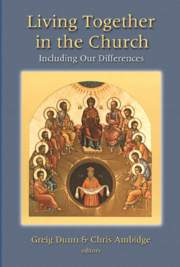
Living Together in the Church: Including our Differences (Anglican Book Centre), edited by Greig Dunn and Chris Ambidge, addresses the sexuality debate directly. It features essays by people who have been actively involved in the blessing of same-sex unions in the Diocese of New Westminster, including Bishop Michael Ingham and Rev. Margaret Marquardt, who officiated at the first such blessing in 2003.
The book made front-page news this year when one of its contributors, Dean Peter Elliott of Christ Church Cathedral in Vancouver, was elected prolocutor, or second-in-command, of the national church's General Synod, or governing body.
In his essay, Elliott comes out as a gay man living in a relationship with a male partner. He describes how, as a teenager, he was dissatisfied with the fact that "much of parish life seemed more social than spiritual," and how he got involved with evangelical and charismatic groups even though he struggled privately with his sexuality.
In seminary, Elliott broke off a relationship with a woman and sought several forms of therapy for his attraction to men, after which he says he "began to discern that God loved me, and that being gay may have been God's gift to me."
When he became a priest, Elliott moved into "educational and administrative positions," hoping that, by not being involved in public ministry, he could have a private relationship. But he still found the secrecy difficult: "I remember a meeting of bishops and senior diocesan executives at the national office, which began with each person sharing something about their home and family life. I was living with a partner at the time. What was I to say? How could I be honest about my domestic life without disclosing my sexual orientation?"
Eventually, Elliott became a parish priest again, and he says the experience at Christ Church Cathedral has been "fulfilling." He concludes that Anglicans can stay united in an "asymmetrical pattern of relationships," in which some churches accept gay relationships while others do not, for the same reason Anglicans have stayed united despite being in a state of "impaired communion" over the matter of female bishops.
"This ability to be in communion with those with whom we differ has always been characteristic of Anglicanism," he says. "We can, if we will, choose to find our unity in Christ, rather than in shared theological propositions, and continue the way forward, even in this difficult time."
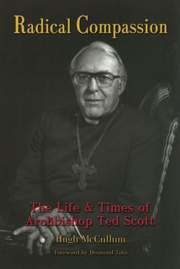 |
The archbishop who led the Canadian church when it first began ordaining women in the 1970s expresses a similar view in his preface to Hugh McCullum's Radical Compassion: The Life & Times of Archbishop Ted Scott (Anglican Book Centre).
"We have lost our moral vision in a society that no longer sees a serious role for an Anglican ethos based on justice, peace, inclusivity and tolerance of diversity. . . . Never has the church devoted so much time and energy, and angst, to an issue that should be capable of resolution within the Anglican ethos," writes Scott (who died in a car accident June 21).
Scott, who pronounced two episcopal blessings at a civil marriage ceremony for two female deacons in Toronto, says those involved in the sexuality debate who refuse to engage in dialogue with one another are guilty of "idolatry."
Scott was primate of the Canadian church when the House of Bishops drafted a key set of guidelines regarding homosexuality in 1979. He tells McCullum the guidelines, which did not condone the blessing of same-sex unions, should have been rewritten even before he left office in 1986, and he says God speaks to the church through larger social trends.
"If we are to be the church in the world, then we cannot ignore the force of secular cultural pressures in decision-making, and it is at least as powerful as scripture and tradition. It is the channel -- the spirit of the age -- through which the Holy Spirit is trying to say something to the church. It cannot simply be dismissed, whether opponents like it or not."
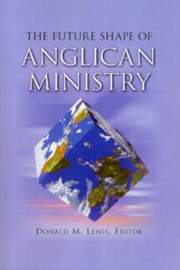 |
The sexuality debate is largely side-stepped in The Future Shape of Anglican Ministry (Regent College Publishing), edited by Don Lewis, secretary of Regent College's Anglican Studies program.
But the essays -- drawn from papers delivered at conferences hosted by Regent and by Wycliffe College in Toronto -- include several by figures who have actively called for the appointment of an alternative bishop who would assume responsibility for conservative parishes that object to Bishop Ingham's decision to permit the blessing of same-sex unions.
These authors include Regent professor J.I. Packer; St. John's (Shaughnessy) rector David Short, whose church is a prominent member of the Anglican Communion in New Westminster, a coalition of parishes seeking an alternative bishop; and Edmonton Bishop Victoria Matthews, who recently chaired a task force that called for such alternative bishops.
The book, the cover of which depicts a cube-shaped earth and focuses on the African and South American continents, alludes to the growth of the Anglican church overseas, in regions where a more conservative theology tends to prevail. North American conservatives who oppose the blessing of same-sex unions have increasingly turned to archbishops in Rwanda, Nigeria and other territories for support.